Posted in Baptism, Body of Christ, Bonheoffer, Book of Worship, God's love, Harry Potter, Jesus, Love, Peter Rollins, real love, Sanctifying Grace, Sermon, Uncategorized, Wesley

Together

Matthew 3:13-17

13 Then Jesus came from Galilee to John at the Jordan, to be baptized by him. 14John would have prevented him, saying, ‘I need to be baptized by you, and do you come to me?’ 15But Jesus answered him, ‘Let it be so now; for it is proper for us in this way to fulfil all righteousness.’ Then he consented. 16And when Jesus had been baptized, just as he came up from the water, suddenly the heavens were opened to him and he saw the Spirit of God descending like a dove and alighting on him. 17And a voice from heaven said, ‘This is my Son, the Beloved, with whom I am well pleased.’

I often hear James Earl Jones booming voice or Morgan Freeman’s distinctive voice when I read that part.  Jesus’ baptism ushers in a new baptism. Not just with voice and the dove.  Christian baptism is not just a washing away of sin as John’s baptism was; but it is the baptism that brings the power of the Holy Spirit and a special relationship with God.  The Gospel writers all 4 tell the story of Jesus’ baptism. As usual John has his own way of saying things, Matthew adds the part about John the Baptist preventing him and then questioning his validity to baptize Jesus, Luke cuts to the chase and has the shortest account, but Mark’s Gospel is different.  Unlike Matthew and Luke, where it says the heavens are opened, Mark writes that as Jesus “was coming out of the water, he saw the heavens torn apart and a dove descending.”  His word for ‘torn apart’ is schizo, and it means “to cleave, to cleave asunder, to rend.” It’s a strangely violent word to describe such a happy occasion.  The way we tend to talk about baptism, it would have made more sense if Mark had talked about the dove, gently cooing, or perhaps fluttering over the surface of the water. But that is not how he talks about it.

Instead, Mark talks about the heavens, schizotorn apart. It’s the word Matthew, Mark and Luke all use to describe that moment on Good Friday when the curtain of the temple is torn in two. It’s the word John uses when the Roman soldiers at the foot of the cross determine not to tear Jesus’ garment and divide it between them, but to cast lots for it, instead. It’s a word with resonances in the prophecies of Isaiah, also, particularly when Isaiah says to God, “O that you would tear open the heavens and come down,” (Isaiah 63:19).

Mark understands very clearly that in Jesus, this is exactly what has happened. God has torn open the heavens and come down.  It is in the waters of baptism that the heavens are torn apart and a voice from heaven claims Jesus as God’s son. Although we rarely think of it as having such a dramatic flourish, baptism today still serves as a time when we recognize our being claimed as children of God.  And this is why, in the Gospel writers’ judgment, the baptism of Jesus is a radical act. In Jesus, God has committed the act of breaking and entering the world, and they want the world to know.

Sometimes, I wish it were harder to join the church, to come to communion, to be baptized.  I mean, honestly, sometimes I think it’s harder to get a membership to Sam’s Club than it is to become a Christian.

Sometimes we cheapen grace.  It’s like the membership vows of the church are in the fine print or it feels like a medical commercial saying, you’ll feel better if you do this whole Jesus thing, you’ll be happier, while the people on the screen are running through a field of flowers or jumping on a trampoline or flying a kite with what seems to be a bright, smiling, happy family.  They’re still showing the pictures of all the smiling people and let’s throw in a pet for good measure, as they read quick like the micro machine man the hazards.  Baptism is terrific but please plan on attending worship, Bible studies, service projects, fellowship events, and don’t forget covenant discipleship groups.  Christmas and Easter only come once a year, but Narcie throws in enough grace to last all year round.  She may make you experience some discomfort and conviction, but that’s at minimum only once or twice a sermon. Following Jesus may cost you.  Putting his teachings into practice may turn your life upside down……

Who can blame people for just tuning that part out?  And not understanding what following Jesus means?  What a big, awesome commitment that is?

We’re involved in a bait and switch.  You may, say hold on a second, I do no such thing.  I would challenge that back to you.  Can those around you, tell you are a Christian?  What makes you different from all of the other do gooders?  What makes this different than any other civic organization?

Peter Rollins, Northern Ireland writer, speaker, philosopher, and theologian writes, “Without equivocation or hesitation I fully and completely admit that I deny the resurrection of Christ. This is something that anyone who knows me could tell you, and I am not afraid to say it publicly, no matter what some people may think…

I deny the resurrection of Christ every time I do not serve at the feet of the oppressed, each day that I turn my back on the poor; I deny the resurrection of Christ when I close my ears to the cries of the downtrodden and lend my support to an unjust and corrupt system.

However, there are moments when I affirm that resurrection, few and far between as they are. I affirm it when I stand up for those who are forced to live on their knees, when I speak for those who have had their tongues torn out, when I cry for those who have no more tears left to shed.”

If you want to actively follow Christ.  It’s going to be hard.  It’s going to be the greatest joy and sacrifice of your life.  Don’t merely get baptized for fire insurance, because you want to flee the wrath of hell, but because you want your life transformed, you want to do more than honor Jesus’ sacrifice.  You seek to live as a changed person walking the way of life, trying to grow more like Jesus every day, and when you mess up, as you inevitably will, God gives you God’s abundant grace, God’s sanctifying grace.  God doesn’t leave us on our own in the mire and the muck.  God begins the mighty work of transforming us.

We’re not going to change overnight into the perfect Christian.  We need to hone our spiritual disciplines:  prayer, scripture reading, daily times alone with God, discerning God’s will for our lives, and not just things we  do alone.  Tenth Avenue North sings in the song No Man is Island,“We’re not meant to live this life alone.”  We are stronger together.  Iron sharpens iron after all.  The kids asked to watch Harry Potter and the Half-Blood Prince on Friday’s Family Movie Night.  Mike says I should use “spoiler alert” even the book came out more than 5 years ago.  At the end of the movie, Dumbledore, the headmaster of Hogwarts, dies and it looks like darkness has won.  He was Harry’s protector and the only one Voldemort was afraid of.  When he dies, the students and staff are mourning him and it seems like all hope is lost, Madame Pomfrey holds her wand in the air, Professor McGonagall joins her, and the students and faculty do the same.  When they do that together, it lights up the night sky.  Together in their sorrow.  Together in their hope that the light will pierce the darkness.  Mike told Enoch and Evy, the darkness doesn’t win and I joined him in saying, when all hope seems lost, even if it looks like the darkness has won, the light will always, always, always eventually conquer the dark.  I want them to be prepared to fight for the light in their choices and to continue fighting even when it feels like it’s not making a difference, even when it seems they are fighting an uphill battle, even in the darkest night of their souls.  Good will triumph.  Spoiler Alert.  The grave didn’t hold him down.

See baptism is an individual sacrament, but it’s also a communal one also.  Whole families were baptized in the New Testament.  The church agrees to love, support, grow and strengthen those baptized persons.  Dietrich Bonheoffer, German Lutheran pastor, theologian, anti-Nazi dissident, believed that a community of love is one which focuses its attention on Jesus and then expects everything else to fall into place. When the people of God come together to share their lives openly and freely, accepting each other with a kind of unconditional positive regard, there is a sort of social-spiritual “chemistry” that emerges, and those who come together experience a delightful cohesion and sense of belonging.  Bonhoeffer’s central idea is that the Church as the fellowship of Christ centers on Christ rather than being a mere association of people with a common purpose. Human love and actions are related to a desire for human community. Christian love, spiritual love, comes from Christ and goes out to the other person, not directly, but through Christ. Christ “stands between me and others”. The most direct way to another is found in prayer to Christ whose influence is greater.  The unity of the community is in Christ, “Through him alone do we have access to one another, joy in one another, and fellowship with one another.”

The Book of Mormon Broadway Musical has a song called Mostly Me.  In it the missionary says he’s doing all of this “good” stuff altruistically, but he’s actually doing it for himself.  This is not just a “but mostly me” but something that if we are to survive, if we are to be a stronger, healthier, more grounded body – we’ve got to be supporters, advocates, confidants, friends to each other.  Bonhoeffer in The Cost of Discipleship writes, “Judging others makes us blind, whereas love is illuminating. By judging others, we blind ourselves to our own evil and to the grace which others are just as entitled to as we are.”  We have to trust each other enough to share our lives together, with no fear of judgment, that’s the only way we get to the Light of Christ.

How do we push through the fear, the doubt, the awkwardness, the ego, and move towards real community?  We have to really love each other, pray for each other, root for one another, weep one another, encourage one another, be CHURCH with each other.  As Hebrews 10:24-25 says, “And let us consider how to provoke one another to love and good deeds, not neglecting to meet together, as is the habit of some, but encouraging one another, and all the more as you see the Day approaching.”  I want us to be a deep, Christ-centered community whether it be as Friday morning Men’s Group, an adult Sunday School Class, the Choir, the Thursday morning Women’s Bible Study, the Somerby Bible Study or one of the other communities we will create this year.  I want us to make as our theme this year to Love God and Love Neighbor.  I want us to make the main thing, the main thing.  Our focus shall be to make disciples of Jesus Christ for the transformation of the world in Park West, in North Mount Pleasant and across the Earth.   We can only legitimately do that if we abide in Christ and seek his leading for our lives, for the call he has put on our lives, for the call he has put on this church to be the hands and feet of Christ at this time and in this place and if we look to Christ – boy, what could happen?  Could you imagine?

People should be able to see Christ in us, just as the song says, “They will know we are Christians by our love.”  Wesley’s General Rules provide an extensive list of the marks of the Christian life that could be summarized by do no harm, do good, and attend upon all the ordinances of God or as Wesley said,

Do all the good you can,
By all the means you can,
In all the ways you can,
In all the places you can,
At all the times you can,
To all the people you can,
As long as ever you can.”

These rules take into account and respond to the great command to love God and neighbor. In our baptism, similar things happen to us as happened to Jesus when he was baptized: 1) The Spirit of God comes into us and remains in us. 2) We are declared to be a child of God. 3) We hear that God is well pleased with us. God’s grace washes away our sin and angst and doubt and we are made clean in the waters of baptism.  We’ve been washed by the water and are set free to live an abundant, thriving life.  Jesus doesn’t say it will be easy, but as Paul writes in Philippians 4, “I can do all things in Christ who strengthens me.”  The Spirit of God opens up the Heavens to give us a taste of the Living God, Emmanuel, one with us, Jesus who was, is, and is to come.  As we journey with our stars and seek God’s personal will for our lives and as we journey as a church to know God’s communal will for this body of Christ and the part God wants each of us to play in that, God’s wonders and mercies are new every day and at every step of the Christian journey, God will be faithful.

I’ll ask you to come to the baptismal waters as you reaffirm your baptism, as you reaffirm that you are a new creation, as you reaffirm your commitment to this body of Christ, to walk with each other in love and grace, spurring each other on to right action and to seek the will of God.

“We will walk with each other, we will walk hand in hand
We will walk with each other, we will walk hand in hand
And together we’ll spread the news that God is in our land
And they’ll know we are Christians by our love, by our love
They will know we are Christians by our love.”


REAFFIRMATION OF BAPTISM         

 The Lord be with you.

and also with you.

Let us pray.

Eternal God: When nothing existed but chaos, you swept across the dark waters and brought forth light. In the days of Noah you saved those on the ark through water. After the flood you set in the clouds a rainbow. When you saw your people as slaves in Egypt, you led them to freedom through the sea. Their children you brought through the Jordan to the land which you promised.

Sing to the Lord, all the earth. Tell of God’s mercy each day.

In the fullness of time you sent Jesus, nurtured in the water of a womb. He was baptized by John and anointed by your Spirit. He called his disciples to share in the baptism of his death and resurrection and to make disciples of all nations.

 Declare Christ’s works to the nations, his glory among all the people.

 Pour out your Holy Spirit, and by this gift of water call to our remembrance the grace declared to us in our baptism. For you have washed away our sins, and you clothe us with righteousness throughout our lives, that dying and rising with Christ we may share in his final victory.

All praise to you, Eternal God, through your Son Jesus Christ, who with you and the Holy Spirit lives and reigns for ever. Amen.

Come as you feel led to the baptismal waters as we reaffirm our baptisms.  As you come forward and touch the water, I will say, “Remember your baptism and be thankful” and you respond “Amen.”  You can touch the water and make a sign of the cross on your forehead or you can scoop the water and let fall back into the bowl.

Remember your baptism and be thankful. Amen.

Prayer reaffirming the Baptismal Covenant:

The Holy Spirit work within you, that having been born through water and the Spirit, you may live as faithful disciples of Jesus Christ. Amen.


Posted in Advent, Good News, Jesus, Justice, Mary Magnificat, Sermons, Uncategorized

Mary’s Magnificat

Are you tired of the 24 hour news cycle or do you stayed glued to CNN, Fox News, or MSNBC?  Do you read your news online?  It’s can make you depressed because inevitably they cover more tragedy than celebration.  I’ve had journalists tell me what I already know, most people prefer the bad news.  It’s like schadenfreude.  Our fascination with others misfortune.  How many times have you been stuck in traffic on an interstate for an accident with the accident on the other side of the road?  We have rubber neck syndrome.  We want to be in the know.  If we’re praying people than we know how to pray for the world, our nation, our community from news sources.  Do we live in our own personal bubbles or are we in the world, but not of it – speaking prophetically, praying intercessory prayers, being informed so we can stand against tyranny on the side of the poor and oppressed.

People often say to veteran broadcaster, Paul Harvey, “Paul, why don’t journalists and broadcasters emphasize more good news instead of tragedy, destruction, discord and dissent?” Harvey’s own network once tried broadcasting a program devoted solely to good news. The program survived 13 weeks. We say we want good news, but we won’t buy it. In Sacramento, California, a tabloid called Good News Paper printed nothing else. It lasted 36 months before it went bankrupt. A similar Indiana tabloid fared even worse — the publishers had to GIVE IT AWAY. Evidently, the positive news people say they want is news they just won’t buy.  The tabloids full of scandals or In Touch or US sale off the shelves.

Listen to any broadcast, Paul Harvey suggests, or pick up any newspaper. You’ll learn that records are crashing, it is the worst wind or the worst fire or flood or earthquake or whatever — because NOISE makes news. For example,

* On August 31, 1997, Chicago Tribune sales soared 40 percent due to coverage of a crash that killed a princess.

* The very next issue of People made it the lead story and sold more than a million copies.

* Newsweek and Time broke sales records when they did the same in the following weeks.

* For an entire month after the crash, Britain’s biggest newspapers gave 35 percent of their total news coverage to the death of Princess Di. Not even the end of World War II got that much ink.

I actually stayed up with friends to watch Princess Diana’s funeral and when Mother Teresa died a few months later, she didn’t get near the publicity.  As Harvey suggests, noise makes news — and one gunshot makes more noise than a thousand prayers. That doesn’t mean it is more important — just that it sells more newspapers. The heads of all the major television networks understand this basic fact, and they make sure that news broadcasts are full of noise. 

That’s why the weather report does not stop with simply announcing that today’s winter temperature fell to 0 degrees. How boring is that?! No, the forecaster goes on to say that the “chill factor” is 40 degrees below! That’s news!

Here, then, is the question du jour: Could the same be true of our lack of enthusiasm for the Christmas story? Let’s face it: Good news can be boring. God is love. Mary is his favored one. Joseph is a righteous man. Jesus is such a sweet little baby. We’ve heard the story so often, and we’ve seen the pageant so many times. It just doesn’t get the adrenaline flowing any more. 

But hold on: There’s a surprise to be found in today’s Scripture, the “Magnificat” from the first chapter of Luke. This passage is an explosion of free verse by Mary — a young woman who could have thought she was getting some bad news when the angel arrived.  I asked the children’s Sunday School last week, what angels look like because anytime they appear, they immediately say, “Do not be afraid.” Gabriel’s announcement to Mary was a mixed bag of good news and bad news.  When she heard Elizabeth’s proclamation, “Blessed are you among women, and blessed is the fruit of your womb.”  When she realized how truly awesome Gabriel’s message was, she began to make some soulful noise, and that’s where the Magnificat comes in.  She does her part to make sure it sells — she does it by itemizing the noisy good news about her Good News God.

Luke 1:46-55

46 And Mary said,
‘My soul magnifies the Lord,
47   and my spirit rejoices in God my Saviour,
48 for he has looked with favour on the lowliness of his servant.
Surely, from now on all generations will call me blessed;
49 for the Mighty One has done great things for me,
and holy is his name.
50 His mercy is for those who fear him
from generation to generation.
51 He has shown strength with his arm;
he has scattered the proud in the thoughts of their hearts.
52 He has brought down the powerful from their thrones,
and lifted up the lowly;
53 he has filled the hungry with good things,
and sent the rich away empty.
54 He has helped his servant Israel,
in remembrance of his mercy,
55 according to the promise he made to our ancestors,
to Abraham and to his descendants forever.’
Is this really “noisy” good news? Yes, it is. We should shout and sing because Mary makes a racket for all of us. There is nothing meek and mild about the song that Mary sings. Check out these headlines:

GOD TAPS NAZARETH NOBODY. “My soul magnifies the Lord,” rejoices  Mary, “and my spirit rejoices in God my Savior, for he has looked with favor on the lowliness of his servant” (1:46-48). It is truly surprising and newsworthy that God chose a poor Galilean girl to become the mother of Jesus the Christ and the most significant woman in all of Holy Scripture.

“Mother of God,” “Heavenly nurse,” “Help of the helpless,” and “Dispensatrix of all grace” are just some of her names. She became an unbreakable link between Jewish and Christian history.  Church historian Jaroslav Pelikan sees her as the inspiration for the great abbesses of medieval times — the most powerful women in an age of powerful men — and today as the driving force behind people engaged in struggles for social justice around the world.

Not bad for a nobody from Nazareth. Her selection by God should give hope to any of us who are feeling trapped in our everyday existence.  Feeling like we’re not making much of a difference to anybody.  The great truth of Mary’s story is that God uses the small to lead the big, the weak to teach the strong, and the ordinary to carry out the extraordinary. All we need to do is to remember that it is availability and not ability that is key, and to say, along with Mary, “Here am I, the servant of the Lord; let it be with me according to your word” (1:38).

But there’s more: LORD BUMPS WALL STREET, LIFTS LITTLE GUY. “He has brought down the powerful from their thrones,” says the Magnificat, “and lifted up the lowly” (1:52). From tech giants to the world’s biggest oil companies, those who run the economy agree on one thing — bigger is better. But what’s wrong with this picture?

What’s wrong with it is that God is working to bring down the powerful and lift up the lowly. God is concerned more about the common good than about corporate greed. “Can anybody seriously suggest that bigger, more powerful, and more profitable corporations will help to protect the interests of workers, consumers, the environment, local communities, and the forgotten poor?” asks Jim Wallis in Sojourners magazine. “Is it right that the casino economy of Wall Street profits when the real economy of workers and their families suffers? Is it fair that the people who do the firing get a raise, while the people fired can only fear for the future of their families?” Christians who follow the Good News God of the “Magnificat” are called to look for the common good for all people.

And here’s some more noisy news: 2000-YEAR-OLD PROMISE KEPT. “He has helped his servant Israel,” Mary notes, “in remembrance of his mercy, according to the promise he made to our ancestors, to Abraham and to his descendants forever” (1:54-55).

God kept his promises to Israel, from the time of Abraham to the time of Mary, and he keeps his promises today. The greatest sign of his promise-keeping was the birth of his son Jesus Christ: “A shoot shall come out from the stump of Jesse,” said God through the prophet Isaiah, “and a branch shall grow out of his roots. The spirit of the Lord shall rest on him, the spirit of wisdom and understanding, the spirit of counsel and might, the spirit of knowledge and the fear of the Lord” (11:1-2). He’ll grow up to judge the poor with righteousness and kill the wicked with the breath of his lips. His kingdom will be a peaceful one, marked by righteousness and faithfulness and the knowledge of the Lord.

This is news — news of surprising selections, unexpected elevations and the preservation of ancient promises. It’s noisy news, awesome news, but better yet … it’s Good News. It’s the Good news that God has come to earth in Jesus Christ, to call us to himself and to point us toward his just and everlasting kingdom.

The sermons I’ve been doing for Advent have had a definite apocalyptic or eschatological lean, “Keep Awake,” “Repent for the One is coming”, and this one will is no different.  “Joy WILL come in the morning.”  Many places Mary is depicted as meek and mild-mannered, Saint-like with a golden halo around her head, pondering things in her heart.  To answer Margaret’s song that she sang beautifully, I think Mary DID know.  She knew just like her foremothers knew, Esther, for such a time as this, Ruth, your people will be my people, your God, my God, and now Mary, the peasant girl who utters this powerful prophecy, the first of Luke’s New Testament.  It is powerful.  A total reversal of the world order.  But do we live that?

I was “over hearing” a conversation on facebook between some FSU Wesley students last week.  One was preaching a sermon on Advent that night and asked, “Talk with me about Advent. Is this season purely about remembering the birth of Christ, or is there more to it?  (I have my thoughts, I want to hear yours)”  I had so much fun reading their comments.  Here’s some of them.  “mary’s song and a lot of the old testament passages that prophesy about the coming of Jesus talk about how he will essentially turn society upside down. the lion will lie with the lamb, he’s brought down the powerful from their throne and lifted up the lowly, etc. These texts demonstrate that Jesus is not just coming to save souls but to radically transform how our society functions, for the better of the poor and the oppressed. for me, advent is a time to remember that God came to save everything (individuals, political systems, economies, etc) and to challenge ourselves to put that belief into action.”
“I think Advent represents a thrill of hope for all weary people. The birth of Jesus didn’t necessarily omit weariness from the world, but it gave us the tools to build a table at which we can all share a meal and rest.”

“dude. Honestly if us millennial, Christians could just build enough tables we would convert the world.”

“i’ve been thinking about not ignoring the weary people around me, and how advent makes me want to be human with other humans (“we’re all passengers on the way to the grave” sort of feeling).  Advent makes me want to take my headphones out and sit next to someone at a bus stop (advise, I don’t even ride a bus) and have a small conversation that recognizes our sameness, because we’re all waiting for things to be fully healed, and we’re all headed the same direction.”

“To me, it’s a deeper reflection on the hope that only Christ can give us; that this groaning here on Earth will eventually lead to peace and rest for anyone that puts their hope and trust in Him. And yes, to celebrate and remind us of the magical and yet simple way that he entered our world as a little baby.”

“I just thought of a late night sermon that Jimmy gave when he turned off all the lights in the worship center and preached with a headlamp on. Advent is sitting in the darkness, without being too quick to jump to the light. Like we’ve got a spoiler alert that the light will come, but sometimes we need to acknowledge the realness of the dark.”

Spoiler alert.  The light breaks in through the darkness and great joy comes in the morning.  Hear me now.  The light breaks through in the darkness and JOY comes in the morning.

What are some of our dark places? What are some dark corners of our hearts and of our worlds?

I’ve asked Mike to play the song, “A Baby Will Come.”  It was written by Bill Wolf after he read Mary’s Song in Luke. “As I was researching the social climate of that time and place, I realized just how dire the lives of the Israelites would’ve been. Between the brutal conquests of the Roman Empire under Caesar Augustus and the obscene taxation of Herod, King of Judea…they found themselves enslaved once again, but this time it was in their very own backyard.  The Promised Land no longer felt like the Promised Land.  And into that climate, a young adolescent Jewish girl was visited by an angel of God and told that she would give birth to a baby boy and His name would be “Salvation”; his very name would “Liberation” for her and her people.  In a moment of joy and restraint, Mary sat down and wrote her Magnificat; a poem that is on one hand personal and introspective, but on the other hand, charged with social and political revolutionary language.”

We need to keep awake, be prepared, and trust that joy comes in the morning.  That GOOD will triumph over evil even when all seems lost.

The kings of this world
Have torn it apart
But we can take heart
A baby will come

To the hungry and meek
To those who grieve
To the broken, in need
A baby will come

We have known pain
We’ve felt death’s sting
God, help us believe
This baby will come

The angel appeared
Said do not fear
For peace is here
A baby has come

The advent of life
Let hope arise
We’ve our King and our Christ
The Baby has come

We’ve waited so long
God, for Your mighty arm
May our doubts ever calm
For the Baby has come

The proud will be low
The humble will know
They’re valued and loved
For the Baby has come

Cause the kings of this world
Won’t have the last word
That, God, is Yours
For the Baby has come

Posted in Disciple, Discipleship, Faith, Healing, Jesus, Prayer, Uncategorized

Creativity, Faith and Healing

Luke 7:1-10

After Jesus had finished all his sayings in the hearing of the people, he entered Capernaum. A centurion there had a slave whom he valued highly, and who was ill and close to death. When he heard about Jesus, he sent some Jewish elders to him, asking him to come and heal his slave. When they came to Jesus, they appealed to him earnestly, saying, ‘He is worthy of having you do this for him, for he loves our people, and it is he who built our synagogue for us.’ And Jesus went with them, but when he was not far from the house, the centurion sent friends to say to him, ‘Lord, do not trouble yourself, for I am not worthy to have you come under my roof; therefore I did not presume to come to you. But only speak the word, and let my servant be healed. For I also am a man set under authority, with soldiers under me; and I say to one, “Go”, and he goes, and to another, “Come”, and he comes, and to my slave, “Do this”, and the slave does it.’ When Jesus heard this he was amazed at him, and turning to the crowd that followed him, he said, ‘I tell you, not even in Israel have I found such faith.’ When those who had been sent returned to the house, they found the slave in good health.

We typically invest a high level of energy and effort at the start of a relationship, to woo someone or put our best foot forward. But, after a time in relationship with someone — once all your good stories and jokes have been shared, once it feels like you’ve learned all there is to learn, once it feels like you’ve got nothing new to say — that takes a persistent creativity. To reinvent ourselves for one another, or to approach each other with fresh eyes, to not take each other for granted, it all takes creativity. The same is true in how we relate to God. The Centurion’s faith is a great example because, as a Roman military commander, he should’ve been the last person on earth to believe in Jesus. Rationally, he should’ve been the last person to ever have a strong relationship with the local Jews and synagogue; rationally, he should’ve been the last person to humble himself to this wandering Jewish rabbi in Jesus; rationally, he should’ve been the last person to have this special insight into Jesus’ power and authority (to be able to command this healing even from afar). The Centurion represents that even though we must be obedient as disciples, it doesn’t mean we check our insights, experiences, and ideas at the door. Guided by the Spirit, we can personally, creatively and with humility understand and relate to the Lord.  Being in the making as a disciple takes creativity.

Where is this in Luke’s narrative and what are these sayings Luke alludes to?  Luke 6 is chock full of teachings.  It is a rich smorgasbord of Jesus’ disciples eating grain on the Sabbath, then the Pharisees hating on them about that, Jesus’ healing on the Sabbath, the Pharisees calling him out about that, but he did it anyway and they were (not surprisingly) furious and that’s just the first 11 verses.  After he names the disciples, verses 17-19 say, “He came down with them and stood on a level place, with a great crowd of his disciples and a great multitude of people from all Judea, Jerusalem, and the coast of Tyre and Sidon. 18They had come to hear him and to be healed of their diseases; and those who were troubled with unclean spirits were cured. 19And all in the crowd were trying to touch him, for power came out from him and healed all of them.”

So the centurion had heard about Jesus and, no doubt, about the miracles he had performed in the town, like healing a man with an unclean spirit right there in the synagogue for which the centurion himself had given a lot of money. The centurion was likely a commander in the army of Herod Antipas rather than a Roman soldier. We can infer this since Capernaum was a minor trade center and toll station along the Via Maris, which was the trade route that led from the countries in the Fertile Crescent down to the Mediterranean. While Capernaum was not a combat post, the centurion was nonetheless a military veteran who may have seen his share of combat earlier in his career. If that were the case, then his slave would likely have been right beside him in the thick of battle, thus forging a relationship that was less master and slave and more like comrades in arms. His most valued slave was ill and close to death so he stepped out in faith, as we have seen all Jesus’ disciples do.  He had the faith that Jesus could heal his battle buddy.  Unlike most of the Gentile soldiers, Roman or otherwise, who were stationed in the notoriously revolutionary region of Galilee, this centurion not only built the synagogue for them (the foundation of which still stands in the ruins of Capernaum) but he went so far as to love the Jewish people. The centurion already saw the world differently than many of his peers, and his creative imagination allowed him to formulate a different vision of reality about the Jewish people AND about the itinerant Jewish preacher and healer who was now back in town.

Still, he recognized that there was a separation between him and the Jews. He wants to be respectful to this Jesus, so he sends some of the Jewish elders to speak with Jesus about his servant, knowing that a pious Jew like Jesus could not enter a Gentile house. The Jewish elders see this generous Gentile as a “worthy” candidate for a healing miracle, but the centurion believes himself to be “not worthy” to have Jesus come under his roof. The centurion understands orders and believes that it isn’t necessary for Jesus to be physically present in order to heal.  Indeed, as a commander of men, the centurion knows that he doesn’t need to be present in order to get things done. He gives an order and it is obeyed, even in his absence, and he now assumes that Jesus has the same kind of spiritual authority. All Jesus has to do is say the word and his healing order will be carried out. The centurion imagines another reality made possible by Jesus, and then acts on it.
Sister Joan Chittister tells the story of a priest who once traveled to see a renowned spiritual teacher, to spend a time on retreat with him.

“Master,” he said upon arriving, “I come to you seeking enlightenment.”

“Well, then,” the master said, “for the first exercise of your retreat, go into the courtyard, tilt back your head, stretch out your arms and wait until I come for you.”

Just as the priest arranged himself in that position, the rains came. And it rained. It rained the rest of the afternoon. Finally, the old master came back. “Well, priest,” he asked, “have you been enlightened today?”

“Are you serious?” the priest asked, in disgust. “I’ve been standing here with my head up in the rain for an hour. I’m soaking wet. I feel like a fool!”

The master said, “Well, priest, for the first day of a retreat that sounds like great enlightenment to me.”

The centurion has all the power in his relationship with Jesus. Yet, unlike the priest in the story, he is no fool. He could have lorded it over Jesus, but instead he sets his personal authority aside and submits himself to the authority of Jesus, a Jew — a subjugated member of a captive people. This wise officer understands that spiritual humility is the prerequisite to healing.

Jesus is surprised at this Gentile centurion’s ability to imagine a different outcome. “Not even in Israel have I found such faith,” Jesus says. It’s like he’s alluding to the two disagreements with the Pharisees in Luke 6 and the instructions at the end where he’s preaching against hypocrisy of the highest order.

Luke 6:46 -49, “‘Why do you call me “Lord, Lord”, and do not do what I tell you? 47I will show you what someone is like who comes to me, hears my words, and acts on them. 48That one is like a man building a house, who dug deeply and laid the foundation on rock; when a flood arose, the river burst against that house but could not shake it, because it had been well built. 49But the one who hears and does not act is like a man who built a house on the ground without a foundation. When the river burst against it, immediately it fell, and great was the ruin of that house.’”  This centurion’s house is built on rock and Jesus rewards him for it.

What is a disciple?  The centurion is obedient.  No doubt.  He followed through.  The centurion owned his own sinfulness, by humbling himself before Jesus.  Remember the Heng story.  How Vietnamese kid in the orphanage that would sacrifice himself for his friend?  The centurion made the sacrifice.  Even to ask Jesus to heal his servant would be looked down upon by his peers, but he did it anyway.  And he had the creative imagination to envision a different reality for himself and his friend.  He believed and had faith in Jesus to heal just by saying the Word.

A recent sign I saw said, “Faith is like Wi-Fi.  It’s invisible but it has the power to connect you to what you need.”  The centurion had a desperate need and Jesus had the power to fill it.  Faith can lift us toward a vision of a different future.  The writer of Hebrews says in chapter 11, “Now faith is the assurance of things hoped for, the conviction of things not seen.”  Even if we do not receive a miraculous healing, a restoration of a relationship, or the satisfactory resolution of any of a thousand other circumstances in which we might find ourselves, faith invites us to begin moving, even if only a bit at a time or a step at a time, toward hope and wholeness.

Like the centurion, we need to be willing to ask for help, even if we feel unworthy of it. Jesus specializes in those of us who believe we are unworthy. Jesus will take on even the roughest of our cases with healing grace. All we have to do is reach out in faith, to bring our hurts to the surface, and allow him to meet us there.

Dr. Harold Koenig, an associate professor of psychiatry at Duke University School of Medicine, and Director, Center for Spirituality, Theology and Health at Duke, is considered to be a pioneer in the scientific study of the potential of spiritual healing. After studying thousands of people since 1984, Dr. Koenig found that religious faith not only promotes overall good health, but also aids in recovery from serious illness.

“By praying to God,” Koenig said, religious patients “acquire an indirect form of control over their illness.” They believe that they are not alone in their struggle and God is personally interested in them. This safeguards them against the psychological isolation that batters so many people with serious disease.

In a study of 455 elderly hospital patients, for example, Koenig found that people who attended church more than once a week averaged about four days in the hospital. People who never or rarely attended church spent about 10 to 12 days hospitalized.

When Koenig initially began telling his colleagues about these observations, many were skeptical. They saw spiritual healing as irrelevant to medical science. In recent years, however, more scientific journals have been publishing reports with similar findings. More and more doctors are beginning to understand that faith can have a role in healing.

A Dartmouth Medical School study found that heart patients were 14 times more likely to die following a surgery if they did not participate in group activities and did not find comfort in religion. Within six months of surgery, 21 patients had died; but there were no deaths among the 37 people who said that they were “deeply religious.”

Researchers in Israel studied 3,900 people living on kibbutzim (Jewish communal living at its finest) over a 16-year period. Their findings: The religious had a 40 percent lower death rate from cardiovascular disease and cancer than their secular peers.

A Yale University study of 28,212 elderly people found that those who rarely or never attended church had twice the stroke rate of weekly churchgoers.

So there are definitely health benefits for people of faith, who are actively walking the walk and talking the talk.   Mike was telling me about the stradivarius violins last night.  They were built during the 17th and 18th century by the Stradivari family from Italy.  Their sound is unparalleled and all sort of stuff goes into the making of one.  Recently they discovered, the more you use it, the better it sounds.  It’s like prayer and walking alongside one another in community, the more you use them, the better your life will be.  God can use us to minister to and encourage others in their walk as disciples of Jesus. It’s faith lived out in relationship to others in the body of Christ.  Sometimes we have to have faith that God’s got this so that the world may see and know.  Sometimes we have to have faith FOR someone, like the centurion asking Jesus for the healing of his servant.  That’s called intercessory prayer and that’s what we do intentionally every Tuesday at prayer group.  That’s also why I created the facebook group “Point Hope Prayer & Encouragement.”  So that we can more fully share life with one another.  So when one of us wants to give up, give in, or give out, we pick one another up and spur each other on.  We’re not meant to live this life or walk this walk alone.  The truth is that we can be the healing presence of Christ to each other, helping one another, supporting one another, encouraging one another, being church to each other. We all need people who can speak into our lives and be the physical presence of the spiritual reality of Christ among us. We are members of one Body, says the apostle Paul, and the members should have “the same care for one another. If one member suffers, all suffer together with it” (1 Corinthians 12:25-26). The Jewish elders in Capernaum saw the Gentile centurion as a neighbor and wanted to alleviate his suffering by going to Jesus. Can we be agents of healing for each other in the same way, acting as intercessors and faith-walkers for those around us?  An old Irish Proverb says, “In the shelter of each other the people live.”  I believe that.  We shelter one another, covering one another’s weaknesses with our strengths.

Who do you know who is struggling? How can you be an advocate, an intercessory healer, a representative of Christ? How can you help others envision a different sort of outcome for the brokenness in their lives? And if you are the one who is suffering, whom can you ask for help? How will you take the step of faith not only to trust Jesus to heal you, but also trust the members of his Body to intercede and advocate for you?

in-the-shelter


Posted in Barth, Beatitudes, Bonheoffer, calling, Disciple, Discipleship, Grace, Jesus, Prevenient Grace, Uncategorized

Discipleship Takes Obedience

Last week, I invited you to “own” your discipleship. To go out in the deeper water and actually follow Jesus. This week we arrive at the very next step, which is the daily decision to keep following Jesus. This is the place where most of us stall out as disciples — somewhere between that first “yes” to Jesus, and the next dozen or hundred “yesses.” After all, at some point down the road Jesus will say, or do, or ask something that makes us slow down in our tracks. Or, we will have something else along the roadside grab our attention. Have you ever seen the movie UP with that dog being so distracted by that squirrel?  I was having dinner with two of my cousins this past week and we were people watching.  Our grandmother used to love to people watch at the State Fair, so it’s in our genes.  Ha!  We observed a couple who were sitting in front of the sunset on their phones.  It was not just a quick glance, it was a whole 5-7 minutes.  Maybe they were texting each other.  They may be texting one another.  I don’t want to judge.  But these smart phones are easy to get distracted by.  Sometimes we will just long to head back to Galilee and that ship full of fish. That would definitely be easier. It’s the struggle to keep following, to keep in step with the Lord. And the word that sums that it all up is obedience. Being in the making as a disciple takes obedience.

It’s hard to wrap our heads around obedience to God, because in human relationships healthy obedience is so rare. How can we obey someone else if even the best make mistakes? And, at worst, human “obedience” can be totally corrupt, based in fear, coercion, control or manipulation. Think about child soldiers in Africa or abusive households. Think about the big ways in history that the people of faith have gone wrong: the Pharisees, the crusades, the inquisition, legalistic fundamentalism, the Jonestown massacre. Because of our fallen human condition, “obedience” can go horribly wrong. If we focus on the “rules” TOO MUCH, we miss the freedom Christ wants to give us. If we focus on getting everything “right,” we miss the beauty of grace. Not a cheap grace, as I said last week, but a costly grace. The grace that comes from a Savior that suffers alongside of us, Emmanuel, and was obedient unto death for you and me.

Philippians 2:5-8 says, “Let the same mind be in you that was in Christ Jesus, who, though he was in the form of God, did not regard equality with God as something to be exploited, but emptied himself, taking the form of a slave, being born in human likeness. And being found in human form, he humbled himself and became obedient to the point of death, even death on a cross.”

Some of you may be thinking of course he was obedient. He was and is Jesus. The perfect one. Need I remind you of his 40 days in the wilderness, of temptation after temptation, or him praying in the Garden of Gethsemane “Take this cup from me.” It’s not easy to be obedient. Not even for Jesus, who was at the same time God and man.

If we own our discipleship and we’re growing more and more like Christ, it’s still going to be hard at times to be obedient, to walk in the way that leads to life. We have a hard time with obedience, because most of our culture rejects it. We want to take the easy way out, get out of things, or be ambivalent. My peers, the millennials and younger, look at all that broken human history and we mistrust human institutions and traditions, especially the Church. We say, “Don’t drink the Kool-Aid. Question everything. Preserve your freedom!” And, culturally, we’ve concluded that there is ultimately only one person who is trustworthy to obey — ourselves. Let that sink in a little bit. Some say the only person you can truly depend on is your self. But the problem with that is my “self” is just as human as everyone else. I operate under the same fallen human condition. If I think obeying only myself is going to solve anything: *newsflash* how has that gone for me so far? I find, sometimes, that myself is an idiot. “I” am just as corrupt and self-centered and off-base as any institution. The Christian faith tells us that our only hope is to be guided by something that exists outside of this broken, fallen system. Something, or rather Someone, who loves us, who understands all the perfection and glory that God meant for us before the fall. Where are we going to find Someone like that? As a matter of fact, he came to find us, and his name is Jesus. It’s totally counter-intuitive, but what it means is that the only way for any of us to be truly free, or to be our truest selves, is to give ourselves over to him. We’ve got to lose our lives to save them. Jesus calls us to live counter-culturally. Obey God alone. Follow Jesus’ instructions. Go where the Spirit leads you. Trust.
I think we get a great glimpse of it in Matthew 10:5-15 today. It’s a great picture, literally, of what comes next right after the disciples have first said “Yes” to begin following Jesus. And it says a lot for proper obedience.
Matthew 10:5-15
These twelve Jesus sent out with the following instructions: ‘Go nowhere among the Gentiles, and enter no town of the Samaritans, but go rather to the lost sheep of the house of Israel. As you go, proclaim the good news, “The kingdom of heaven has come near.” Cure the sick, raise the dead, cleanse the lepers, cast out demons. You received without payment; give without payment. Take no gold, or silver, or copper in your belts, no bag for your journey, or two tunics, or sandals, or a staff; for labourers deserve their food. Whatever town or village you enter, find out who in it is worthy, and stay there until you leave.As you enter the house, greet it. If the house is worthy, let your peace come upon it; but if it is not worthy, let your peace return to you.If anyone will not welcome you or listen to your words, shake off the dust from your feet as you leave that house or town. Truly I tell you, it will be more tolerable for the land of Sodom and Gomorrah on the day of judgement than for that town.
All of a sudden for basically the first time in Matthew’s Gospel, the disciples are going to leave the training wheels behind and ride the bikes. Jesus takes them aside for special instructions, and they’re being sent out. Can you put yourselves in the disciples’ shoes? It’s been a sweet deal. They’ve been little tag-alongs, watching Jesus do the fireworks, and being in awe like everybody else. Not only that, but they’re probably starting to be noticed, right? Like, fame by association since they’re his inner circle, like the tv show Entourage. If Jesus is the lead singer of this boy-band that everybody swoons over, sooner or later someone will start to notice the rest of us, his disciples. There’s the bad boy – Judas; the one with the good hair – Philip; the cute one – Bartholomew; the other cute one – Simon the Zealot, and so on. No risk, no effort, no tough decisions, all reward. Until Jesus says, now I’m sending you out, and by the way, I’m not coming with you. And, by the way, you’re still going to be responsible for carrying on my mission in just as powerful a way as you’ve seen me do it. As Scooby Doo would say, *Ruh roh*.
I, personally, may be a little freaked out with this change. Jesus is giving specific instruction about how to go about this mission, but he says he wants us to do these things AND not take practically ANYTHING with us!?!?!?! I admit, I’m a bit of a control freak. You may not fully realize this about me, but I like things a certain way. Some may call it OCD, some may call it organized, whatever. I’ve had to learn the hard lesson of not being so self-reliant and independent that it begins to becomes an idol or a mantra. “I can do it myself.” Just like a kid learning to do something for the first time shouting, “By Myself!!” Thomas Merton writes, “All the good that you do will come not from you but from the fact that you have allowed yourself, in the obedience of faith, to be used for God’s love. Think of this more and gradually you will be free from the need to prove yourself, and you can be more open to the power that will work through you without your knowing it.” We need to let go of the need to prove ourselves. We are enough. We are called to be Disciples of the Most High King. We all need not our own ways, but God’s provision for each of us. That God will pick us up and dust us off when we fall from the bike with no training wheels. We may scratch and scrape our knees, but our God works things for good for those who love God, and what is seen is only temporary, but what is unseen is eternal. We have to trust that if we risk ourselves and are obedient, he will give us the power and authority to move mountains.
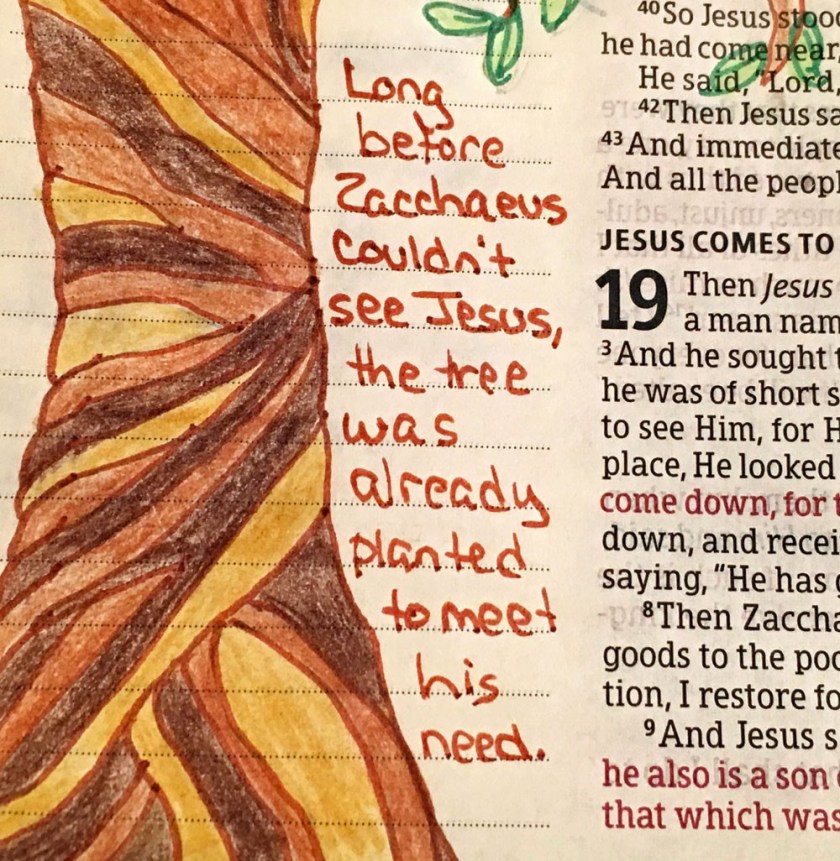
One of the biggest ways we turn away from obedience is we doubt ourselves. We doubt our abilities. We aren’t comfortable with God’s call. And we, ultimately, secretly say to ourselves: he’ll just get someone else to cover this. Surely it can’t depend on me? There are 12 other disciples, there are millions of other Christians, there are so many better Christians than me. I’d rather just be the one “with the good hair.” But Jesus challenges that here. Jesus wants them to not only hear the Good News but take it to the world. Jesus not only wants them to see miracles, but perform them. Jesus wants them to seek out the lost, the last and the low, not the easy crowds that have gathered to hear a celebrity preacher or a magician. Jesus wants them to seek out the Zacchaeus in the group, the bent over woman, the Samaritan. Karl Barth writes, “The human righteousness required by God and established in obedience — the righteousness which according to Amos 5:24 should pour down as a mighty stream — has necessarily the character of a vindication of right in favor of the threatened innocent, the oppressed poor, widows, orphans, and aliens. For this reason, in the relations and events in the life of his people, God always takes his stand unconditionally and passionately on this side and on this side alone: against the lofty and on behalf of the lowly; against those who already enjoy right and privilege and on behalf of those who are denied and deprived of it.”
What crowd do you think Jesus would hang out with today? Republicans? Democrats? Independents? Green Party? Everything in between? Police officers? Protesters? National Guard? First Responders? Anarchists? Red? Yellow? Black? White? Brown Hair? Purple Hair? Don’t Care. God gives his prevenient grace to all people. God woos us to God’s self before we’re even aware of it. We are ALL created in the image of God. Who would Jesus want to reach? All of us sinners and saints. You. Me. The person on the other side of the political divide, cultural divide, any kind of divide.
I’ll close with these words from Dietrich Bonhoeffer, “Humanly speaking, it is possible to understand the Sermon on the Mount in a thousand different ways. But Jesus knows only one possibility: simple surrender and obedience — not interpreting or applying it, but doing and obeying it. That is the only way to hear his words. He does not mean for us to discuss it as an ideal. He really means for us to get on with it.”
Matthew 5:3-11,
3 “Blessed are the poor in spirit, for theirs is the kingdom of heaven.
4 “Blessed are those who mourn, for they will be comforted.
5 “Blessed are the meek, for they will inherit the earth.
6 “Blessed are those who hunger and thirst for righteousness, for they will be filled.
7 “Blessed are the merciful, for they will receive mercy.
8 “Blessed are the pure in heart, for they will see God.
9 “Blessed are the peacemakers, for they will be called children of God.
10 “Blessed are those who are persecuted for righteousness’ sake, for theirs is the kingdom of heaven.
11 “Blessed are you when people revile you and persecute you and utter all kinds of evil against you falsely on my account. 12 Rejoice and be glad, for your reward is great in heaven, for in the same way they persecuted the prophets who were before you.

Posted in calling, Disciple, Discipleship, Grace, Jesus, Sanctifying Grace, Uncategorized, Vision

Being a Disciple Takes Owning Where We Are

Luke 5:1-11

Once while Jesus was standing beside the lake of Gennesaret, and the crowd was pressing in on him to hear the word of God, 2he saw two boats there at the shore of the lake; the fishermen had gone out of them and were washing their nets. 3He got into one of the boats, the one belonging to Simon, and asked him to put out a little way from the shore. Then he sat down and taught the crowds from the boat. 4When he had finished speaking, he said to Simon, “Put out into the deep water and let down your nets for a catch.” 5Simon answered, “Master, we have worked all night long but have caught nothing. Yet if you say so, I will let down the nets.” 6When they had done this, they caught so many fish that their nets were beginning to break. 7So they signaled their partners in the other boat to come and help them. And they came and filled both boats, so that they began to sink. 8But when Simon Peter saw it, he fell down at Jesus’ knees, saying, “Go away from me, Lord, for I am a sinful man!”9For he and all who were with him were amazed at the catch of fish that they had taken; 10and so also were James and John, sons of Zebedee, who were partners with Simon. Then Jesus said to Simon, “Do not be afraid; from now on you will be catching people.” 11When they had brought their boats to shore, they left everything and followed him.

We’ve embarked on a 5-week Discipleship series and this week’s is being a Disciple takes ownership.  What is a disciple?  Merriam-Webster defines it this way “someone who accepts and helps to spread the teachings of a teacher” or “one of a group of 12 men who were sent out to spread the teachings of Jesus Christ.”  The Greek word generally refers to a student or apprentice or devoted follower.

Some may not know what a big deal this was to invite ordinary, uneducated fishermen to be disciples. As Rob Bell shares in his Nooma video “Dust,”

“Jewish education was made up of three primary sections: Bet Safar – Usually from the ages five to ten, it is a time taught in the synagogue by the Rabbi. During this time, good Jewish boys memorized Torah – Genesis, Exodus, Leviticus, Numbers, and Deuteronomy.  In Bet Talmud, it continues from the age of ten on to fourteen. During this time, the student would memorize the Psalms, prophets, and the rest of the Hebrew Scriptures (the Old Testament).   In Bet Midrash, at the age of fourteen, the best of the best would continue to apply oral and written law from the Talmud, the Mishna, Sages, and years and years of commentary on the scriptures. Each Rabbi would have their own interpretation of how to live out the Torah. The Rabbi’s rules were called his yoke. When you studied under a Rabbi, you took his yoke upon you.

But Jesus came and said His yoke was easy. In Matthew 11, he says He isn’t about endless lists of rules and regulations.  You see, when Jesus is speaking, He’s not just picking words out of the air; He’s speaking as a Rabbi would.

One of the Sages from the Mishna is quoted as this, “May you be covered in the dust of your Rabbi.” Rabbis are passionate and animated. They would spend their days taking their disciples around teaching them, and as they traveled from place to place, they would literally kick up a cloud of dust. And because the disciples were following the Rabbi, at the end of the day, they would actually be covered in the dust their Rabbi kicked up – May you be covered in the dust of your Rabbi….

Where does this come in the context of Jesus’ earthly ministry?  Jesus has been tempted by the Devil, he’s read the scroll where Isaiah alludes to him saying he’ll proclaim release to the captives and recovery of sight to the blind, but they ran him off and tried to hurl him off a cliff.  So much for being welcomed in your hometown.  He set about proving his message – he healed people and preached in the synagogues doing what he said he would do.  In chapter 5 Jesus calls his first disciples – a group of smelly fishermen.  Mark and Matthew have him passing by the fishermen while they are casting their nets, but Luke has him actually going out on the boat.  In a way, this is more powerful, though the calling is still the same.

Can the world see from our “dust” who we follow?  Who our Master is?   Jesus constantly issued a personal call to people to simply follow him. It was always an open-ended call, and they were free to choose to do so or not, and just as free to bail out on following him when things got tough. The same is true for us. Even in Mount Pleasant, this life is still a choice, and we all need to check ourselves on whether or not we are actually followers of Jesus. Not just if we once were, but if we are currently “in the making,” in process of growing in the Lord and in grace. If we are, we need to own it boldly. If not, it’s okay, but it’s a life that goes through the motions from point a to b to c.  God doesn’t want that lukewarm faith for us but God lets us make the choice.  God is not a puppet master.  We have free will to choose.

The sun had just risen when the Boy Scouts began their trek up Baldy Mountain.  At 12,441 feet, Baldy is the highest peak in the Philmont Scout Ranch, a high-adventure backpacking camp run by the Boy Scouts of America. From the summit, hikers can enjoy spectacular views of the mountains, forests and lakes of northern New Mexico.

But the summit was still a dream when the crew of eight Scouts and two adults started out, hiking through a dense pine forest in the early-morning light. Reaching a gorgeous, gurgling mountain stream, they took a turn and headed down a wide and comfortable trail for about a mile.

Turned out to be the wrong trail.

Realizing their mistake, they turned around and hiked back. This detour added an extra two miles to their trip, and you might think they would be discouraged by it. But the extra distance had a surprising benefit. One Scout who had been struggling at the start of the hike gained confidence throughout the detour, and when the group got back on track, he felt strong enough to hike to the summit.

His success required venturing out, beyond his comfort zone. And so does ours.

The Boy Scouts of America have been challenging boys to push their limits for over a century now. So just exactly who has been a Boy Scout? Two-thirds of all astronauts and 11 of the 12 men to walk on the moon. 191 members of the 113th Congress have been involved in Scouting.  Ten of the 100 members of the United States Senate are Eagle Scouts. Eagle Scouts were disproportionately represented among Hurricane Katrina’s volunteer relief workers. Steven Spielberg, Jon Tesh, George W. Bush, Harrison Ford, JFK, Martin Luther King, Jr., Jim Morrison, Jimmy Buffett, Jimmy Stewart, Bill Gates and even Sir Paul McCartney were scouts.

Mike and Enoch participated in a Cub Scout Clean Up at the Park yesterday and Enoch’s super excited to participate in all that scouting has to offer.  It got Enoch out of the house when he normally would have been playing videogames or watching TV.  That’s the beauty of the Scouts, to get us out of our comfort zone, and on our feet, doing good in the world.  Do all the good you can, in all the ways you can, as long as ever you can.

We’re called to deep water, not shallow water.  To experience the fullness of the adventure of being a disciple of Jesus Christ who walks in the way that leads to life.  To own our failings and to own that we are sometimes scared to take that next step, to even cast a vision for the future because we’re so afraid of getting lost or of failing.

When Jesus finishes his speech to the crowd, he decides to extend his lesson with a dramatic illustration. He challenges Simon, “Put out into the deep water and let down your nets for a catch” (v. 4).

“Master, we have worked all night long but have caught nothing,” whines Simon. He sounds like he wants to stay close to shore, safe and comfortable because his time on the water hasn’t yielded any fish.

Put out into the deep water, says Jesus. He invites us to venture out, take a chance, be active and adventurous.

Jesus is looking for commitment. The idea of doing the same thing expecting a different outcome is the definition of insanity, so when Jesus asks Simon and his fishing buddies James and John to continue doing what they were already doing, they get a surprise – an unexpected, amazing and overwhelmingly abundant catch. All because they’re willing to follow Jesus’ words and scout the deep water.  This story reminds us that Jesus may use significant force to overcome our reluctance. The only reason for the huge catch of fish was to open the hearts of these men who had not previously considered themselves disciple material. And it worked, too, because as soon as Peter saw the size of the catch, it knocked him off his feet. He prostrated himself before Jesus and said, “Go away from me, Lord, for I am a sinful man.”

If we fish in the deep waters without Jesus, we will always come up empty, but if we fish the deep waters with Jesus and the Holy Spirit guiding us, we can fish for people.   That miraculous catch opened these fishermen’s hearts to respond when Jesus asked them to do something they had never done: “From now on you will be catching people.”   No thought to how much money that great catch would bring, Luke says they left everything on the shore and followed Jesus.

That’s the challenge for us today: to venture beyond our comfort zones and put out into the deep water in lives of Christian discipleship. Too often we stay close to shore, safe and comfortable, when Jesus is calling us to be active, adventurous and willing to explore new territory. That’s where the fish are. That’s where the growth happens. That’s where we can make surprising discoveries about ourselves and the world around us.  We scout the deep water when we venture out to share the Christian faith with our neighbors. Jesus challenges us to reach out to our friends and neighbors with the Good News of the Gospel.

In her book Unbinding the Gospel, Martha Grace Reese says that “our most important discovery is that a vivid relationship with God lies at the heart of real evangelism.” You have to ask yourself, “Has being a Christian made any difference in my life?” If so, then you’re going to want to share this reality with other people. Quite simply, evangelism is grounded in the realization that your life is better because of your relationship with God, and this is a relationship that can benefit others as well.

Reese says evangelism is all about relationships. Not high-pressure conversion programs — relationships. We need to reflect on our relationship with God, and then find natural, authentic and sincere ways to share that relationship with others.

We’re all disciples in the making. It’s an unfolding discipleship.  We are being formed into something, something new and different from when we started.  We’re not in Kansas anymore Toto, gone is the black and white and hello the technicolor.  Jesus has called us to the mission field of our community – Park West, Mount Pleasant, the city of Charleston, South Carolina…Proverbs 29:18 says where there is no vision, the people perish.  Helen Keller says it in a different way.  She says, “The only thing worse than being blind is having sight but no vision.”

What is God’s vision for the Church?  What is God’s vision for this church – Point Hope UMC? How does God want us to shape our community by being salt and light bearers and loving the people with an agape love?  If we put it off as a vision of the “church,” we can take out our personal accountability.  What is God calling YOU to do as you follow Jesus?  What is God asking you to bring to the table, the altar?  Your doubts, your fears, your excuses?  There is no one “good enough.”  As Roman 8 says we’ve all fallen short of the glory of God.

We don’t get the walk of Christian discipleship “right” all the time.  No one does.  Billy Graham shares on July 18, 2016, “”In God’s eyes all sin is equally serious, because all sin is an act of rebellion against God. This includes not only doing wrong, but also failing to do right. God also sees our hearts, and he knows the sins of greed and jealousy and selfishness that lurk there.”  Jesus knows everything about us, and yet, he STILL calls us.  Being in the making, is a Wesleyan understanding.  The first phase in that journey is to own this reality, to acknowledge (1) that Jesus has revealed himself to me, personally, in a powerful way through the different channels of God’s grace, (2) the point of that revealing is to draw me in, attract my attention/curiosity/hope, and prepare in me the desire for more, and (3) this desire is meant to open the door for calling, for Jesus to invite me to head down a very brand new pathway. It’s by sanctifying grace that God doesn’t let us wallow around in our own muck.  God keeps growing us in grace, transforming us, making us new.

For many of us, our being disciples doesn’t get off the ground, or doesn’t take clear form, or stays in a nebulous “whatever” or “blah” kind of place, because we don’t own what Jesus is trying to do, what he’s calling us to, and what it asks of us. Peter and James and John had a moment like this by the Sea. There was no doubt who Jesus was, or what he had done, or that something special was going on. And Simon left no doubt that he was changed and ready to change, ready to embark after following the Lord’s direction. And then Jesus leaves no doubt that this is exactly what he’s there for, and what he calls us each to do – go to the deep, dangerous depths.  He doesn’t promise it will be easy, but he promises to be FAITHFUL.

We need to own where we are in the process, wherever it might be. Some of us need to own that we answered God’s call and then never took another step. Some of us, we followed, but then petered out. Some of us, we’re still struggling to follow and not sure anymore where we are or what we’re about. Some of us, we’re faithfully following and ready for more. Some of us, we never answered the original call, or have claimed that we never heard one. Whatever the case, wherever we are today, we have to start by owning where we are and then deciding whether or not to own that we’re meant to be active, intentional disciples.

We are good in the United Methodist Church about talking about grace. When I was a campus minister, we often would set up in the student center a place for all of the campus ministries to share a brochure and a sticker.  The Catholics and the Baptists would get the majority of students.  At Emory and the University of Florida, we had a great many Jewish people that wanted info.  Methodists rarely came up to the table.  I would wager that we taught “grace” so well, that they knew if they took a hiatus from church, God’s grace would be enough to cover a multitude of sins in college/grad school/young adulthood.  And in fact, that’s true, but it’s a half-life or a shadow life from the one Christ seeks to give us.  Dietrich Bonhoeffer writes about this cheap grace in The Cost of Discipleship,

“Cheap grace is the preaching of forgiveness without requiring repentance, baptism without church discipline, Communion without confession, absolution without personal confession. Cheap grace is grace without discipleship, grace without the cross, grace without Jesus Christ, living and incarnate.

Costly grace is the treasure hidden in the field; for the sake of it a man will go and sell all that he has. It is the pearl of great price to buy which the merchant will sell all his goods. It is the kingly rule of Christ, for whose sake a man will pluck out the eye which causes him to stumble; it is the call of Jesus Christ at which the disciple leaves his nets and follows him.

Costly grace is the gospel which must be sought again and again, the gift which must be asked for, the door at which a man must knock.

Such grace is costly because it calls us to follow, and it is grace because it calls us to follow Jesus Christ. It is costly because it costs a man his life, and it is grace because it gives a man the only true life. It is costly because it condemns sin, and grace because it justifies the sinner. Above all, it is costly because it cost God the life of his Son: “ye were bought at a price,” and what has cost God much cannot be cheap for us. Above all, it is grace because God did not reckon his Son too dear a price to pay for our life, but delivered him up for us. Costly grace is the Incarnation of God.”

What if we believed in that kind of “costly grace”?  Surely our world would be different.  Surely it would be.  The ball is in your court, will you follow Jesus and be fishers of people?  Bringing God’s kingdom to earth, meeting the needs of those in our community, and sharing the God’s love and grace with everyone you meet?  Or will you wait on the sidelines, being non-committal as ever?  It’s your choice, as this walking the talk of discipleship always is. Do you have the dust of your rabbi?  Are you going into the deeper waters?  Are you going to rock the world as a disciple of Jesus?  I hope so.

Posted in Empowerment, Enough, Flash Cards, Flourish, Jesus, Parenting, Parents, Practice, Reading, Uncategorized

Phonic Books & Flash Cards

I don’t hesitate where my kids’ education is concerned.  I will buy any amount of Fancy Nancy or Dick and Jane or Pinkalicious or Star Wars phonic books  on Amazon Prime.  I will buy any sight word flash cards.  ANYTHING to make Evy a strong reader.  I have heard since we were married that when Mike moved to South Carolina from Alabama, the South Carolina schools were a year behind. It’s clear that the schools here in Mt. Pleasant are a little further ahead than the schools our kids were at in Florida.  When you move to a different school, sometimes you’re ahead and sometimes you’re behind.

Mike and I help them both with their homework and it takes patience to work with either of them.  They go too fast and make careless mistakes, or get tired and don’t try, or get frustrated and don’t try, or give up and don’t try, or make excuses and don’t try, or get tired and feel like they can’t try anymore.  We give them all the tools and resources and they KNOW they need to learn it.  They know they need to practice.  They know they need to keep trying.  They know there’s no playing indefinite hooky.  We’ve explained that very extensively.  But it’s hard to learn to read.  Its hard to learn multiplication. They both have to practice, practice, practice to catch up and it’s a hard thing not to give the answers to them, not to sound it out for Evy.   It’s hard not to give the answers to her, not to sound it out for her.  For our children, we would move heaven and earth to do anything for them.  There’s nothing more frustrating/heart wrenching/miserable to a parent than not being able to help their children.

As I teach her about walking with Jesus, I told her on Sunday night that you can talk to him any time you want, when you’re frustrated or embarrassed at school, when you’re feeling alone or misunderstood, he can help you.  I then told her what so many of us need to here.  You’re enough.  You’re kind enough.  You’re smart enough.  You’re enough.  She buried her head in my shoulder and began to cry.  She needed to hear that.  She needed to know we’re always in her corner no matter what and she matters to the great God of the universe.  Mostly she needed to know she was loved.

It’s a both/and.  God must be so frustrated with us, God’s children, when we don’t learn, when we give up and don’t try.  Because obviously we want our children to not only to succeed, but to flourish.  The definition of “flourish” is to “grow or develop in a healthy or vigorous way, especially as the result of a particularly favorable environment.”  God wants all of us to flourish.  God wants the best for us.  God wants us to know from the tops of our head to the tips of our toes that we are enough.

But, we have to practice.  We have to practice loving people that are different from us.  We have to practice taking that extra couple of steps to help someone.  We have to practice reaching out as a church to a world that’s hurting and busy beyond their means.  We have to practice being salt and light, in the world, but not of it.  Just as Evy has to practice her reading and Enoch has to practice his multiplication, we have to practice living as followers of Jesus Christ.  Phonic books and flashcards may help, but we have to DO.  Knowing and trusting that when we fail, God’s grace is enough.  But we have to TRY.  Or we’re selling ourselves short and not reaching out and stretching ourselves to be who God created us to be.  God wants us to reach our full potential just as we want Enoch and Evy to reach their full potential.  How is God calling you to practice your faith?  What is God calling you to practice?  It sometimes will be hard.  You may fall and scrape your knees, but God’s going to be right there when that happens and we as your community will be right there with you to pick you up and dust you off.  God doesn’t want us to suffer or struggle.  God wants to give us good and abundant gifts, as we as parents, but we and God can’t do it for our children.  God gives us the free will to choose how we spend our time.  God gives us the tools and the resources but we have to make the choice to ACT for ourselves.

I’m going to close with this “Prayer for Empowerment” by Kathleen Fischer.

Creator and Healer, you dwell closer to us than the air we breathe, yet far surpass all we know.

We bless you for the stunning beauty of your cosmos, the gifts you unendingly give.

Forgive us our failure to be grateful and to trust you.

Fill our hearts with your courage, and our minds with your vision of what we might become.

Free us from fear of the dark unknown spaces where you give birth to new possibilities.

You are a God of adventure, and you took a great risk in creating us.

Empower us to become the community of which your heart dreams.

Amen.

Posted in God's Providence, Grace, Jesus, Outcasts, Prevenient Grace, Providence, Sanctifying Grace, sin, Uncategorized, Zacchaeus

We Choose to Follow Jesus

What did we talk about last Sunday? You might remember the Parables of the Talents, The Legend of Bagger Vance or the quotes on success from Larry Bird or Queen Elizabeth II, but the main point was when God chooses us, we’re chosen FOR something and fear is the main thing that holds us back.
Our scripture this morning is Luke 19:1-10.
19 He entered Jericho and was passing through it. 2 A man was there named Zacchaeus; he was a chief tax collector and was rich. 3 He was trying to see who Jesus was, but on account of the crowd he could not, because he was short in stature. 4 So he ran ahead and climbed a sycamore tree to see him, because he was going to pass that way. 5 When Jesus came to the place, he looked up and said to him, “Zacchaeus, hurry and come down; for I must stay at your house today.” 6 So he hurried down and was happy to welcome him. 7 All who saw it began to grumble and said, “He has gone to be the guest of one who is a sinner.” 8 Zacchaeus stood there and said to the Lord, “Look, half of my possessions, Lord, I will give to the poor; and if I have defrauded anyone of anything, I will pay back four times as much.”9 Then Jesus said to him, “Today salvation has come to this house, because he too is a son of Abraham. 10 For the Son of Man came to seek out and to save the lost.”

Did you ever climb trees as a kid? We had a magnolia tree in a neighbor’s backyard that was perfect for climbing. If you know anything about magnolia trees, their branches are close together, which makes it an easy tree to climb. We spent many afternoon of my childhood climbing trees.

That’s why the story of Zacchaeus has always fascinated me. The story of Zacchaeus is familiar to many of us. He was the short guy who had to climb a tree to see Jesus. There’s even a song that we sang in Sunday school about him.  “Zacchaeus was a wee little man, a wee little man was he. He climbed up in a sycamore tree, for the Lord he wanted to see. Jesus said, “You come down for I’m coming to your house today, for I’m going to your house today.” I can’t believe after all these years I still remember that.

Zacchaeus wasn’t the funny short guy climbing in a tree that I pictured in my mind’s eye as a child. He wasn’t the wee leprechaun that I imagine when using the word “wee.”  He’s the chief tax collector. Zacchaeus doesn’t need to be told he’s a sinner. Society’s already made that clear. He doesn’t need people to tell him he’s an outcast. He already feels it.
The English word sin is used to translate at least six Hebrew and seven Greek words. Soren Kierkegaard defines sin this way. “Sin is the steadfast refusal to be your one true self.” That is a very different understanding than the typical definition of sin. Evigras of Pontus’ understanding of sin is that sin is a “forgetfulness of God’s goodness.” Jesus actively sought out sinners and made room at the table for them, he was searching them out reminding them of God’s love specifically for them.
You would think that the religious people would get used to Jesus hanging out with the social outcasts, lepers, women of ill repute, tax collectors, dirty and smelly fisherman, but they didn’t catch on at all. That he picked them continually only seemed to make them more angry and haughty. They reject any idea that he would pick THOSE people over them. He CHOOSES to hang out with sinners and NOT the hyper religious or wealthy. They are surprised by this EVERY time. I want to shake my head and ask, “Don’t you get it?” Jesus chooses to go where no one else would go. Jesus chooses the least, the last, and the low. Jesus chooses the ones what society stamps “not good enough.” Jesus chooses us sinners. In verse 10, it says Jesus came to seek out and to save the lost. Jesus didn’t seem to mind that he was getting a “reputation” for hanging out with tax collectors and prostitutes. Everyone that he encountered, he saw as a person in need of God’s love, even the Pharisees.
If they would stop looking down their noses and judging, they would realize we’re all in need of God’s grace and mercy because in fact, we’re ALL sinners. They probably didn’t like when he said in Luke 6, “37 “Do not judge, and you will not be judged; do not condemn, and you will not be condemned. Forgive, and you will be forgiven.” Or “41 Why do you see the speck in your neighbor’s eye, but do not notice the log in your own eye? 42 Or how can you say to your neighbor, ‘Friend, let me take out the speck in your eye,’ when you yourself do not see the log in your own eye? You hypocrite, first take the log out of your own eye, and then you will see clearly to take the speck out of your neighbor’s eye.” A good and challenging word for today. As Mother Teresa says, “If you judge people, you have no time to love them.” If you judge people, you have no time to love them.

I’d like to tell you a story, “There was a young, intelligent university student named Bill. Bill was what some people call a “free spirit” or “hippie.” He had wild long hair, always wore the same old and torn T-shirt, jeans and no shoes. Across the street from the university campus was a church. The people there were rich, older and well-dressed. They wanted to help the university students nearby, but they did not know exactly how to do it.

Well, one day Bill decided to go visit this church by his university. As usual, he went wearing his only jeans, old, torn T-shirt and his dirty long hair. The church service had already started and was full, so Bill walked down the center aisle looking for a seat. People were getting more and more uncomfortable as they watched this unclean, wild-looking young man. Finally, Bill got to the front and saw there were no more empty seats, so he just sat down on the floor right in front of the preacher. No one had ever done that in this church before! By now, everyone was upset and distracted.
Then, a respected old church deacon got up and started toward the front. Everyone was thinking: “You can’t blame the deacon, he really should correct this disrespectful young man.” Everyone was watching. Even the preacher stopped his sermon when the old man finally got to the front. Then, they were all completely surprised to see the old deacon drop his walking stick and very slowly sit down on the floor next to this young hippie. He did not want this young man to sit alone and feel unaccepted. The people in the church were moved to tears. Finally, the preacher said: “What I am preaching about today you will probably never remember. But what you have just seen you will never forget!””

Jesus came for all of us. It doesn’t say, “For God so loved some of the world…” The great God of the universe came down and was Emmanuel God with us and he seeks relationships with each of us. Just as Harry seeks the horcruxes in the later books of the Harry Potter series, just like they seek the ring of Mordor in the Lord of the Rings trilogy, just like they seek the Lost Ark of the Covenant and the Holy Grail in Indiana Jones, the and they seek treasure in the Mummy, National Treasure, and the Goonies, our Lord SEEKS us. And we don’t have to hide who or what we are. God knows us. God knows when we sit and when we rise. We are sinners. We are lost. We don’t have to put on our masks every day that we put on for work or school. We don’t have to hide behind our answer of “fine” when someone asks how we’re doing. With God we can let our guard down. God already knows the things that we’d rather keep hidden. What we’re worried about, our hopes, fears, and dreams. That can be freeing for some people and it should give hope to ALL of us because Romans 3:23-24 says, “All have sinned and fall short of the glory of God; they are now justified by his grace as a gift, through the redemption that is in Christ Jesus.” We have all fallen short. None of us immune. It is a free gift of grace through Jesus.

This is a poem by Roberta Porter. It’s called “Transforming Love.”
“God wants our lives –
Not Sunday morning shiny,
But all of the fragments of our failures,
Shards of struggle and sin
We’ve gathered, hidden, on our way.
And in Jesus’ transforming love,
His willing brokenness, sacrifice, rising,
Our sorrow and pain become gifts
To be used for others,
Our weakness the dwelling place
For the Spirit’s strength,
Our broken-open lives
Bearers of God’s grace.”

We’re not perfect. None of us are. At least Zacchaeus was aware of his sinfulness. He was aware that he needed saving. As C S Lewis perceptively wrote in his classic book, Mere Christianity:  “When a man is getting better he understands more and more clearly the evil that is still left in him. When a man is getting worse he understands his own badness less and less. A moderately bad man knows he is not very good: a thoroughly bad man thinks he is all right. This is common sense, really. You understand sleep when you are awake, not while you are sleeping. You can see mistakes in arithmetic when your mind is working properly: while you are making them you cannot see them. You can understand the nature of drunkenness when you are sober, not when you are drunk. Good people know about both good and evil: bad people do not know about either.” It doesn’t say in the text when Zacchaeus made a change of heart – if it was when he saw Jesus, when Jesus recognized him worthy to speak to him, actually when he invited him down from the tree, or as he was climbing down the tree, but it’s clear that this is a lifestyle change. It’s clear that he has repented.
He says in verse 8, “Look, half of my possessions, Lord, I will give to the poor; and if I have defrauded anyone of anything, I will pay back four times as much.” It was biblical custom to only pay them back twice as much, so he’s going above and beyond because of this encounter with Jesus.
How do we encounter Jesus? Do we pretend to not see him and not meet his eyes? Or do we ignore his voice by putting our fingers and doing what we want? Do we even consciously admit to being sinful or do we push that aside because it’s distasteful? Or are we so oblivious to our own faults like the Pharisees? Maybe Jesus liked to hang out with sinners because they were real. They chose to be honest about their flaws or growing edges. Zaccheaus chose to lay it all out there, repent, change, make amends and then Jesus said to him, “Today salvation has come to this house.”
Zacchaeus’ are obviously “out there” – the social misfits, the humans that wound each other, the anarchists, the people on the fringes or outside society’s norms, BUT there’s a bit of Zacchaeus in all of us. We’re all Zacchaeus. Jesus would have come into the world for any one of us. We all have worries and fears. It’s okay. Like the parable of the good shepherd who leaves the 99 to find the one lost sheep. All for one.

tree
God will give you the evidence you need to help you believe. Like in Luke 9:24, when the man of the child that Jesus is healing says to Jesus, “I believe, help my unbelief.” One of the most profoundly honest prayer.  I believe, help my unbelief.  Just ask. Jesus desires a personal relationship with each one of us. That’s why before we even have understanding of it, God searches us out and draws us to God’s self in God’s prevenient grace. We recognize we’re in need of God’s grace – that that grace is for us – in justifying grace. God doesn’t leave us where we are in the mire and the muck. In God’s sanctifying grace, God helps us to grow and mature as Christians. God will give us the signs and the answers that we need to believe if we but ask him. God will answer our doubts and reassure you when you need it most. 1 John 4:9-10 says, “9 God’s love was revealed among us in this way: God sent his only Son into the world so that we might live through him. 10 In this is love, not that we loved God but that he loved us and sent his Son to be the atoning sacrifice for our sins.”
God’s heart reaches, searches, longs for EACH of us and meets our needs. If you don’t hear anything I say this morning, hear that. There are no outsiders because no one is out of the reach of the love of God. Nothing can separate us from it. Romans 8:38-39 says, “For I am convinced that neither death, nor life, nor angels, nor rulers, nor things present, nor things to come, nor powers, nor height, nor depth, nor anything else in all creation, will be able to separate us from the love of God in Christ Jesus our Lord.” That is a verse I cling to on my darkest nights.
Have y’all ever heard of cardboard testimonies? On one side of the cardboard you write what you’re struggling with and when you flip the cardboard over, you can see the power of God working in your life.

What would you write as your cardboard testimony? Do you live your life in such a way that people know your cardboard testimony without you even writing it down? Is it known that you’re a Christian? Or is it just known that you’re a nice person?
Bob Goff says, “Follow the footsteps of God. Walk (don’t just fall) in love. Love God. Be like Jesus.” How are we like Jesus? How are we to be Jesus to the world? I read an author once that said, “Love is the only power that can compel us to risk our own lives. And love is the only power that has the potential to heal all the wounds that human beings inflict upon one another.”
Love is the answer. Love God. Love people. It’s that simple.
We choose to follow Jesus. We choose to follow him because of his great love for us. Because he’s the answer to all of our quests, to all of our journeys, to all of our adventures. He’s the One that we’ve been waiting for and the world needs to know. Will you share it with them? Will you share it by living your life of faith out loud? The good, the bad, the ugly and the faithful. Growing in grace and growing the depth of our faith that the world may see and know that our God reigns and God’s grace is available to them without price, without strings attached. Tax Collectors. Prostitutes. You and Me.

Posted in Butch O'Hare, Character, Choices, Fruit of the Spirit, Galations, Habit, Input/Output, Jesus, Reaping, True Vine, Uncategorized

Choices – You Reap What You Sow

Galatians 6:1-10 (NRSV)

My friends, if anyone is detected in a transgression, you who have received the Spirit should restore such a one in a spirit of gentleness. Take care that you yourselves are not tempted. Bear one another’s burdens, and in this way you will fulfill the law of Christ. For if those who are nothing think they are something, they deceive themselves. All must test their own work; then that work, rather than their neighbor’s work, will become a cause for pride. For all must carry their own loads.

Those who are taught the word must share in all good things with their teacher.

Do not be deceived; God is not mocked, for you reap whatever you sow. If you sow to your own flesh, you will reap corruption from the flesh; but if you sow to the Spirit, you will reap eternal life from the Spirit. So let us not grow weary in doing what is right, for we will reap at harvest time, if we do not give up. 10 So then, whenever we have an opportunity, let us work for the good of all, and especially for those of the family of faith.

Growing up, my two younger brothers would have cavity after cavity, and though I ate the most candy, I never had one.  We got Evy’s “Vacation Fun” book, where she writes a whole story about seeing candy, the scent of candy being in the air, so much so she could almost taste it.  She’s a child after my own heart.

IMG_5734

Though Josh and Caleb didn’t eat near the amount of sugar I did, my senior year of high school we moved and it all changed.  Dr. Anderson, our new dentist, got a lot of money from my parents.  I had 7 cavities that year.  It had all caught up to me and my brothers said after all of those years skirting by after they received filling after filling, I deserved it.

Out of the verses in this passage,you reap what you sow is probably the most famous and one of the most commonly used Biblical passages in the vernacular.   Even Urban Dictionary has a definition for it. It begins by saying it’s the basic nature of God’s justice.  It gives us these definitions:  1. Everything that you do has repercussions. It comes back to you in one way or another. 2. You cannot escape the consequences of your actions. 3. You will see the long-term effects of your actions. 4. What goes around comes around.  Terrence Trezvant ends his post this way, “Sow a thought you reap an act. Sow an act, you reap a habit. Sow a habit, you reap a character. Sow a character, you reap a consequence.” 

I always want to know the context for a verse.  Both what the writer of the letter is trying to say and where it is in the passage.  Paul was writing a letter to the Christian communities in Galatia.  He was battling the controversy of Gentiles not adhering to Mosaic law, such as circumcision.  You see, the Galatians were converted directly from Paganism and some of them became Judaizers, which means they followed all the laws, living like Jews.  Paul’s arguing against this in many of his letters.  It’s a constanttheme in his epistles that you put your faith in Christ alone or the law of the Messiah, which requires living life in community.  Love God and love neighbor.  So you see in verse 6:2, “Bear one another’s burdens, and in this way you will fulfill the law of Christ” and this you do in care and compassion as verse 1 makes priority.  Be gentle with one another, but be firm in convictions so as not to be tempted, however, this not leads to lack of personal responsibility.

The college students that I’ve worked with didn’t have very many universal feelings, but they all detested group projects and they would come to me from time to time to gripe and commiserate with one another about how their group was the worst.  It’s true for group projects, you have to bear one another up but it’s not an excuse to let one group member do the work, and not take personal responsibility, not  put forth your best effort, or not to do your fair share.  It’s grace and accountability.  You’ve got to give people grace, but you also have to hold them accountable.  It’s a balancing act.  Verses 4 and 5 says each person must answer to God individually, testing and taking pride in their own work.  Isn’t that a relief?  We don’t have to judge others, we are only responsible for what we put in the world.  I’m reminded of Trezvant’s words, “Sow a thought you reap an act. Sow an act, you reap a habit. Sow a habit, you reap a character. Sow a character, you reap a consequence.”

How are we to sow to the Spirit and what are we to sow?  Simple things like smiling at someone.  Angela Johnson is a Deacon of the South Carolina Annual Conference serving in Atlanta at Action Ministries and she wrote on facebook the other day, “Be still my heart.” Daily, I encounter individuals and families who are homeless. While I cannot immediately change their circumstances, I know that I play a role in helping people obtain housing. A gentleman told me today that “my smile encouraged him and gave him a sense of hope.” I do not share this to brag about myself, but want to encourage you that small things can make or possibly change someone’s life/situation/or circumstance.  Be the light…so others may see Christ in you.”  Galatians itself gives us the answers in chapter 5 verses 22-23 talking about the fruit of the Spirit. “22 By contrast, the fruit of the Spirit is love, joy, peace, patience, kindness, generosity, faithfulness, 23 gentleness, and self-control. There is no law against such things.”  If we plant these fruits of the Spirit as little seeds, and cultivate, nurture, water and tend them then they will burst forth from us.

My mom had this tape that she bought us when we were little by the Bill Gaither trio.  It had a song called “Input Output.”  I actually looked up the lines.  I warn you that they’re really cheesy and outdated but the concept is still the same.  Input output that is what it’s all about

Chorus 1

Input output what goes
In is what comes out
Input output that is what
It’s all about
Input output your mind is a computer
Whose input output
Daily you must choose

Verse 1

Let the Bible be your primary feed
It’s got all the data you need
Talk to Jesus all the time
That’s the way that
You can stay on line

Verse 2

If your printout reads to lie or cheat
There’s some data you should delete
Debug your mind of sinful bytes
Then you will operate all right

It’s a simple concept.  What you put into your life is what comes out.  You can either sow seeds of peace, joy, and kindness or sow seeds of duplicity, malice, and destruction.  We have to be connected to the true vine, Jesus, to get our daily nourishment through prayer, reading the Bible, worship, walking through God’s creation, meditating on a scripture while you exercise.  God nourishes us in many various ways, but we have to stay connected.  John 15:1-6, “I am the true vine, and my Father is the vine-grower. 2He removes every branch in me that bears no fruit. Every branch that bears fruit he prunes to make it bear more fruit. 3You have already been cleansedby the word that I have spoken to you. 4Abide in me as I abide in you. Just as the branch cannot bear fruit by itself unless it abides in the vine, neither can you unless you abide in me. 5I am the vine, you are the branches. Those who abide in me and I in them bear much fruit, because apart from me you can do nothing.” That’s the key to this whole thing, we can’t do it on our own.  No one is “good” enough.  No one has a corner on the kingdom.  There’s not a giant sticker chart in the sky that you are able to earn gold stars for and get into heaven.  The only way to finish the race is by the grace of God.  Psalm 51:10-12 says, “10Create in me a clean heart, O God, and put a new and right spirit within me.11Do not cast me away from your presence, and do not take your holy spirit from me.12Restore to me the joy of your salvation, and sustain in me a willing spirit.”

IMG_5735

It’s a God action, not a human action,but because of the grace God has given us, comes great responsibility and that leads us to our last two verses, “So let us not grow weary in doing what is right, for we will reap at harvest time, if we do not give up. 10 So then, whenever we have an opportunity, let us work for the good of all, and especially for those of the family of faith.”  You will hear the phrase “do not grow weary in doing what is right” echo in the Bible.  Don’t be weary in spending time in God’s word and seeking to live it out.  Don’t be weary in planting seeds of the fruit of the Spirit.  Don’t be weary of praying for your family, friends, community, and country.  Don’t be weary in serving God with all that you have.  As John Wesley says, “Do all the good you can. By all the means you can. In all the ways you can. In all the places you can. At all the times you can. To all the people you can. As long as ever you can.”

We can support each other on the journey to sow seeds of light.  We don’t have to do it alone, remember we bear with one another.  Archbishop Desmond Tutu says, “Do your little bit of good where you are; it’s those little bits of good put together that overwhelm the world.”  Together we can shine a brighter light.  Together we will reap a great harvest.  You have to choose to sow the seeds that produce good things and it’s sometimes hard.  As Dumbledore says in the Harry Potter series, “It is not our abilities that show what we truly are.  It is our choices.”

Let me close with a couple stories that I think illustrate this passage.   This is an example of how a single choice of whether to sow good or not can greatly impact others.   STORY NUMBER ONE Many years ago, Al Capone virtually owned Chicago. Capone wasn’t famous for anything heroic. He was notorious for enmeshing the windy city in everything from bootlegged booze and prostitution to murder. Capone had a lawyer nicknamed “Easy Eddie.” He was his lawyer for a good reason… Eddie was very good! In fact, Eddie’s skill at legal maneuvering kept Big Al out of jail for a long time. To show his appreciation, Capone paid him very well.

Not only was the money big, but Eddie got special dividends. For instance, he and his family occupied a fenced-in mansion with live-in help and all of the conveniences of the day. The estate was so large that it filled an entire Chicago City block. Eddie lived the high life of the Chicago mob and gave little consideration to the atrocity that went on around him. Eddie did have one soft spot, however. He had a son that he loved dearly. Eddie saw to it that his young son had the best of everything: clothes, cars and a good education. Nothing was withheld. Price was no object. And, despite his involvement with organized crime, Eddie even tried to teach him right from wrong. Eddie wanted his son to be a better man than he was.

Yet, with all his wealth and influence, there were two things he couldn’t give his son; that he couldn’t pass on a good name and a good example. One day, Easy Eddie reached a difficult decision. Easy Eddie wanted to rectify wrongs he had done. He decided he would go to the authorities and tell the truth about Al “Scar face” Capone, clean up his tarnished name and offer his son some semblance of integrity. To do this, he would have to testify against The Mob, and he knew that the cost would be great. So, he testified. Within the year, Easy Eddie’s life ended in a blaze of gunfire on a lonely Chicago Street. But in his eyes, he had given his son the greatest gift he had to offer, at the greatest price he would ever pay.

STORY NUMBER TWO

World War II produced many heroes. One such man was Lieutenant Commander Butch O’Hare. He was a fighter pilot assigned to the aircraft carrier Lexington in the South Pacific. One day his entire squadron was sent on a mission. After he was airborne, he looked at his fuel gauge and realized that someone had forgotten to top off his fuel tank. He would not have enough fuel to complete his mission and get back to his ship. His flight leader told him to return to the carrier. Reluctantly, he dropped out of formation and headed back to the fleet. As he was returning to the mother ship he saw something that turned his blood cold. A squadron of Japanese aircraft was speeding their way toward the American fleet. The American fighters were gone on a sortie, and the fleet was all but defenseless. He couldn’t reach his squadron and bring them back in time to save the fleet. Nor could he warn the fleet of the approaching danger. There was only one thing to do. He must somehow divert them from the fleet. Laying aside all thoughts of personal safety, he dove into the formation of Japanese planes. Wing-mounted 50 caliber’s blazed as he charged in, attacking one surprised enemy plane and then another. Butch wove in and out of the now broken formation and fired at as many planes as possible until all his ammunition was finally spent. Undaunted, he continued the assault. He dove at the planes, trying to clip a wing or tail in hopes of damaging as many enemy planes as possible and rendering them unfit to fly. Finally, the exasperated Japanese squadron took off in another direction. Deeply relieved, Butch O’Hare and his tattered fighter limped back to the carrier.

Upon arrival he reported in and related the event surrounding his return.   The film from the gun-camera mounted on his plane told the tale. It showed the extent of Butch’s daring attempt to protect his fleet. He had in fact destroyed five enemy aircraft. This took place on February 20, 1942, and for that action Butch became the Navy’s first Ace of W.W.II, and the first Naval Aviator to win the Congressional Medal of Honor. A year later Butch was killed in aerial combat at the age of 29. His home town would not allow the memory of this WW II hero to fade, and today, O’Hare Airport in Chicago is named in tribute to the courage of this great man. So the next time you find yourself at O’Hare International, give some thought to visiting Butch’s memorial displaying his statue and his Medal of Honor. It’s located between Terminals 1 and 2.

SO WHAT DO THESE TWO STORIES HAVE TO DO WITH EACH OTHER?

Butch O’Hare was Easy Eddie’s son.

The choice is yours.  Know what you sow.

Let us pray.

Posted in Abundance, Christian music, Community, Jesus, Uncategorized

Our Stories

I preached this at Point Hope UMC this morning.  They were very gracious to me and we had a delicious lunch after church that Mike and the kids have raved about all afternoon.  Thanks for being with me on this crazy journey called life.  I want you to share your stories  with me too!  ‘Cause we’re not meant to do this life alone.  Amen?

Psalm 77

1I cry aloud to God, aloud to God, that he may hear me.

2In the day of my trouble I seek the Lord; in the night my hand is stretched out without wearying; my soul refuses to be comforted.

3I think of God, and I moan; I meditate, and my spirit faints. Selah

4You keep my eyelids from closing; I am so troubled that I cannot speak.

5I consider the days of old, and remember the years of long ago.

6I commune with my heart in the night; I meditate and search my spirit:

7“Will the Lord spurn forever, and never again be favorable?

8Has his steadfast love ceased forever? Are his promises at an end for all time?

9Has God forgotten to be gracious? Has he in anger shut up his compassion?”

10And I say, “It is my grief that the right hand of the Most High has changed.”

11I will call to mind the deeds of the Lord; I will remember your wonders of old.

12I will meditate on all your work, and muse on your mighty deeds.

13Your way, O God, is holy. What god is so great as our God?

14You are the God who works wonders; you have displayed your might among the peoples.

15With your strong arm you redeemed your people, the descendants of Jacob and Joseph. Selah

16When the waters saw you, O God, when the waters saw you, they were afraid; the very deep trembled.

17The clouds poured out water; the skies thundered; your arrows flashed on every side.

18The crash of your thunder was in the whirlwind; your lightnings lit up the world; the earth trembled and shook.

19Your way was through the sea, your path, through the mighty waters; yet your footprints were unseen.

20You led your people like a flock by the hand of Moses and Aaron.

Some of you may be wondering what on earth is this preacher doing using a Psalm as her text on her first Sunday.  The Psalms get to the heart speak.  They get down deep, to the nitty gritty.  They’re full of real people celebrating their Good Shepherd and crying out desperately to God.  Both the mountaintops and valleys, the fullness of the human experience, is captured in the Psalms.

Let me tell you a story.  In my previous appointment I went to Costa Rica for a Spring Break mission trip in 2013 with Pura Vida Ministries.  Listen to their mission statement: “We exist to transform lives by providing Christ-centered, life-changing mission adventures.  We believe that following Jesus is Not an Event, but a Life!”  Not an event, but a life.  Not an event, but a life.  I believe that.  You will hear in my messages and hopefully see in my life a fervent desire to live our faith out loud, no matter the storms or challenges.  They had different merchandise you could buy with “Not an event, but a life” so I brought back a mousepad for my office, not knowing then that I would have my second brain surgery later that May.

At a conference in Winchester, VA I had my first seizure.  It was 2010 and I was 30 at the time.  I was diagnosed with a brain tumor that they removed most of two weeks later.  My tumor has a Harry Potter spell-like pronunciation to it – an oligodendroglioma. I had no complications or deficits after surgery.  I mean I had a tube coming out of my head with a blood bulb that I would put in the pocket of my hospital gown when I went to the bathroom but you go through what you have to.  I had the surgery on Friday and I was out on Sunday.  My son Enoch had just turned 3 and Evy was 1;58969_656598733737_2486331_n

so I recuperated at my brother Josh’s house.  I was back home and at work the next Thursday, less than a week later, easy, peasy, lemon squeezy.

I remember writing on the prayer request card from Pura Vida at the end of the trip that I would have an MRI the following Monday.  The MRI unfortunately showed the tumor had grown and so I began sharing with people that I would have a second surgery.  I thought it would be like the first surgery, so I agreed to do a wedding 3 weeks later and was set to do a workshop in Chicago that June and set to preach at camp for a week in July.  Unlike the first surgery where I had no complications, when I woke up I could understand everything the nurses, doctors, and my family were saying but I had lost my ability to speak.  The doctors and speech therapists call it apraxia.  Apraxia is the inability to execute learned purposeful movements, despite having the desire and the physical capacity to perform the movements. Oh, I had the desire in spades.  In other words, the words were still there but the ability to form sentences was broken, non-existent.

The tumor is on the motor cortex, that’s why they didn’t get it all the first time, so I had no feeling in my right arm or hand, and I’m right-handed.  I texted these words to my husband, Mike, with my left hand over two weeks later, “The quickness with which I speak comes back?”  It took me 45 minutes to text that.  I did 30 radiation treatments, 6 months of chemo, physical, occupational, and speech therapy over that year and then I went to the Ukraine to speak at a conference, but that is another sermon.

I’ve learned to rely on God because I HAVE to.  I am an independent, non-conformist person mixed with a perfectionistic people pleaser and I ALWAYS relied heavily on my communication skills.  I didn’t know how much until I couldn’t rattle off a prayer or answer a theological question or explain simple things to my kids or preach without a manuscript, or even the little things.  I used to carry around a small calendar in my purse to jot stuff down in, I used to type x number of words a minute, I used to love to send handwritten notes to people.  The ease and what came naturally to me before was lost and I still sometimes grieve that loss.  It’s okay to grieve.  God is with us when we mourn.  God promises to bring joy in the morning, so I went back to preaching in June.  I could read things and I reused every sermon that I had full manuscripts for that summer.  My oncologist, who I met with more frequently that first year and now at least every 3-4 months, was an older man who was all business and had a wry sense of humor.  Dr. Stahl always asked me if I was still preaching every week and I would always say yes.  He doesn’t know, by him asking me that question every time that I’m just stubborn, bull-headed and tenacious enough to see that as a challenge and with God’s strength, to make it happen!  He wrote this to me when he found out as I was moving, “It has been a privilege and a pleasure to have you as a patient-You have remarkable courage and determination-both of which have you served you well.”

We at the time had services every Sunday at 11 and every Wednesday night at 8:30 and shared in communion each time and it was a challenge to say the least.  A number of things helped me get through that time great students and other church members, Gator Wesley had been a local church and our older members sent me cards of encouragement almost every day, my speech therapist being patient and pushing me and saying your brain will rewire itself, songs like “Lord I Need You,” movies like “Rise of the Guardians” talking about what is your center and having faith even when you cannot see and “The Legend of Bagger Vance” talking about each of us has one, true, authentic swing, when I didn’t feel confident in my own voice, and y’all’s prayers, cards, and prayer shawls from around the United Methodist connection.  When I didn’t have the strength or the words or even the desire, on the dark nights of the soul, God was faithful.  When my primary care doctor said to me that September, I don’t think this brain tumor’s going to kill you, let’s get you healthy and strong, God was working through her to give me the hope that I needed to keep putting one foot in front of the other.  God can and does use us to be lights in a world full of darkness.  I knew then and I know now that God is with me every step of the way, continuing to strengthen me for the journey.  How do I know?  God gives us proof.   The little reassurances along the way – the person that says something and God’s speaking to me through their voice, the song that happens to come on the radio or the itunes shuffle at just the right time, the passage of scripture I happen to read that morning…it doesn’t just “happen.”  It’s a God thing.  Claim it.  Know it.  Trust it.  Be the person that Mother Teresa emulated as she said, “I’m a little pencil in the hand of a writing God, who is sending a love letter to the world.”

God is ever present reminding me I am enough even when I don’t have the words.  I am worthy even when I don’t have the answers.  I can claim my inheritance by simply resting in the surety that I am a child of God.  We all can.  We are all worthy and enough.  If I have learned anything over the past 6 years is it’s not enough to just merely have these quick fix Jesus highs, these Psalms of praise alone – no matter how great they are – because they won’t sustain you when the ship hits the sand or when the rubber hits the road and you’re left bereft.  Developing a real, in depth relationship with Jesus will.  Developing a faith that lasts and is rooted and grounded in scripture will.  A verse, a song lyric, a prayer….When the storms of life are raging, I know where my hope is and that is in Christ alone.  We sang the hymn, “In Christ Alone” at Annual Conference in 2011, one year after the first surgery, and we sang it just now before the sermon.  It’s a song that means very much to me, especially the last verse.

No guilt in life, no fear in death,
This is the power of Christ in me;
From life’s first cry to final breath.
Jesus commands my destiny.
No power of hell, no scheme of man,
Can ever pluck me from His hand;
Till He returns or calls me home,
Here in the power of Christ I’ll stand.

At a retreat a year after the second surgery, the facilitator asked us to write questions on 3 cards.  They were to be questions where we needed the Holy Spirit to intercede, questions that were rolling around our heads but we had never articulated.  Then we were to paint and cut out pictures from magazines for each card without seeing what questions were on the back.  So I went to a place by myself and I invited the Holy Spirit to come by lighting a candle and I wrote these questions:

1.  What do I need more of in my life?
What do I need to embrace? 
Question 1

2.  What obstacles of the joy God wants for me do I consciously or subconsciously allow to hinder me from experiencing that joy? Question 2

3.  What do I need to let go?  Why am I so afraid to share my story?  Question 3

I went through the cards and picked colors and themes as I felt the Spirit leading me to.  Despite my skepticism, this activity ended being one of the most powerful practices that I have ever experienced.  I had gotten so caught up in my designs and cutting anything out that struck me that I had completely forgotten the original questions.

The answer to the first question was this: written in pencil “In Christ Alone, cancer, and colors.   I needed to embrace my cancer.  I was a cancer survivor.  And I need to place my trust “in Christ alone.”  Even the part about the skin was pointing to me embracing myself.  I had the dot tattoo so they could line me up to do my radiation and I had the scars from both the surgeries, but in the back of my mind I was still hiding.Image 1

We had been singing “In Christ Alone” during this retreat and when I shared that piece of my story later when all of us were sharing, we sang that as a closing song, which brought me to healing, relieving tears, like I let go of a burden.  The second question was this picture.  I look at this picture, I feel peace and beauty, and I needed more of that in my life after the year I had so I made a commitment to make room for beauty and positive and calming messages, so that’s why my office and home are decorated in such ways.Image 2

The last question of “What do I need to let go?” was the safe question.  God was leading me to ask what I really needed.  And the Holy Spirit was so loud in me, that I scribbled down the last question. It was surprising to me because I try to be real and authentic in all aspects of my life.  That’s why I created the blog in 2010. I didn’t want to actually talk about my blog or anything that I wrote.  And it was self-preservation and a bit of laziness to be sure because it was a  way to share with my family, friends, students and the communities that raised me and fed me and are praying with me something I couldn’t say out loud.  It was to share authentically with the world what was going on with me.  It was a way to update everyone at once with what was going on inside my head.  I rarely re-read and edit.  So this question was surprising to me.  But Proverbs 3:5-6 says “Trust in the Lord with all your heart, and do not rely on your own insight. In all your ways acknowledge him, and he will make straight your paths.”  It struck me as I was writing this sermon that I use “afraid.”  And I think that is telling.  I admit now I was afraid and I am afraid of being misunderstood, of losing my words, of not being in control…but as 1 Timothy 1:7 says God does not give us a spirit of fear, but rather a spirit of power and love.  God doesn’t call us to be silent, God calls to be bold and step out in faith and God will give us the words to speak. Image 3

Everything.  I needed to let go of everything.  And I felt safe in the arms of Mike in it all, but more than that I felt like God had and is protecting me from the storm.  God was creating the perfect shelter, an eye in the hurricane.  God was also giving me a clear message with these cards.  I needed to share my story, integrating the cancer, no matter how hard, personal, and vulnerable.

 I’ve claimed the words of Isaiah 41:8-10 (NRSV) But you, Israel, my servant, Jacob, whom I have chosen, the offspring of Abraham, my friend; you whom I took from the ends of the earth, and called from its farthest corners, saying to you, “You are my servant, I have chosen you and not cast you off”; 10 do not fear, for I am with you, do not be afraid, for I am your God; I will strengthen you, I will help you, I will uphold you with my victorious right hand.”

Bob Goff in his book Love Does says, “I once heard somebody say that God had closed a door on an opportunity that they hoped for.  But I’ve always wondered if, when we want to do something that we know is right and good, God places that desire deep in our hearts because He wants it for us and it honors Him.  Maybe there are times when we think a door has been closed and, instead of misinterpreting the circumstances, God wants us to kick it down.  Or perhaps just sit outside of it long enough until somebody tells us we can come in.”

God wants us to dream large God-sized dreams.  God wants us to sometimes kick doors down.  God wants to give us a future with hope.  As Jeremiah 29:11-14 says, “11 For surely I know the plans I have for you, says the Lord, plans for your welfare and not for harm, to give you a future with hope. 12 Then when you call upon me and come and pray to me, I will hear you. 13 When you search for me, you will find me; if you seek me with all your heart, 14 I will let you find me, says the Lord, and I will restore your fortunes and gather you from all the nations and all the places where I have driven you, says the Lord, and I will bring you back to the place from which I sent you into exile.”  Or as it is in 1 Corinthians 2:9, “What no eye has seen, nor ear heard, nor the human heart conceived, what God has prepared for those who love him.”  Or as it is in Ephesians 3:20, “Now to him who by the power at work within us is able to accomplish abundantly far more than all we can ask or imagine.”

We’re not meant to walk this road alone.  I want to walk with you and hear your stories so that in the mountain tops and the valleys, we can share with one another, come alongside one another, praying for each other, being church with one another.  It’s a crazy cool relay race in the United Methodist Church’s system of itineracy.  Joe passed Walter the torch. Walter passed me the torch and I am ever grateful for that torch and the care in which he handed it off.  In 1 Corinthians 3:6, “Paul wrote, “I planted the seed, Apollos watered it, but God has been making it grow.”   The earth is fertile here at Point Hope and God is indeed in your midst making things grow and making all things new.  I trust God to rock our socks off!  That’s the beautiful and crazy gift of having life in Christ.  You follow where God has called you, no matter that you’re too old to have kids, like Abraham, no matter if you’re a prostitute, like Rahab, no matter the speech impediment like Moses, no matter if you don’t want to, like Jonah, no matter if you’re left in a foreign land with your mother in law, like Ruth…and that’s just the Old Testament.  The Bible is chock full of stories about God doing extraordinary things with ordinary people.  God didn’t stop writing stories two thousand years ago.  I’m reminded of the Big Daddy Weave song that weaves in the hymn “This is my story, this is my song.”  The lines are

 If I told you my story
You would hear hope that wouldn’t let go
If I told you my story
You would hear love that never gave up
If I told you my story
You would hear life but it wasn’t mine

If I should speak then let it be

Of the grace that is greater than all my sin
Of when justice was served and where mercy wins
Of the kindness of Jesus that draws me in
To tell you my story is to tell of Him

We all have a story and when we take a moment in our busy lives to catch our breath and let the God that came and dwelt among us have room in our lives, we create room for God to share with us.  If you’re thinking you don’t have a story, ask God and God will reveal your story.  Or if the problem is not you not knowing, but getting it out or just not telling it, than Marianne Williamson says it this way, “Our deepest fear is not that we are inadequate.  Our deepest fear is that we are powerful beyond measure.  It is our light, not our darkness that most frightens us.  We ask ourselves, Who am I to be brilliant, gorgeous, talented, fabulous?  Actually, who are you not to be.  You are a child of God.  Your playing small does not serve the world.  There is nothing enlightened about shrinking so that other people won’t feel insecure around you.  We are all meant to shine, as children do.  We were born to make manifest the glory of God that is within us.  It is not just in some of us; it is in everyone.  And as we let our own light shine, we unconsciously give other people permission to do the same.  As we are liberated from our own fear, our presence automatically liberates others.”  Let your light shine that the world may see and know.  If we all share our lights together – we will – with God’s strength – rock their socks off!

I had no idea before the age of 30 that my story would include a brain tumor, but I know I have life, indeed abundant life in Christ.  Not just surviving but thriving. Too often I hear that we’ve just got to get through high school or college or grad school or we have to get our first job or get married or have children or retire to figure out what in the heck to do with our lives, but God doesn’t want us to let life pass us by so that we’re only barely surviving. God wants us to thrive.  Jesus didn’t come so we could have a complacent life.  He came for us to have abundant life.

I want each of us to be a part of God’s larger. Broader story, in our own particular way, with our own spiritual gifts, strengths or weaknesses that God works for good.  Look under your chair, some of you might have peeked already, and that’s perfectly okay.  This is to basically sum up my sermon and it was made by one of my favorite artists Suzanne Vinson.  Here’s the full quote from Frederich Buechner.

“The grace of God means something like: Here is your life. You might never have been, but you are because the party wouldn’t have been complete without you. Here is the world. Beautiful and terrible things will happen. Don’t be afraid. I am with you. Nothing can ever separate us. It’s for you I created the universe. I love you. There’s only one catch. Like any other gift, the gift of grace can be yours only if you’ll reach out and take it. Maybe being able to reach out and take it is a gift too.”

I would like you to take this with you.  Keep it in your wallet or in your dashboard or on your bathroom mirror.  Let it be a reminder that nothing can separate you from the love of God and God’s abundant grace, and though beautiful and terrible things will inevitably happen, we are not to fear, because we know the One who spoke things into existence, who is our Creator, Redeemer and Sustainer.  Amen.  Let us pray.

*  Music that I was listening to while I wrote this sermon.  TobyMac “Move” Hawk Nelson  “Drops in the Ocean” “Lord I Need You”  Lauren Daigle “Trust In You” Sidewalk Prophets “Prodigal” Ryan Stevenson “The Eye of the Storm” Aaron Shust“Ever Be” Hollyn “Alone”


Posted in Emotion, God, Grief, Jesus, Lazarus, Lent

Deep Cries Out – Lent 5

OLYMPUS DIGITAL CAMERAPsalm 130
1 Out of the depths I cry to you, O LORD.
2 Lord, hear my voice!
Let your ears be attentive
to the voice of my supplications!
3 If you, O LORD, should mark iniquities,
Lord, who could stand?
4 But there is forgiveness with you,
so that you may be revered.
5 I wait for the LORD, my soul waits,
and in his word I hope;
6 my soul waits for the Lord
more than those who watch for the morning,
more than those who watch for the morning.
7 O Israel, hope in the LORD!
For with the LORD there is steadfast love,
and with him is great power to redeem.
8 It is he who will redeem Israel
from all its iniquities.

John 11:1-45
11 Now a certain man was ill, Lazarus of Bethany, the village of Mary and her sister Martha. 2 Mary was the one who anointed the Lord with perfume and wiped his feet with her hair; her brother Lazarus was ill. 3 So the sisters sent a message to Jesus, “Lord, he whom you love is ill.” 4 But when Jesus heard it, he said, “This illness does not lead to death; rather it is for God’s glory, so that the Son of God may be glorified through it.”5 Accordingly, though Jesus loved Martha and her sister and Lazarus, 6 after having heard that Lazarus was ill, he stayed two days longer in the place where he was.

7 Then after this he said to the disciples, “Let us go to Judea again.” 8 The disciples said to him, “Rabbi, the Jews were just now trying to stone you, and are you going there again?”9 Jesus answered, “Are there not twelve hours of daylight? Those who walk during the day do not stumble, because they see the light of this world. 10 But those who walk at night stumble, because the light is not in them.” 11 After saying this, he told them, “Our friend Lazarus has fallen asleep, but I am going there to awaken him.” 12 The disciples said to him, “Lord, if he has fallen asleep, he will be all right.” 13 Jesus, however, had been speaking about his death, but they thought that he was referring merely to sleep. 14 Then Jesus told them plainly, “Lazarus is dead. 15 For your sake I am glad I was not there, so that you may believe. But let us go to him.” 16 Thomas, who was called the Twin, said to his fellow disciples, “Let us also go, that we may die with him.”

17 When Jesus arrived, he found that Lazarus had already been in the tomb four days.18 Now Bethany was near Jerusalem, some two miles away, 19 and many of the Jews had come to Martha and Mary to console them about their brother. 20 When Martha heard that Jesus was coming, she went and met him, while Mary stayed at home. 21 Martha said to Jesus, “Lord, if you had been here, my brother would not have died. 22 But even now I know that God will give you whatever you ask of him.” 23 Jesus said to her, “Your brother will rise again.” 24 Martha said to him, “I know that he will rise again in the resurrection on the last day.” 25 Jesus said to her, “I am the resurrection and the life. Those who believe in me, even though they die, will live, 26 and everyone who lives and believes in me will never die. Do you believe this?” 27 She said to him, “Yes, Lord, I believe that you are the Messiah, the Son of God, the one coming into the world.”

28 When she had said this, she went back and called her sister Mary, and told her privately, “The Teacher is here and is calling for you.” 29 And when she heard it, she got up quickly and went to him. 30 Now Jesus had not yet come to the village, but was still at the place where Martha had met him. 31 The Jews who were with her in the house, consoling her, saw Mary get up quickly and go out. They followed her because they thought that she was going to the tomb to weep there. 32 When Mary came where Jesus was and saw him, she knelt at his feet and said to him, “Lord, if you had been here, my brother would not have died.”33 When Jesus saw her weeping, and the Jews who came with her also weeping, he was greatly disturbed in spirit and deeply moved. 34 He said, “Where have you laid him?” They said to him, “Lord, come and see.” 35 Jesus began to weep. 36 So the Jews said, “See how he loved him!” 37 But some of them said, “Could not he who opened the eyes of the blind man have kept this man from dying?”

38 Then Jesus, again greatly disturbed, came to the tomb. It was a cave, and a stone was lying against it. 39 Jesus said, “Take away the stone.” Martha, the sister of the dead man, said to him, “Lord, already there is a stench because he has been dead four days.” 40 Jesus said to her, “Did I not tell you that if you believed, you would see the glory of God?” 41 So they took away the stone. And Jesus looked upward and said, “Father, I thank you for having heard me. 42 I knew that you always hear me, but I have said this for the sake of the crowd standing here, so that they may believe that you sent me.” 43 When he had said this, he cried with a loud voice, “Lazarus, come out!” 44 The dead man came out, his hands and feet bound with strips of cloth, and his face wrapped in a cloth. Jesus said to them, “Unbind him, and let him go.”

45 Many of the Jews therefore, who had come with Mary and had seen what Jesus did, believed in him.

I thought about opening with something from The Walking Dead or World War Z about zombies or mummies because Lazarus comes out of the tomb wrapped as if he were a mummy, but I could not find one not gross and then you would remember that I played a clip from The Walking Dead instead of the sermon.
In the psalm text today, the voice waits for the Lord and cries out for the Lord, just like Mary and Martha hope that God answers their cries for their brother’s healing.

Sometimes we read these stories and think that’s just it, they’re mere stories. About characters, as are our tv shows or movies, not real people. I find myself talking about characters on tv shows like they’re real people. Blah Blah does this, feels this, she wouldn’t do that, he would definitely do that. There really was a Lazarus and a Mary and Martha, and there was this man called Jesus. He was fully human and fully divine. Meaning the God part of him could see the larger picture, but the fully human part of him, felt like we do, with real emotions. Jesus was not a drone or a robot. He was a living, breathing human being with moments of clarity and sureness of purpose as well as moments of doubt and wrestling. You read about his calmness in the face of his best friend being sick. Much is debated about whether he knew that Lazarus would die at the outset of our pericope today. It doesn’t say what he stayed two days longer for and it doesn’t say when he actually knew that Lazarus had died, but obviously he tells the disciples, who think that Lazarus’ just sleeping. In verses 14 and 15, “14 Then Jesus told them plainly, “Lazarus is dead. 15 For your sake I am glad I was not there, so that you may believe. But let us go to him.”

And then we have a side conversation that the disciples had with one another saying the Jews were already riled up against you and if you go back there they’ll probably stone you, and Thomas answering in verse 16, “Let us also go, that we may die with him.” Let us go, that we die with him???!!! We all know the story has a happy ending, but if one of my brothers died, I would be devastated. And I would want a miracle. Knowing me, I would demand it! I would fight for it. Because that’s what big sisters do. We may torture them when they are younger, but no one outside of us can mess with them and if there’s a way to prevent them pain, I will certainly do whatever it takes. That’s basically what Martha does, but Jesus seems to be detached somewhat from the situation until Mary runs out to him weeping. Jesus fell apart at seeing Lazarus’ tomb. By the way, a bit of Bible trivia, this is the shortest verse in the Bible, verse 35, “Jesus wept.” Seeing Mary’s grief and her tears, made Jesus face his own grief. Jesus cries along with us. Jesus cries for the hurting in our world. Jesus cries when we each face our own particular “valleys of shadows of death.” We may not know we need a savior who feels, but we do. We may not comprehend how important it is to have a God that is both indeed part of the triune God and is God with us, Emmanuel, fully living breathing humanity, but we do.

I appreciate in verses 41 and 42, “So they took away the stone. And Jesus looked upward and said, “Father, I thank you for having heard me. I knew that you always hear me, but I have said this for the sake of the crowd standing here, so that they may believe that you sent me.” He’s modeling what we need to do. Come to God with our requests because God already knows our prayers and petitions. God hears. God answers. There’s a beauty in the prayers we actually articulate and those that the Spirit articulates as the Holy Spirit intercedes for us, when we cry out. God always hear you. You may not get the answer you seek or you don’t always see the miracle that you thought you would, but God is present with you every step of the way.

Through our Lenten journey as we make our way to the cross, we celebrate the defeating of death and we claim the words in verses 25 and 26, “Jesus said to her, “I am the resurrection and the life. Those who believe in me, even though they die, will live, and everyone who lives and believes in me will never die.” But may we not forget that it wasn’t easy for Jesus, he didn’t just snap his fingers and go to a place of acceptance. He had his own Garden of Gethsemane. We don’t go straight to acceptance either. We have to journey through all of the stages of grief. There’s real grief with a loss of a loved one and trite answers like “it happened for a reason” or “God needed another angel in heaven” bring little comfort. We can celebrate that “all things work together for good for those that love God,” but God doesn’t cause a girl to be sexually assaulted, a young father to be diagnosed with a rare form of cancer, or an accidental drowning. There’s a tension, a dance that comes through questions of theodicy and we sometimes wonder if God can work good. It’s okay to question God. It’s okay to yell at God. Aren’t we glad that we love a savior who knows, intimately, what it means to be human? To feel the full weight of the brokenness of our world?

So I’ll leave you with these words that mean a great deal to me and basically encapsulate what I’m getting at,

In Christ alone my hope is found
He is my light, my strength, my song
This Cornerstone, this solid ground
Firm through the fiercest drought and storm

What heights of love, what depths of peace
When fears are stilled, when strivings cease
My Comforter, my All in All
Here in the love of Christ I stand

In Christ alone, who took on flesh
Fullness of God in helpless Babe
This gift of love and righteousness
Scorned by the ones He came to save

Til on that cross as Jesus died
The wrath of God was satisfied
For every sin on Him was laid
Here in the death of Christ I live, I live

There in the ground His body lay
Light of the world by darkness slain
Then bursting forth in glorious Day
Up from the grave He rose again

And as He stands in victory
Sins curse has lost its grip on me
For I am His and He is mine
Bought with the precious blood of Christ

No guilt in life, no fear in death
This is the power of Christ in me
From a lifes first cry to final breath
Jesus commands my destiny

No power of hell, no scheme of man
Could ever pluck me from His hand
Til He returns or calls me home
Here in the power of Christ I stand

I will stand, I will stand
All other ground is sinking sand
All other ground, all other ground
Is sinking sand, is sinking sand
So I stand