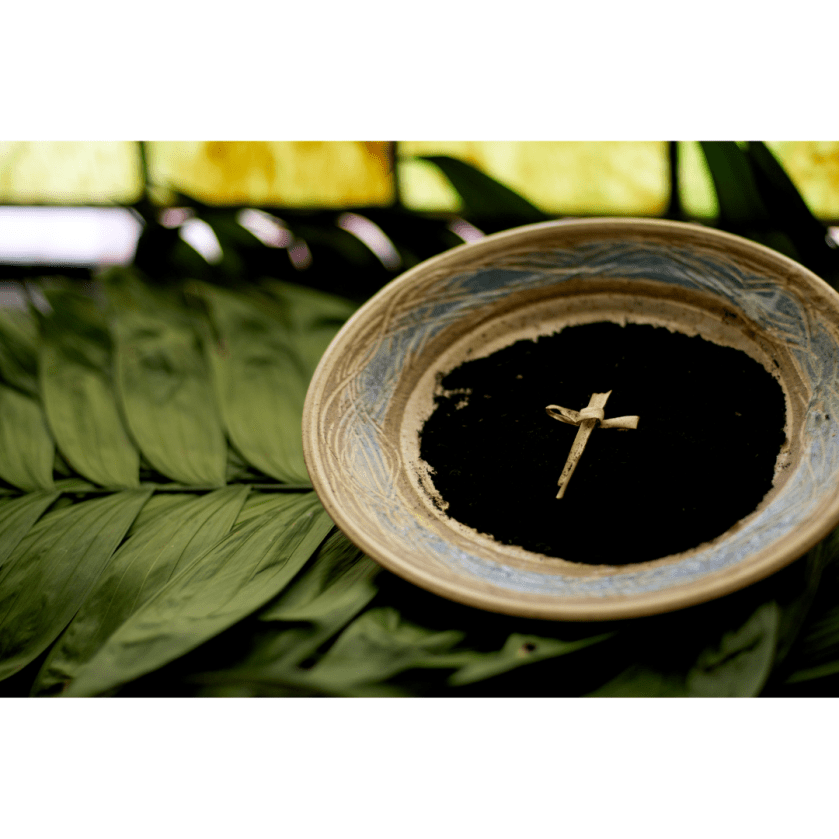
Posted in Ash Wednesday, Dust

Ash Wednesday

Matthew 6:1-6, 16-21

“Beware of practicing your piety before others in order to be seen by them; for then you have no reward from your Father in heaven.  “So whenever you give alms, do not sound a trumpet before you, as the hypocrites do in the synagogues and in the streets, so that they may be praised by others. Truly I tell you, they have received their reward. But when you give alms, do not let your left hand know what your right hand is doing, so that your alms may be done in secret; and your Father who sees in secret will reward you.  “And whenever you pray, do not be like the hypocrites; for they love to stand and pray in the synagogues and at the street corners, so that they may be seen by others. Truly I tell you, they have received their reward. But whenever you pray, go into your room and shut the door and pray to your Father who is in secret; and your Father who sees in secret will reward you.

 “And whenever you fast, do not look dismal, like the hypocrites, for they disfigure their faces so as to show others that they are fasting. Truly I tell you, they have received their reward. But when you fast, put oil on your head and wash your face, so that your fasting may be seen not by others but by your Father who is in secret; and your Father who sees in secret will reward you.   “Do not store up for yourselves treasures on earth, where moth and rust consume and where thieves break in and steal; but store up for yourselves treasures in heaven, where neither moth nor rust consumes and where thieves do not break in and steal. For where your treasure is, there your heart will be also.

Ash Wednesday gives us the chance to question our priorities, our motivations, and our own sinfulness.  Dust to dust.

Here’s an old, cute story: 
A little boy came home from Sunday school and went into his room to change his clothes. When he emerged he asked his mother, “Is it true we come from dust?”     
“Yes, sweetie,” replied his mother, a knowledgeable and deeply religious woman. “That’s absolutely right.”
“Is it true that when we die we go back to the dust?”  
“Yes, dear, that’s right. Why all these questions?” 
The little boy ran into his room and came out all excited. 
“Mom, I just looked under my bed and there’s someone either coming or going!”

It doesn’t have to be scary.  There’s beauty in that the great God of the universe breathed us into life and then because he defeated sin and death, they no longer bind us, even if when we return to dust.  We know that we’re going to return to dust sooner or later.  It’s how we live our lives that matters.

You see Lent is a time in which we’re seeing our own mortality clearly in our failings, in our sins, but that only points us still more to the One who never fails us and scatters our sins from the east to the west.  Ann Voskamp says this about giving things up for Lent, “I can’t seem to follow through in giving things up for Lent. Which makes me want to just give up Lent.  Which makes me question Who I am following.  Which may precisely be the point of Lent.”  We can’t do it on our own strength, but Christ who strengthens us.  It’s not based on our goodness or effort or natural gifts and graces, it’s through nothing but the blood of Jesus.  He alone is worthy.  Not us in both our human frailty or one-upmanship.  That’s exactly what the passage in Matthew is warning against.

I’m not saying you shouldn’t try to give up something like chocolate, caffeine, social media, complaining or using what I call my football words or add in spiritual practices like a daily quiet time or writing things that you are thankful for or fasting a day a week strengthening your walk with Jesus.  Those are all great additions.  Giving things up is meant to symbolize when Jesus was tempted in the wilderness for 40 days.  Adding things into your daily life that are spiritual disciplines allows us to grow closer with Jesus as a time of preparation before Easter.  Doing a short devotional first thing in the morning so that you can meditate on the Word you heard from the Lord throughout your day is an amazing thing.  It’s not going to hit you perfectly every time, but it’s amazing how God can work through words on a page or a song on the radio.  As with most things in life, what you put into it, is what you’ll get out of it.  It’s only a tool, a ritual, to draw us closer to Jesus when we’re deep in the wilderness of life. 

When your deep in the wilderness of life is exactly where Jesus meets us and says you don’t have to do anything, you don’t have to figure it out, you don’t have to bear the world’s burdens alone, come to me all you who are weary and heavy laden and I will give you rest. 

The artist and poet, Jan Richardson, writes in her poem “Blessing the Dust,”

All those days
you felt like dust,
like dirt,
as if all you had to do
was turn your face
toward the wind
and be scattered
to the four corners or swept away
by the smallest breath
as insubstantial—

did you not know
what the Holy One
can do with dust?

This is the day
we freely say
we are scorched.

This is the hour
we are marked
by what has made it
through the burning.

This is the moment
we ask for the blessing
that lives within
the ancient ashes,
that makes its home
inside the soil of
this sacred earth.

So let us be marked
not for sorrow.
And let us be marked
not for shame.
Let us be marked
not for false humility
or for thinking
we are less
than we are

but for claiming
what God can do
within the dust,
within the dirt,
within the stuff
of which the world
is made
and the stars that blaze
in our bones
and the galaxies that spiral
inside the smudge
we bear.

I can’t help but think of the Ukrainians who are suffering as they round out another year of war. I can’t help but think of the one’s in this community who are suffering.  I can’t help but think of the people and ministries we will minister to on Saturday in our Volunteer Extravaganza during our Missions Possible Weekend and the communities they support, advocate for, and walk alongside.

Hear this Good News!  God can work wonders from dust.  God knit you in your mother’s womb.  As Hawk Nelson’s “Diamond” says, “God’s making diamonds out of dust.  God’s refining and in God’s timing, God’s making diamonds out of us.” Psalm 8:3-4 says, “When I look up at your skies, at what your fingers made — the moon and the stars that you set firmly in place — what are human beings that you think about them . . . that you pay attention to them?”  The Great God of the Universe calls each one of us by name and walks with us through the valleys and the mountaintops, sometimes cradling us in God’s mighty arms, sometimes nudging us forward to answer his call, but always our Emmanuel, God with us, is present with us on the bathroom floors, when bombs are going off around us, in the hospital rooms, everywhere, at all time.  May we practice a Holy Lent, trusting in God’s mercy and Jesus’ grace and forgiveness, as we prepare for Christ’s resurrection over these next 40 days.  To dust you come and to dust you will return.  Repent and believe in the Gospel. 

Posted in Barth, Beatitudes, Bonheoffer, calling, Disciple, Discipleship, Grace, Jesus, Prevenient Grace, Uncategorized

Discipleship Takes Obedience

Last week, I invited you to “own” your discipleship. To go out in the deeper water and actually follow Jesus. This week we arrive at the very next step, which is the daily decision to keep following Jesus. This is the place where most of us stall out as disciples — somewhere between that first “yes” to Jesus, and the next dozen or hundred “yesses.” After all, at some point down the road Jesus will say, or do, or ask something that makes us slow down in our tracks. Or, we will have something else along the roadside grab our attention. Have you ever seen the movie UP with that dog being so distracted by that squirrel?  I was having dinner with two of my cousins this past week and we were people watching.  Our grandmother used to love to people watch at the State Fair, so it’s in our genes.  Ha!  We observed a couple who were sitting in front of the sunset on their phones.  It was not just a quick glance, it was a whole 5-7 minutes.  Maybe they were texting each other.  They may be texting one another.  I don’t want to judge.  But these smart phones are easy to get distracted by.  Sometimes we will just long to head back to Galilee and that ship full of fish. That would definitely be easier. It’s the struggle to keep following, to keep in step with the Lord. And the word that sums that it all up is obedience. Being in the making as a disciple takes obedience.

It’s hard to wrap our heads around obedience to God, because in human relationships healthy obedience is so rare. How can we obey someone else if even the best make mistakes? And, at worst, human “obedience” can be totally corrupt, based in fear, coercion, control or manipulation. Think about child soldiers in Africa or abusive households. Think about the big ways in history that the people of faith have gone wrong: the Pharisees, the crusades, the inquisition, legalistic fundamentalism, the Jonestown massacre. Because of our fallen human condition, “obedience” can go horribly wrong. If we focus on the “rules” TOO MUCH, we miss the freedom Christ wants to give us. If we focus on getting everything “right,” we miss the beauty of grace. Not a cheap grace, as I said last week, but a costly grace. The grace that comes from a Savior that suffers alongside of us, Emmanuel, and was obedient unto death for you and me.

Philippians 2:5-8 says, “Let the same mind be in you that was in Christ Jesus, who, though he was in the form of God, did not regard equality with God as something to be exploited, but emptied himself, taking the form of a slave, being born in human likeness. And being found in human form, he humbled himself and became obedient to the point of death, even death on a cross.”

Some of you may be thinking of course he was obedient. He was and is Jesus. The perfect one. Need I remind you of his 40 days in the wilderness, of temptation after temptation, or him praying in the Garden of Gethsemane “Take this cup from me.” It’s not easy to be obedient. Not even for Jesus, who was at the same time God and man.

If we own our discipleship and we’re growing more and more like Christ, it’s still going to be hard at times to be obedient, to walk in the way that leads to life. We have a hard time with obedience, because most of our culture rejects it. We want to take the easy way out, get out of things, or be ambivalent. My peers, the millennials and younger, look at all that broken human history and we mistrust human institutions and traditions, especially the Church. We say, “Don’t drink the Kool-Aid. Question everything. Preserve your freedom!” And, culturally, we’ve concluded that there is ultimately only one person who is trustworthy to obey — ourselves. Let that sink in a little bit. Some say the only person you can truly depend on is your self. But the problem with that is my “self” is just as human as everyone else. I operate under the same fallen human condition. If I think obeying only myself is going to solve anything: *newsflash* how has that gone for me so far? I find, sometimes, that myself is an idiot. “I” am just as corrupt and self-centered and off-base as any institution. The Christian faith tells us that our only hope is to be guided by something that exists outside of this broken, fallen system. Something, or rather Someone, who loves us, who understands all the perfection and glory that God meant for us before the fall. Where are we going to find Someone like that? As a matter of fact, he came to find us, and his name is Jesus. It’s totally counter-intuitive, but what it means is that the only way for any of us to be truly free, or to be our truest selves, is to give ourselves over to him. We’ve got to lose our lives to save them. Jesus calls us to live counter-culturally. Obey God alone. Follow Jesus’ instructions. Go where the Spirit leads you. Trust.
I think we get a great glimpse of it in Matthew 10:5-15 today. It’s a great picture, literally, of what comes next right after the disciples have first said “Yes” to begin following Jesus. And it says a lot for proper obedience.
Matthew 10:5-15
These twelve Jesus sent out with the following instructions: ‘Go nowhere among the Gentiles, and enter no town of the Samaritans, but go rather to the lost sheep of the house of Israel. As you go, proclaim the good news, “The kingdom of heaven has come near.” Cure the sick, raise the dead, cleanse the lepers, cast out demons. You received without payment; give without payment. Take no gold, or silver, or copper in your belts, no bag for your journey, or two tunics, or sandals, or a staff; for labourers deserve their food. Whatever town or village you enter, find out who in it is worthy, and stay there until you leave.As you enter the house, greet it. If the house is worthy, let your peace come upon it; but if it is not worthy, let your peace return to you.If anyone will not welcome you or listen to your words, shake off the dust from your feet as you leave that house or town. Truly I tell you, it will be more tolerable for the land of Sodom and Gomorrah on the day of judgement than for that town.
All of a sudden for basically the first time in Matthew’s Gospel, the disciples are going to leave the training wheels behind and ride the bikes. Jesus takes them aside for special instructions, and they’re being sent out. Can you put yourselves in the disciples’ shoes? It’s been a sweet deal. They’ve been little tag-alongs, watching Jesus do the fireworks, and being in awe like everybody else. Not only that, but they’re probably starting to be noticed, right? Like, fame by association since they’re his inner circle, like the tv show Entourage. If Jesus is the lead singer of this boy-band that everybody swoons over, sooner or later someone will start to notice the rest of us, his disciples. There’s the bad boy – Judas; the one with the good hair – Philip; the cute one – Bartholomew; the other cute one – Simon the Zealot, and so on. No risk, no effort, no tough decisions, all reward. Until Jesus says, now I’m sending you out, and by the way, I’m not coming with you. And, by the way, you’re still going to be responsible for carrying on my mission in just as powerful a way as you’ve seen me do it. As Scooby Doo would say, *Ruh roh*.
I, personally, may be a little freaked out with this change. Jesus is giving specific instruction about how to go about this mission, but he says he wants us to do these things AND not take practically ANYTHING with us!?!?!?! I admit, I’m a bit of a control freak. You may not fully realize this about me, but I like things a certain way. Some may call it OCD, some may call it organized, whatever. I’ve had to learn the hard lesson of not being so self-reliant and independent that it begins to becomes an idol or a mantra. “I can do it myself.” Just like a kid learning to do something for the first time shouting, “By Myself!!” Thomas Merton writes, “All the good that you do will come not from you but from the fact that you have allowed yourself, in the obedience of faith, to be used for God’s love. Think of this more and gradually you will be free from the need to prove yourself, and you can be more open to the power that will work through you without your knowing it.” We need to let go of the need to prove ourselves. We are enough. We are called to be Disciples of the Most High King. We all need not our own ways, but God’s provision for each of us. That God will pick us up and dust us off when we fall from the bike with no training wheels. We may scratch and scrape our knees, but our God works things for good for those who love God, and what is seen is only temporary, but what is unseen is eternal. We have to trust that if we risk ourselves and are obedient, he will give us the power and authority to move mountains.
One of the biggest ways we turn away from obedience is we doubt ourselves. We doubt our abilities. We aren’t comfortable with God’s call. And we, ultimately, secretly say to ourselves: he’ll just get someone else to cover this. Surely it can’t depend on me? There are 12 other disciples, there are millions of other Christians, there are so many better Christians than me. I’d rather just be the one “with the good hair.” But Jesus challenges that here. Jesus wants them to not only hear the Good News but take it to the world. Jesus not only wants them to see miracles, but perform them. Jesus wants them to seek out the lost, the last and the low, not the easy crowds that have gathered to hear a celebrity preacher or a magician. Jesus wants them to seek out the Zacchaeus in the group, the bent over woman, the Samaritan. Karl Barth writes, “The human righteousness required by God and established in obedience — the righteousness which according to Amos 5:24 should pour down as a mighty stream — has necessarily the character of a vindication of right in favor of the threatened innocent, the oppressed poor, widows, orphans, and aliens. For this reason, in the relations and events in the life of his people, God always takes his stand unconditionally and passionately on this side and on this side alone: against the lofty and on behalf of the lowly; against those who already enjoy right and privilege and on behalf of those who are denied and deprived of it.”
What crowd do you think Jesus would hang out with today? Republicans? Democrats? Independents? Green Party? Everything in between? Police officers? Protesters? National Guard? First Responders? Anarchists? Red? Yellow? Black? White? Brown Hair? Purple Hair? Don’t Care. God gives his prevenient grace to all people. God woos us to God’s self before we’re even aware of it. We are ALL created in the image of God. Who would Jesus want to reach? All of us sinners and saints. You. Me. The person on the other side of the political divide, cultural divide, any kind of divide.
I’ll close with these words from Dietrich Bonhoeffer, “Humanly speaking, it is possible to understand the Sermon on the Mount in a thousand different ways. But Jesus knows only one possibility: simple surrender and obedience — not interpreting or applying it, but doing and obeying it. That is the only way to hear his words. He does not mean for us to discuss it as an ideal. He really means for us to get on with it.”
Matthew 5:3-11,
3 “Blessed are the poor in spirit, for theirs is the kingdom of heaven.
4 “Blessed are those who mourn, for they will be comforted.
5 “Blessed are the meek, for they will inherit the earth.
6 “Blessed are those who hunger and thirst for righteousness, for they will be filled.
7 “Blessed are the merciful, for they will receive mercy.
8 “Blessed are the pure in heart, for they will see God.
9 “Blessed are the peacemakers, for they will be called children of God.
10 “Blessed are those who are persecuted for righteousness’ sake, for theirs is the kingdom of heaven.
11 “Blessed are you when people revile you and persecute you and utter all kinds of evil against you falsely on my account. 12 Rejoice and be glad, for your reward is great in heaven, for in the same way they persecuted the prophets who were before you.