Posted in affirmation, call to action, calling, Campus Ministry, clergy, Discernment, Ministry, United Methodist Church, Young Adults, Young Clergy

Affirmation and Calling

It’s been an interesting process the past couple of days as our search committee at Winthrop Wesley interviews candidates for the Director/Campus Minister job. I have been thankful to not be directly a part of the process and able to spend time at the end of each candidate’s interview times being able to answer questions and affirm them.

What I’ve found from a lot of them as well as from some of my current and former students is that our church is not always in the practice of affirming our young, capable and qualified leaders if their calling is something other than that of the local church.

As a member of a District Committee on Ministry and as someone who was loved and affirmed in my calling and in this process, I’ve seen some of this from both sides. I felt some of this as someone going through trying to articulate something that didn’t necessarily include a steeple or a pulpit. But, call me crazy, I thought that with all of the research talking about young people going into ministry and with it being over 10 years since I went through our process that things had gotten better. That committees and boards were more open to young people seeing church in sometimes different ways and wanting to live out their calling in ways that doesn’t always fit the life-long career path of previous generations.

I have people tell me all the time that they feel called to campus ministry and want to work with young people but that their committees on ministry or their senior pastor or those giving them counsel on how to get larger appointments with higher paying salaries warn against this because of their career or how they’ll be perceived or pigeon holed asking questions like, “Why would you waste your gifts there?” Yes, I have really heard this.

It feels like we just want to lift up people that look like and talk like us…40 years ago and we want them to follow our exact life map. We’re talking about the Call to Action and vital congregations and I’m all about us having that conversation, but changing our general agencies in no way completely solves the problem of our relevance or our connection with the world. If we ask the same questions that we asked 40 years ago and we expect the same answers, leaving no room for change or growth or a flip the script moment, we’re setting ourselves up for great failure. Not as a Church, not as a body of Christ, not as a movement but as a system – a structure that exists to continue its existence.

In contrast to all of this our amazing intern Erica just got back from her interview process with the General Board of Global Ministries for the Mission Intern program, which would train her to be a missionary 16 months internationally and 16 months domestically. She had an awesome experience. She felt affirmed. She felt heard. She felt like it was actually intentional and discerning and open…and she is bubbling from the experience! Hers is not the most traditional road to ministry, but it is such a rich and wondrous thing to witness. It’s exciting. It gives me hope for our church. Hearing about her wanting to share the Good News of Christ makes me excited that the United Methodist Church sends out missionaries all over the world – with all of their quirks, oddities, diversity, and high caliber!

I want to be able to encourage young people into ministry – whether ordained or in great UMVIM or GBHEM or World Race or whatever opportunities. I want to know that yes, they are questioned and people help them discern and give them counsel, but I also want them to be affirmed that God has called them to serve God’s kingdom – not in a particular venue or in specific cookie cutter ways. Not hating on the cookie cutters because I love them and I am related to them, but we’ve got to lift up our young people and listen to them and hear their hopes, dreams, and passion. We’ve got to see and believe, not just say that all of these ministries are not just valid but just as “important” as the other. And this can’t just happen in our campus ministries. Our students can’t just be affirmed here, in the safety of our communities. The larger church has to be willing to affirm this calling as well and there has to be room made at the table.

I’m sitting here listening to Erica tell two of our students about her experience and what she could possibly do and it’s so contagious that we all need to hear it. We all need to hear this joy and passion. We all need to have a chance to sit down with a group of young people and listen to how they see the world and how they view the church.

So a huge thank you to all of those who have affirmed some of us crazy folks that love the local church – absolutely love it – but are called to serve in a variety of ways. A huge thank you to those that see quality, solid people and don’t say things like – you don’t want to serve there, you want to be able to move up our system, why would you waste your gifts with such a transient and changing group. A huge thank you to those that support these crazy ministries that we do and who believe in the work that we are doing. A huge thank you to our advocates who have stepped into the gaps, who have tried to translate for us, and who have journeyed with us.

May each of us experience times of affirmation and calling, as well as time of challenging and questioning. AND may we as a church realize that some of our larger struggles are not just structural, but so much more. Help us Lord to not just break glass ceilings in our particular ministries but may the greater church realize the gifts, graces, and beautiful ministry that is happening throughout our connection as we seek the already and not yet of your kingdom.

Posted in Books, Campus Ministry, Faith, Sermons, Young Adults

Do we care enough to pray?

One of our small groups is reading Shane Claiborne’s Irresistible Revolution right now and it has brought about a lot of interesting discussion.  I often feel like I’m defending young adults to the church and the church to young adults.  As someone who was nourished and formed in the United Methodist Church who has seen the good, the bad, the ugly and the awesome as a preacher’s kid, and as someone who has felt called to lead and be apart of this church, there’s part of me that wants to defend it until I’m blue in the face.  At our recent small group talking about the book, it was me and another student who is a PK who were defending the established church in the face of students that don’t necessarily align themselves with a particular denomination or group, but are serious about their spirituality.  And before some of you reading think, that it’s just young people that feel that way, it’s not.  Yesterday we had someone stop by Wesley giving us a donation to help with painting and repairing some of our windows around the building.  Is this guy a United Methodist?  Nope.  Had I ever met him before?  Nope.  Was he young guy?  Nope.  He simply said he didn’t really believe in all the denominations but that he was a Christian and he wanted to help us out by doing the repairs and help the guy doing the work out, by giving him some work in this hard economy.  There’s something about some of our denominational structures that people find intimidating or they’re just mistrusting.  Who can blame them?

In a world where not just young people, but many relate sincerely to the statement, “I’m spiritual, not religious,” what role do we play as the church?  There’s something about living out our faith and actions that speak louder than words that my students and many of us find refreshing in books like Shane Claiborne’s.  Even the biggest of mega churches are starting to realize, you have to have that service and outreach component for people to buy in to what you’re offering.  I’m not at all saying that our older generations aren’t socially conscious and don’t where their faith on their sleeves.  Quite the contrary.  I see the amazing folks of Bethel UMC rocking the soup kitchen week after week.  I see many of our “great generation” as Tom Brokaw calls it, being the ones that give to our churches, to our missions, and to our campus ministries with their time and money.  These folks are our bedrock.  They are our foundation.  We have relied upon them in our attendance, giving, and mission reports for years and years.  I honestly have no idea what our church is going to look like a decade from now.

For years I’ve heard people rally around sayings like, “Our young people aren’t the future of the church but are the church today.”  I also have heard very clearly that in the next ten or twenty years our church is going to change radically.  At a recent District Superintendent gathering of the SEJ, Lovett Weems talked about a “tsunami of death” expected to happen by 2018. A new body is going to have to step up.  Even more than that, a collective body needs to be formed and shaped and nourished as we go into this new territory together.  And it needs to be something new…and thank God we believe in One that makes all things new.  What worked in the 50’s and 60’s in our hayday is not going to work now.

I think most people would agree that we want our churches to have young people.  I can’t imagine anyone actually admitting out loud in front of people that they really don’t want to give up their space or their community or that they want to keep it solely theirs and nobody else’s.  Most people would also probably agree that we don’t really want to see our average age of clergy or congregant creep any higher. We want these young people to join our churches, but how often do we really try to plug them in to the life and leadership of the church?    We think that a college Sunday school class is the answer to everything, like somehow these young adults are going to smell this addition out in the atmosphere or its like batman’s bat light is going to shine forth from that particular church and young adults will automatically flock to it. 

I hear pastors say that campus ministry is a great place for college students and young adults but it’s hard to get them invested back in our local churches.  You’re right about that.  It is hard for young adults that have been fed, nourished, and empowered in campus ministries to go back to local churches where they don’t always feel heard or like they matter except in the “we really want you here because you’re young, but we don’t want to give you any kind of say-so over anything.”  It’s not that you should be pandering to young adults or any one else in this consumerist crowd, but if some of the keys of the kingdom aren’t gently handed over it’s going to be hard to pry them out of the cold dead hands of our churches a decade from now.

So what does this mean for us?  Where can we go from here?  How do we bridge this divide?

A wise beyond words former student of mine posted this on facebook in reaction to some of the assumptions in the Call to Action report.    This quote comes from the top of the page talking about vital congregations (http://www.umc.org/atf/cf/%7Bdb6a45e4-c446-4248-82c8-e131b6424741%7D/PROPOSEDVITALCONGREGATIONSPLANNINGGUIDE-2-14-11%20(2)%20(2).PDF) “The United Methodist Church is called to be a world leader in developing existing churches and starting new vital congregations so that we make disciples of Jesus Christ for the transformation of the world.” Then he writes, “But what if we’re not?  How do we know? How do we know we’re not called to repent of our sin of desiring worldly influence that has resulted in our church functioning to bolster war, imperialism, eugenics, and the like over the past two centuries? How do we know we aren’t called to use all our buildings to feed the hungry and house the homeless? How do we know we’re not meant to shrink and become even more marginal before our comfortable church learns what being the body of Christ is about? I’m unimpressed with the presumed triumphalism.”  I want to give a huge amen and shout a loud PREACH BROTHER!

Yes, things are changing.  And like I said before, I have no idea what the church is going to look like in the next 10 – 15 years, but instead of being sad and angry and depressed and bitter and cynical as is so easily slipped into, why don’t we intentionally pray, discern and vision, call on the Spirit to lead, get totally excited about the possibilities of what can happen if we let the old paradigms fall away and we revision anew.  A “revision” of a paper, isn’t writing the whole thing over again, even though some paragraphs and parts, some sentences and words, sometimes even some of the critical parts are tweaked, corrected, and changed.  We don’t have to throw the whole thing out, but we do have to imagine again what this church is called to do and to be in this world and what that means for us.

This is representative of where we are in campus ministry right now, trying to offer the Good News in the midst of people being pulled in different directions, trying to articulate that “church” isn’t just always those brick and mortar buildings with the steeple but that it can be community and justice and discipleship and nourishment too.  As we stand on the precipice of something that’s going to change and happen whether we like it or not, we need to all be intentional in our prayer, in the Gospel that we share, in the asking of the Spirit to lead and guide us in ways that we can’t even imagine. These aren’t times to be afraid or hold even tighter to our fear and control, but this is an exciting time in the life of our larger faith community.  How are we going to set the tone?  How are we going to shape the conversation through the power of the Spirit?  How are we going to step out in faith?  What do we keep and what needs pruning? 

I don’t know about y’all, but I haven’t decided what I’m adding or giving up to help me draw closer to God during this Lenten season yet.  I still have til tomorrow night so I’m fine.  I’ve heard of pastors intentionally praying for everyone in their congregation – love that idea or adding times of fasting and prayer.  I think though one of the things that I would like to do and I would like my students to do, is to pray for our church.  And not just little c church, but also big c Church.  Instead of watching all of this unfold and getting swept to and fro in the midst, why don’t we actually ask the Spirit to steer the ship and blow and move?  Why don’t we ask for guidance and discernment and illuminating instruction to be given to our church leaders, those lovely people we call the bureaucrats of the church, and not just them but to all of us – lay and clergy alike?  Would you care enough about the present/future of our church to intentionally pray for 40 days?  Do you think it’s inevitable doom and gloom or is there hope in the midst?  I choose hope.  And I choose to pray.  And I choose to believe that God will shock our socks off with all that’s in store.  We’re right on the edge of a powerful movement.  The signs are there.  It could happen.  We can choose to see this as a wonderful opportunity or as the last death nail….let’s choose life.

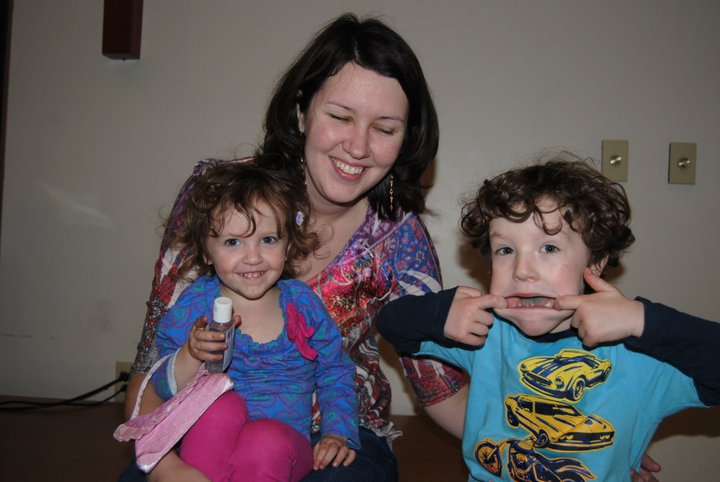
Evy and Enoch at a recent youth event...what will the Church look like when they're young adults?