Brilliant! They won’t be expecting that!

 Prince of Peace

Isaiah 9:2-7

New Revised Standard Version (NRSV)

The people who walked in darkness
have seen a great light;
those who lived in a land of deep darkness—
on them light has shined.
You have multiplied the nation,
you have increased its joy;
they rejoice before you
as with joy at the harvest,
as people exult when dividing plunder.
For the yoke of their burden,
and the bar across their shoulders,
the rod of their oppressor,
you have broken as on the day of Midian.
For all the boots of the tramping warriors
and all the garments rolled in blood
shall be burned as fuel for the fire.
For a child has been born for us,
a son given to us;
authority rests upon his shoulders;
and he is named
Wonderful Counselor, Mighty God,
Everlasting Father, Prince of Peace.
His authority shall grow continually,
and there shall be endless peace
for the throne of David and his kingdom.
He will establish and uphold it
with justice and with righteousness
from this time onward and forevermore.
The zeal of the Lord of hosts will do this.

These are familiar words that we often hear at a Christmas Eve service.  These are some of my favorite words of the Advent season.  You see, because we all have walked in deep darkness, the color of ink, and we have felt the light of Christ pierce that darkness.  Our darkness.  The world’s darkness.

It doesn’t feel like Christmas to me.  Christmas is supposed to be cold.  Evy, my 5 year old, is really expecting it to snow on Christmas Eve.  I don’t know where she’s gotten that information, whether from a book or a song or a movie, but she’s convinced of this.  Guess where we’re spending Christmas?  In lovely Gainesville, Florida.  The likelihood that she’ll see snow on Christmas Eve is slim to none.  Mike didn’t feel like it was Christmas yet with the 80 degree whether that we’ve been having so he started playing Christmas music in the house, much like the radio stations that try to cram Christmas music down our throats until we’re being sufficiently festive.  But I have to admit, in my Grinch-like heart, to feeling slightly in the Christmas spirit, on Friday and Saturday as we finally had a chance to decorate and as Amy Grant’s Christmas albums played on the itunes.

You see, Advent is that time of preparation.  Of preparing our hearts, whatever way that gets us to turn the world off for a second, whatever hook we need to expect the unexpected.  This is a preparation that’s not just about the everyday hustle and bustle but also about getting ready for something completely out of this world—something revolutionary, new, an in-breaking of the kingdom of God.  We get ready for the coming of God in the form of a baby—a God who dwells among us and with us.  But we also get ready for the second coming of our savior—a time when there is good news and great joy for ALL people.  This is good news not just for the pretty ones or smart ones or the ones lucky enough to be born on the right side of the tracks or in the wealthy country, but for all of God’s children.

I think of Mary and Joseph, the shepherds, the wisemen, the angels – a mix of folks.  I think of the words of the prophet—to look to the star and that there is One who is coming who is beyond our imagining.  This story is not just one of familiar and beautiful manger scenes and it’s certainly not just a good children’s story.  These were trying times and people were being taxed and children lost lives as Herod began his search for the Christ child.

How many of you have seen Catching Fire?  This is the second movie in The Hunger Games trilogy.  I’ve still not seen it yet.  Suzanne Collins does an amazing job bringing this post-apocalyptic world to life.  She got the idea from flipping through channels on her television and seeing on one channel a reality tv competition and on the next channel footage of the Iraq war.  Her stories are not for the faint of heart.  They are violent and graphic and terrifying.  It’s people being forced to send their children off to fight to the death.  Mike and I looked forward to the first movie, but we both felt uneasy after watching that being portrayed on screen.  And you’re supposed to be uneasy with it.

But that’s not much different from the context Jesus arrived in.  Here these people were under Roman control, not knowing what was going to be demanded of them next—their money, their children, their lives.  The thing about the books—there’s no savior at the end.  For some of us, we relate to some of these horrors.  There are hard things that we see every day whether it be children going without food or the loss of a friend or loved one or the loss of one’s job or home.  For some this isn’t just a hustling and bustling time of year, but it’s a painful time.  That’s there.  That’s part of the story.  Pain and hurt and fear are there.  For so many their Christmas traditions have a missing void as new traditions are made and a new normal is established.

We take comfort in that we are told very clearly, “Fear not, for behold, I bring you good news of great joy that shall be for all people.  For unto you is born this day a savior who is Christ the Lord and has name shall be called Wonderful Counselor, Prince of Peace…”  This Prince of Peace can give us that peace that transcends all understanding whether it be as we are awaiting that class exam that is for our particularly hard class, grades or exam results, health questions, job changes, life decisions or larger questions like what are we going to be when we grow up and what’s my purpose and what is the meaning of life.

This kind of peace can transform the world.  Nelson Mandela, who died on Thursday, said “And as we let our own light shine, we unconsciously give other people permission to do the same.”  We give others the courage to do the same.  Mandela lived his life in a way that inspired others to let their light shine.  Not just people in this place, in this community, or in this land—but all the world.  My hope over this Christmas break is that in the midst of everything as students are catching up on sleep and connecting with family and friends and as all of us frantically try to make it through, that we can find time to stop and breathe and take in what it means to be a people who believe in this Emmanuel, a people who believe and live out this peace.

Alex Miller sent me this video this past week.

“I feel so far away from my kids down there.”

God almighty, God the creator of the universe, God that was, and is, and is to come – came to earth as a tiny baby.  The most vulnerable thing on Earth.

I LOVE it when the kid says, “Brilliant!  They won’t be expecting that!”

I also love the little girl’s question to God, “Lord, how will people know he’s there, what if they don’t notice?”  God answers, “Those who are looking will find him and his mission will bring all people closer to me, even if they do something really wrong.  When the Prince (of Peace) is done, nothing will get between them and my love.”

Love came down on Christmas.  Amen and amen.

“Peace On Earth” – Casting Crowns

Extended Version of the Christmas Story

 

Posted in Advent, Bear Grylls, Black Friday, Campus Ministry, Duck Dynasty, Jesus, John the Baptist, Modern Family, Pope Francis, Sermons

Christ the WAY

img_jesus_is_the_way

Isaiah 11:1-10

11A shoot shall come out from the stump of Jesse, and a branch shall grow out of his roots. 2The spirit of the LORD shall rest on him, the spirit of wisdom and understanding, the spirit of counsel and might, the spirit of knowledge and the fear of the LORD. 3His delight shall be in the fear of the LORD. He shall not judge by what his eyes see, or decide by what his ears hear; 4but with righteousness he shall judge the poor, and decide with equity for the meek of the earth; he shall strike the earth with the rod of his mouth, and with the breath of his lips he shall kill the wicked. 5Righteousness shall be the belt around his waist, and faithfulness the belt around his loins. 6The wolf shall live with the lamb, the leopard shall lie down with the kid, the calf and the lion and the fatling together, and a little child shall lead them. 7The cow and the bear shall graze, their young shall lie down together; and the lion shall eat straw like the ox. 8The nursing child shall play over the hole of the asp, and the weaned child shall put its hand on the adder’s den. 9They will not hurt or destroy on all my holy mountain; for the earth will be full of the knowledge of the LORD as the waters cover the sea.

10On that day the root of Jesse shall stand as a signal to the peoples; the nations shall inquire of him, and his dwelling shall be glorious.

Matthew 3:1-6

3In those days John the Baptist appeared in the wilderness of Judea, proclaiming, 2“Repent, for the kingdom of heaven has come near.”3This is the one of whom the prophet Isaiah spoke when he said, “The voice of one crying out in the wilderness: ‘Prepare the way of the Lord, make his paths straight.’” 4Now John wore clothing of camel’s hair with a leather belt around his waist, and his food was locusts and wild honey. 5Then the people of Jerusalem and all Judea were going out to him, and all the region along the Jordan, 6and they were baptized by him in the river Jordan, confessing their sins.

In verse 4 of Matthew chapter 3 it says, “Now John wore clothing of camel’s hair with a leather belt around his waist, and his food was locusts and wild honey.” Call me crazy. I discovered this purely by accident. But when John the Baptist is described I happen to envision my brother Josh. As I sat thinking about how I would describe John the Baptist, Josh immediately came to mind, for whatever reason. Perhaps that’s to do with my spending Thanksgiving in South Carolina with my family. Perhaps you think everyone from South Carolina is straight off of Duck Dynasty. My uncle Ralph recently said at a football tailgate that he HATES the show. He quickly followed that up with the comment, “Because I live it!” His words, not mine. Josh went to Clemson (y’all would expect me to talk about the game last night – but I won’t) where he fell in love with waterfalls and lakes and hiking in the mountains. Josh is what I would describe as rugged? Scraggly – with his cut off khakis and flip flops? Fearless? Let’s just say Josh thrives on adventure. His love of Bear Grylls was on full display at our Fall Retreat where he talked about survival. I didn’t know that Bear was a man of faith until the retreat, but I could have assumed by the way he lives that he was a man after God’s own heart.

Before I show this clip, it’s not for the faint of heart or people with weak stomachs, so be forewarned….

Now, I realize those weren’t locusts. These bugs were juicier and oozier, if that’s even a word, and locusts would be crunchier. But what that entire description of John the Baptist tells me is that he was not afraid to march to the beat of his own drummer. He was not afraid to be different. He was not afraid to be prophetic – no matter the cost, no matter the friends he lost, no matter what.

The beginning of the Gospel of Mark begins with a quote from Isaiah about John the Baptist.

Mark 1:1-4
1 The beginning of the good news of Jesus Christ, the Son of God. 2 As it is written in the prophet Isaiah, “See, I am sending my messenger ahead of you,

who will prepare your way; 3 the voice of one crying out in the wilderness:
‘Prepare the way of the Lord, make his paths straight,’” 4 John the baptizer appeared in the wilderness, proclaiming a baptism of repentance for the forgiveness of sins.

Mark and Matthew both explicitly name John the Baptist as the one the prophet Isaiah talked about.

Fast forward through Jesus’ baptism by John the Baptist, through the temptation of Jesus, and the start of Jesus’ public ministry to John the Baptist’s imprisonment. In Matthew chapter 11, verses 2-6, “2When John heard in prison what the Messiah was doing, he sent word by his disciples 3and said to him, ‘Are you the one who is to come, or are we to wait for another?’ 4Jesus answered them, ‘Go and tell John what you hear and see: 5the blind receive their sight, the lame walk, the lepers are cleansed, the deaf hear, the dead are raised, and the poor have good news brought to them. 6And blessed is anyone who takes no offense at me.’”
Jesus wanted to continue John the Baptist’s legacy, making it complete, in him. The prophets had foretold this. Jesus’ wanted to build on John’s teaching, baptizing not just by water but by the spirit also. Jesus wanted to continue the revolution that John had started. Jesus also stepped to the beat of a different drum so he understood. He asked John’s disciples to take back what they could hear and see. And if Jesus came back today, what would he hear and see?

HOLIDAY SPIRIT: SHOOTINGS, STABBINGS, BRAWLS

2 Arrested In Walmart Parking Lot Stabbing… Las Vegas Shopper Shot On Way Home… New Jersey Man Pepper Sprayed… PHOTO: Madness At Macy’s… Staff Holding Back Shoppers… $300 Purses In Shambles… 2 Hurt After Shoplifting Call… Kmart Workers Strong-Armed… 110 Arrested At Walmart Protests…

Not to mention the guy that told off the lady on the airline flight and who later slapped him.

There’s got to be a different WAY.

We lit this candle on the Advent wreath symbolizing Christ the Way.

Do we know the way? In John 14:6 says, “Jesus said to him, “I am the way, and the truth, and the life. No one comes to the Father except through me.” That’s pretty clear. I am the way. I am the truth. I am the life. Model my behavior. Be my light to the world.

Pope Francis on Tuesday released “Evangeli Guadium” or The Joy of the Gospel. It’s the first official document written entirely by Pope Francis. He writes, “I prefer a Church which is bruised, hurting and dirty because it has been out on the streets, rather than a Church which is unhealthy from being confined and from clinging to its own security.”

He writes, “More than by fear of going astray, my hope is that we will be moved by the fear of remaining shut up within structures which give us a false sense of security, within rules which make us harsh judges, within habits which make us feel safe, while at our door people are starving.”

He writes, “I beg the Lord to grant us more politicians who are genuinely disturbed by the state of society, the people, the lives of the poor.”

He writes, “Everyone can share in some way in the life of the Church; everyone can be part of the community, nor should the doors of the sacraments be closed for simply any reason. The Eucharist, although it is the fullness of sacramental life, is not a prize for the perfect but a powerful medicine and nourishment for the weak.”

Prophetic and powerful words that have much to teach us.

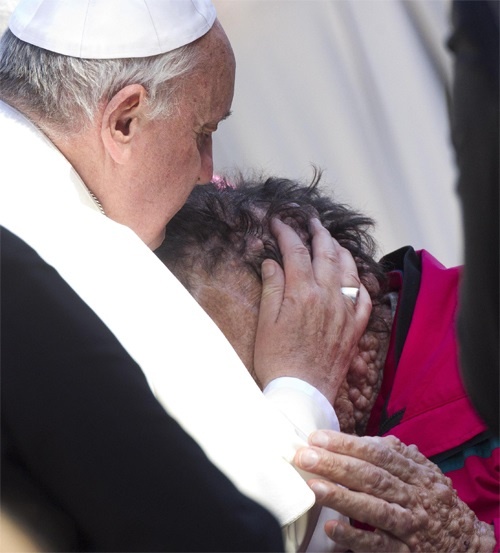
And, who can forget this picture?

pope francis

Pope Francis knows something of what the prophet Micah spoke of in Micah 6:8, “He has told you, O mortal, what is good; and what does the LORD require of you but to do justice, and to love kindness, and to walk humbly with your God?”

Is that epitomized in our society? Is that epitomized within the flight incident? Jesus would have called her out – sure. But he was not passive aggressive. He would have done it in love.

Rivalry Saturday brings out the absolute worst in human nature, especially on facebook posts. Don’t even get me started on local politics because there was a lack of respect/decorum/common courtesy at the City Commission meeting I recently attended. I was appalled that adults acted that way.

We may pile up all sorts of opinions and points in an argument or debate, but in the end, with Jesus, love is the last word of all – God’s love for US, for all the world, and all of creation. During this season talking about the last word has a lot of connotations for me. For some, we’re coming off a holiday week and family brings out the best and the worst in each of us. We may wonder if we’ll ever get the last word on anything. For others, we think of some of our friends or family or co-workers or maybe even ourselves as ones who thrive on having that last word and can’t imagine life without getting it. I think of the television show Modern Family and the hilarity that ensued during the holiday episode between the “Realists” and the “Dreamers.”

Start at 17:00 – Stop at 21:34

But as the episode pointed out, you need a little bit of both. We need each other – both realists and dreamers. We have to find a middle way. We have ones who are ready to concede the argument and ones that will fight to the bitter end trying to get the last word – but we all need to be somewhere in the middle. We shouldn’t bowl over just because we’re “Christians” and let people walk and talk all over us, but we also shouldn’t be the ones that are raising our voices so that we’re the loudest so that our point can be heard over all the masses not caring about the casualties that may surround us. AND we can speak up for the voiceless. It often doesn’t feel like we get a say in anything and we’re merely reacting to what happens, instead of setting the course. I learned this advice in defensive driving class that I always carry with me, “You can only control your car. You can’t control what another driver does, how he or she acts, or whether or not they tailgate you and speed around you. You can only control how YOU react to the situation.”

So walk the talk this Advent season. Walk it. Do justly, love mercy, and WALK humbly with your God. And that is the WAY of Christ Jesus our Lord. Are we ready to jump in and live out the WAY of Christ in our last two days of classes? Are we ready to rock our final exams? All the tests, essays, or final group projects? Or jumping ahead to the break – family plans or packing up the residence hall room or bills or how we’re going to pay for next semester or the future or health or the glorious graduation celebration for our December graduates that thought this day would never come. Are we ready to walk in the WAY of truth, the WAY of grace, and the WAY of love?

We will answer with a big, resounding YES.

Posted in Advent, Advent Conspiracy, Brown Thursday, Campus Ministry, Evangeline, Gator Football, Sermons

The First Sunday in Advent

isaiah61

Isaiah 60:2-3

New Revised Standard Version (NRSV)

For darkness shall cover the earth,
and thick darkness the peoples;
but the Lord will arise upon you,
and his glory will appear over you.
Nations shall come to your light,
and kings to the brightness of your dawn.

 Hebrews 11:1-3

New Revised Standard Version (NRSV)

11 Now faith is the assurance of things hoped for, the conviction of things not seen. Indeed, by faith our ancestors received approval. By faith we understand that the worlds were prepared by the word of God, so that what is seen was made from things that are not visible.

We’re sticking with our tradition of starting Advent early, but the way the calendar falls this year, we’re just starting a week early.  So this is the first Sunday of Advent or Hope, the second Sunday of Advent or Christ the Way or Love will be next Sunday, the third Sunday of Advent or Peace will be on December 8th, and the fourth Sunday of Advent or Joy will be celebrated on December 15th.  We will celebrate Christmas Eve on Reading Day which is December 4th.  Is that confusing for anyone else?  We’re committed to celebrating the full season of Advent as we prepare our hearts for the coming of our Savior.

When I noticed the Christian radio stations starting to play Christmas music, I was indignant because I thought it was still mid-October.  I stopped and thought a minute before realizing it was the week before Thanksgiving.  So for some of you sticklers out there that don’t listen to any Christmas music pre-Thanksgiving, you would agree with my indignation.  But considering that the Charlotte and Columbia Christian radio stations would play Christmas music starting on Halloween, I’ll take the week before Thanksgiving any day.  Thank goodness that our Halloween decorations were Harvest-themed because we still haven’t taken them down.  Who knows when we’ll decorate for Advent/Christmas?  And the kids have already started asking.  We’re decorating here at Wesley during our leadership meeting next Sunday.  Better late than never.  We’re only going to be halfway through Advent at that point.

It’s hard to get into the spirit of Advent because we’re skipping over holidays and in the life of students this is definitely crunch time.   If I start running down my list of thing to do, buy, and parties to attend I’ll want to stay in bed and pull the covers up over my head and let this Advent/Christmas pass on by.  Speaking of getting prepared – tell me you haven’t heard of Brown Tuesday.  It ISN’T a thing.

(start at 1:24 and stop at 2:31)

Brown Thursday?  Where you get a jump on shopping for Christmas presents?  Or HDTV’s for yourself?  Note:  Four years ago, Mike and I decided to get up early on Black Friday for the specific purpose of buying a TV.  So I’m not hating or judging or pointing fingers.  Well, maybe I am, but I’m guilty too!

But what if we did things a little differently this year?  Give a goat for just $120 to Heifer International, dig a well for just $35 through Church World Service, or give to UMCOR for the typhoon in the Philippines or the communities recently hit by tornadoes in the Midwest, knowing that the money you give is going 100% to the victims of these natural disasters because United Methodist Churches all over the world give money to pay UMCOR’s administrative costs.  What if we do Advent differently?

Advent is one of my favorite times in the church calendar.  But this year, as I’ve spent all morning describing, I’m completely not ready for it.  It’s much more than just getting ready for Christmas and knowing how many shopping days you have left.  We have to pace ourselves.  Advent is the season that past and future collide in the present.  A time of already (as in Christ did come and is here) and not yet (Christ will come again).  The word Advent comes from the Latin verb advenire, which means “to come toward, to draw near, to approach.”  This is the time when we remember God’s drawing near to us in Jesus Christ in the past, in the present, and in the age to come.  Just like the Alpha and the Omega – the kingdom of God is the already and not yet – here amongst us, but also something that we long to come to completion.

I guess it’s that sense of expectation and hope that draws me in.  It’s a time of preparation, different from Lent, when there’s a sense of anticipated joy and hope not just from the ashes but at the end of a long journey.  Maybe those are similar in your minds but to me there’s a difference.  Take the Gators.  I know, I know.  In many ways it feels like you’re living a life of Lent.  From dust you came and to dust you will return and to witness the game yesterday was demoralizing.  But then there’s that sense of hope that comes with being a true fan.  The hope that we’ll have a better season next year.  Or maybe we’ll end the season on a high note?  Advent teaches us to expect the unexpected and nothing would be more unexpected than if the Gators beat the Noles next Saturday.  A brief commercial for the Gator Seminole Showdown….one way that we can beat the Seminoles on Saturday is if we win the pledge per point contest so go to www.gatorwesley.com/showdown.

No one expected the savior of the whole world to be born as a baby.  No one could foresee the Great God of the Universe coming in the form of the most vulnerable thing on earth – a baby.

Although we may be more comfortable with a “baby Jesus” because he’s cute and we can find some semblance of controlling him.  We may be more comfortable with Christmas Jesus versus Easter Jesus.  But if you’ve ever had children you know from the time that they enter the world they’re on their own schedule and you can expect the unexpected.

And no one knows “expectant waiting” like a pregnant woman.  I will never forget the first Sunday of Advent in 2008.  My mom, dad, grandmother, Josh, Caleb, and my sister-in-law Karen, and of course Enoch and Mike, had all come to our town house to celebrate Thanksgiving.  Because I was about to pop with Evy.  My due date was a month away, but Enoch had come a month early, so Thanksgiving happened at our house that year.  It was baby watch.  Have you ever heard the phrase, “a watched cake never bakes” or “a watched pot never boils.”  My grandmother, Ganny (I couldn’t say my r’s when I was little, so because I was the first grandchild they became Ganny and Gandaddy) kept asking me throughout the weekend if I was feeling anything.  If I was feeling anything like contractions.  I repeatedly told her I was not and could she leave me alone!

I was preaching that Sunday at St. John’s in Fort Mill, the next town over, where Mike did the music for the non-traditional service.  That was the first Sunday of Advent.  I have never forgotten how it felt to do the first Sunday of Advent as a pregnant person – the anticipation, the waiting , the expectancy, the perceived urgency…I don’t remember what exactly I said that day.  Who knows.  I blame it on pregnancy brain.  But as soon as I was done preaching and Mike and the band started playing the closing song, I began to have contractions.  I didn’t tell Mike or my Mom right away.  I needed some confirmation first.  As we got into the car a song I had never heard before was playing.

The song was “Jesus Born on This Day” by Avalon that was originally done by Mariah Carey.  It had just come out in November 2008.  That was just the confirmation I needed.  So we dropped Mom and a sleeping Enoch off back at our house with instructions to let the rest of the family know because they had been worshipping at Josh’s church.  And we drove back in the other direction for Charlotte calling the doctor on the way.  I’ll spare you the details, but as soon as the Carolina Panthers game was over, Mike and the doctor turned around and within two pushes Evangeline Grace Jeter made her way into the world at 4:30 in the afternoon.  Evangeline means “Good News or the bearer of Good News” and Grace is self-explanatory, but what a name to start the Advent season right, and we planned the name, before realizing how appropriate it would be.

Good news.  Good news of great joy.  Grace.  God with us.

This is Advent.  Not just a time of talking about dreams or what if’s or one day’s, but getting ready right now.  Putting yourself out there, right now.  Going for it, right now.  It’s easy in the consumerism and the narcissism and the pessimism to let the weight of the world fall heavy on our shoulders.  It’s hard in student land to get in the spirit of Advent as you feel the full weight of the semester with assignments, tests, papers, group projects, etc., with most of you exhausted, sick and ready to have a break and I’m not just talking about Thanksgiving when you’ll be doing school work in the midst, I’m talking about a nice, long Winter’s break.  It’s hard in the lives of teachers and parents trying to get through these last few weeks before Santa, Santa, Santa.  It’s hard for those who have lost loved ones, who have lost jobs, who have no idea where money is going to come for electricity much less gifts.  It is hard.

But Advent is so much more than just our personal worlds.  It’s the in-breaking of the kingdom of God as God Almighty, the Great God of the Universe, became One of us.  It’s the waiting not only for this child (the already) but for the Triumphant King (the not yet).  It’s the waiting for justice and righteousness and all of the beautiful words in Isaiah 9:6-7 “For a child has been born for us, a son given to us; authority rests upon his shoulders; and he is named Wonderful Counselor, Mighty God, Everlasting Father, Prince of Peace.  His authority shall grow continually, and there shall be endless peace for the throne of David and his kingdom.  He will establish and uphold it with justice and with righteousness from this time onward and forevermore.  The zeal of the Lord of hosts will do this.”

So in this season of Advent I’m doing my best to focus on the thanksgivings.  Which is ironic.  I’m doing my best to open my eyes and my heart to the unexpected all around me.  I’m trying to not let the to do lists or the gifts to still be gotten or the Christmas cards that probably won’t happen or the people that cut you off in traffic or the things that constantly go wrong in the midst throw me off track in centering my heart and being present to the journey towards the stable.

I am asking God to wipe away my cynicism and my weariness and to fill my heart with the joy and wonder and Christmas spirit that’s more than a cheesy Christmas song or tv movie, but that is life giving and life changing.  Come, Lord Jesus, Come.

As we enter into a season that often looks a lot more like Brown Thursday or Black Friday with the rush, bustle, mayhem, and angst than the arrival of our Savior into the world, may we remember, may we know, may we connect, may we take time to explore this Advent season anew and afresh.

May God open our eyes to some of our disconnect.  May we realize when we’re drawing from the Source or when we’re just running on fumes.  May we see and know and feel God’s rhythm in our bones as we go about our day to day resting in God’s love, strength, patience and wisdom and not our own will, arrogance, or seeming energy.

I am grateful for a God who loves me even when I’m spinning my wheels.  I am grateful for the Spirit who leads and guides and gives us the nudges and awakening when we need it.  I am grateful for the inspiration of Christ to show us how we are to live, bringing God’s kingdom to earth.

As we go forward with a different kind of Advent, may we hear the words anew and afresh from Matthew 5:16, “Jesus said, ‘Let your light shine before others, so that they may see your good works and give glory to your Father in heaven.

I’ll leave you with Amy Grant’s “I Need a Silent Night.”  Reflect on how you want to start this Advent season.  Set some goals so as to not let the season pass you by.  May we do Advent a little bit differently this year.

– I Need a Silent Night by Amy Grant

Posted in Campus Ministry, Duke speedo Guy, Grace, Holy Spirit, Sermon

The Invisible 12th

We’ve reached the end of our sermon series on Len Sweet’s 11 indispensable relationships that you can’t be without and I hope you’ve enjoyed it as much as I have.  It’s certainly challenged me as I’ve prepared these sermons.  My prayer is that you can realize the profound impact your web of community has on your past, present and future and you can search out those relationships that will help you to grow stronger, speak truth over your life, or give you a good kick in the pants.  Nathan – your editor, Jonathan – your true friend, Jethro – your butt kicker, Barnabas – your encourager, and Deborah – your back coverer.  These relationships come in many different forms and it’s not supposed to be a checklist where you say, “Oh, I have a one of those – a Nathan, someone who both comforts and convicts me, so I don’t need another one.”  Although, I’m not sure you would want another Nathan.  Likewise, some of us seriously don’t have that many close friendships.  Introverts breathe a sigh of relief.  There’s nothing wrong with friends or colleagues or mentors playing multiple roles.  I’ve agreed with Sweet’s basic premise but I have to admit to taking some poetic license every once and a while.

So this chapter is called “The Invisible 12th:  You Need the Paraclete.”  Josh mentioned the paraclete in his sermon on Barnabas because part of its definition is encourager.  The Merriam-Webster Dictionary simply defines paraclete as Holy Spirit.  Helpful, I know.  Paraclete comes from the Greek word that can signify “one who consoles or comforts, one who encourages or uplifts and/or who intercedes on our behalf as an advocate in court.”  In the Greek New Testament the word appears most prominently in the Gospel of John where it’s used as counselor, helper, encourager, advocate or comforter.  There are two examples I’ll use here, both in John 14.

JOHN 14:15-17 –

“If you love me, you will keep my commandments.  And I will ask the Father, and he will give you another Advocate,to be with you forever. This is the Spirit of truth, whom the world cannot receive, because it neither sees him nor knows him. You know him, because he abides with you, and he will be inyou.”

What words jump out at you?  Advocate, forever, Spirit of truth, abide, and the claim that the Holy Spirit is in us.

JOHN 14:25-27 –

“I have said these things to you while I am still with you.  But the Advocate,the Holy Spirit, whom the Father will send in my name, will teach you everything, and remind you of all that I have said to you.  Peace I leave with you; my peace I give to you. I do not give to you as the world gives. Do not let your hearts be troubled, and do not let them be afraid.”

Sweet begins this chapter with these words, “Sometimes – Jethros fail.  Sometimes – Yodas are no-shows.  Sometimes – Jonathans turn into Judases.  Sometimes – Deborahs fall asleep.  Your VIP’s turn into duds.”  That’s when we have another promise, “He who watches over Israel will neither slumber nor sleep.” [Ps 121:4]  God works the late shift.  God always has your back.  And every other part of your being as well.

Las Vegas statisticians set the spread of points between the winners and losers in football.  And all sports.  And they even had a bet when the royal baby would be due.  It doesn’t take a rocket scientist to know that big money flows in and out of Vegas for college football games.  This may be something you didn’t know, but they always give the home team a three point advantage just because they’re playing at home.  There’s nothing like the energy of the home crowd.  I had written this sermon prior to the game and what struck me was how many fans sat through to the bitter end.  “In all kinds of weather, we all stick together.”

Texas A&M might have first come up with the 12th man concept, but every team has EMBRACED it.  So I triple-checked with Mike before explaining this because I wanted to make sure I got it right.  The 12th man or 12th player is a term for the fans within a stadium during football games. As most football leagues allow a maximum of eleven players per team on the playing field at a time, referring to a team’s fans as the 12th man implies that they have a potentially helpful role in the game. The presence of fans can have a profound impact on how the teams perform and an element in the home advantage. Namely, the home team fans often create loud sounds or chants in hopes of distracting, demoralizing and confusing the opposing team while they have possession of the ball; or to persuade a referee to make a favorable decision. It’s like the commercial that says we’ll never know if somehow in some way we can affect the outcome of the game


or the Duke speedo guy that made North Carolina’s Jackie Manuel miss two free throws back in 2003

And little known fact, the speedo guy became a pastor.  We never know the affect the crowd, that 12th man on the field, will have.  That mysterious, invisible 12th is the Holy Spirit and the Holy Spirit never fails to appear.

The Holy Spirit is more than a voice from the great beyond a la Obi Wan Kenobi telling Luke Skywalker to trust in the force.  The Holy Spirit doesn’t get much fanfare or a theme song, unless you count the cacophony of voices that day on Pentecost.  “The Holy Spirit is our garment of protection, our armor of light, our spiritual bodyguard and our battle companion.”

My dad is bald.  There’s no other way to say it.  I have very few memories of him with hair.  He jokes, “They don’t put marble tops on cheap furniture,” but I’ve heard that joke tens of thousands of times.  So our family has an assortment of throw blankets or afgans or comforters, all throughout the house because my mom is hot-natured and my dad will be wrapped up in a blanket with a ski cap on top of his head and thick socks on his feet year round.  It’s ridiculous.  But now I do it too.  You’ll find me in the evenings with a blanket on year round.  I don’t know why I do it.  Maybe it’s the fact that I married someone warm blooded as well.  But there’s something comforting about it.

Do any of your churches back home knit prayer shawls?  I’ve gotten my fair share of them with both of my surgeries.  This is what Indian River City United Methodist Church in Titusville, Florida sent me.  With it was a card, and the card reads.  “Dear Lord, please bless this prayer shawl.  Please comfort the recipient and hold her close.  Let her know that the stitches of this shawl were made with loving hands to reach to her heart and bring her peace.  As this shawl lies close to her, let her feel the prayers and love that have been knit into it.  Let her know that, even in the middle of the darkest night, she is not alone.  Let her feel Your constant promise that, no matter what travail she must face, You are beside her.  Lord, may Your grace be upon this shawl, warming, comforting, enfolding, and embracing.  May this mantle be a safe haven…a sacred place of security and well-being, sustaining and embracing in good times, as well as difficult ones.  May the one receiving this shawl be cradled in hope, kept in joy, graced with peace, and wrapped in Your love always.  In Jesus precious name, Amen.”

I think of the Holy Spirit in that way.  Wrapped around us tight, going with us into life’s conflicts protecting not only our backs, but also our sides, our fronts, our insides, our whole being!  Psalm 34:7 says, “The angel of the Lord encamps around those who fear him, and delivers them.”  And these words from Isaiah 43:2, “When you pass through the waters, I will be with you; and through the rivers, they shall not overwhelm you; when you walk through fire you shall not be burned, and the flame shall not consume you.”  People on the front lines of battle, when you’re feeling attacked from all sides, and you’re fighting with your roommates, struggling in your classes, and don’t know what way is up or down – you need the Holy Spirit to intervene on your behalf.  In Romans 8:26-28 it says, “Likewise the Spirit helps us in our weakness; for we do not know how to pray as we ought, but that very Spirit intercedes with sighs too deep for words.  And God, who searches the heart, knows what is the mind of the Spirit, because the Spirit intercedes for the saints according to the will of God.  We know that all things work together for good for those who love God, who are called according to God’s purpose.”

The Holy Spirit is part of the Godhead.  God is 3 in 1 – Father, Son, and Holy Spirit – Creator, Redeemer, and Sustainer.  God is our chief advocate, who makes a way when there’s none, who braces us for impact, who goes with us.  A group traveled to Anna’s dad’s and Kelly and Kenneth’s uncle’s funeral this past week.  His name was Scott Swygert and he lived life to the fullest, squeezing out every moment.  Countless stories were told by friends and family about his tremendous impact, so much so, it was clear that he exemplified all that it means to be a Christian.  Rev. David McEntire concluded the service by reading this passage of scripture.  Also from Romans, chapter 8:31-39, where it starts off with the question, “What then are we to say about these things? If God is for us, who is against us? He who did not withhold his own Son, but gave him up for all of us, will he not with him also give us everything else? Who will bring any charge against God’s elect? It is God who justifies. Who is to condemn? It is Christ Jesus, who died, yes, who was raised, who is at the right hand of God, who indeed intercedes for us. Who will separate us from the love of Christ? Will hardship, or distress, or persecution, or famine, or nakedness, or peril, or sword?  As it is written,

“For your sake we are being killed all day long;
we are accounted as sheep to be slaughtered.”

No, in all these things we are more than conquerors through him who loved us. For I am convinced that neither death, nor life, nor angels, nor rulers, nor things present, nor things to come, nor powers, nor height, nor depth, nor anything else in all creation, will be able to separate us from the love of God in Christ Jesus our Lord.”

Nothing can separate us from the love of God.  Not changes of majors, not knowing what we want to do when we grow up, not parent’s expectations, not a broken relationship, not a complete failure, not asking for a do over, not even Gator Wesley “drama.”  Nothing can separate us from the love of God.  So if we truly believe that, how would we live our lives differently?   If we truly believe the Holy Spirit is at work in our lives and in this ministry blowing where it will, igniting and enlivening, fanning the flame and equally putting out fires, how would we live our lives differently both as a community and individually?

We would take GRACE seriously.  Such a good Methodist answer.  And not just grace for ourselves, but for others.  In God’s prevenient grace, God draws us to God’s self.  God’s prevenient grace is available to all. And all means all.  In God’s justifying grace, we realize that this gift of Jesus sacrifice on the cross was for each of us.  It’s nothing we earned for good behavior.  It’s only through the grace of God.  In sanctifying grace, God does not leave us where we are, it’s a lifelong journey of growing and stretching and seeking to be more and more like Christ.  You may have noticed that I also mentioned grace for others.  Ie.  Matthew 7:3, “Why do you see the speck in your neighbor’s eye, but do not notice the log in your own eye?”  If we always see ourselves as the exception to the rule or think that we have it all figured out, while we judge others’ commitments, looking down our noses at them in judgment – we DON’T take God’s grace seriously.  That’s not very grace-filled.  As Macklemore says, “Those words aren’t anointed.”

That’s the thing about the Holy Spirit, you can’t control, you can’t contain – because the Holy Spirit won’t be boxed in.  The Holy Spirit has the dual roles of being great sustainer and comforter, working to guide and lead us, as well as convicting us when we need it and often don’t want to hear it.

May the Spirit

Bless you with discomfort

At easy answers, half-truths, and

Superficial relationships so that

You will live deep in your heart.

May the Spirit

Bless you with anger

At injustice and oppression,

And exploitation of people and the earth

So that you will work for Justice, equity and peace.

May the Spirit

Bless you with tears to shed

For those who suffer

So that you will

Reach out your hand

To comfort them.

And may the Spirit

Bless you with the foolishness

To think you can make a difference

In the world,

So you will do the things

Which others say cannot be done.

Amen.

Holy Spirit, please comfort us now, with your healing and perfect peace that transcends all understanding.  Holy Spirit, please work within our lives, giving us the tenacity to discern in our personal relationship with you.  Holy Spirit, we ask that you guide and lead us in all that we do, as individuals and as a community.  And you spread forth your love and grace, that all may see and know your truth, your power, your redeeming love.  We boldly pray all these things in your name and we join Christians all over the world with the prayer you taught us to pray saying,

Posted in All Saints Day, Campus Ministry, Lazarus, Lydia, Ministry with*, Mother Teresa, poor, Rich, Sermon

Lydia and Lazarus – Are you a better giver or receiver???

We’re going to be looking at the Biblical characters of Lydia and Lazarus, but as we prepare our hearts and feet to be in action for National Hunger and Homeless Awareness Week, that Gator Wesley will be hosting, I thought I would begin with this video that shows the ever-widening divide between rich and poor.

These are some pretty eye-opening statistics.  But I invite you to not let the research/fact part of your brain take over urging you to gloss over the information downloaded.  As an African proverb says, “Statistics are numbers without tears.”  In other words, we can tune out or trick our brain into thinking that these are not real people.  Real struggle.  Real challenge.  Real hunger.

The actual title of this chapter is “Who Are Your VIPs?  You Need a Lydia and Lazarus, Rich and Poor.”  So the author of the book, Len Sweet, is setting up a dichotomy between Lydia, who represents the rich and Lazarus, who represents the poor.  I will read the passage where we meet Lydia for the first time.  It’s in the book of Acts, when the early church is first forming.


Acts 16:11-15

New Revised Standard Version (NRSV)

The Conversion of Lydia

11 We set sail from Troas and took a straight course to Samothrace, the following day to Neapolis, 12 and from there to Philippi, which is a leading city of the district of Macedonia and a Roman colony. We remained in this city for some days. 13 On the Sabbath day we went outside the gate by the river, where we supposed there was a place of prayer; and we sat down and spoke to the women who had gathered there. 14 A certain woman named Lydia, a worshiper of God, was listening to us; she was from the city of Thyatira and a dealer in purple cloth. The Lord opened her heart to listen eagerly to what was said by Paul. 15 When she and her household were baptized, she urged us, saying, “If you have judged me to be faithful to the Lord, come and stay at my home.” And she prevailed upon us.

Lydia is found in the Bible only in two places both of which are in Acts.  When it says that she was a dealer in purple cloth that was a signal to readers that she was wealthy because purple cloth was expensive so it was a sign of nobility or royalty.  Her husband is not mentioned anywhere in the passage, but it says she and her household were baptized, which most likely would have included her children and servants.  She offered hospitality in her home to Paul, Silas, Timothy, and Luke.

Let’s flip to Lazarus.  First off, it’s not THAT Lazarus.  It’s the only parable that Jesus ever told where he gives the main character a name.  Lazarus is Hebrew for “God helps.”  He gives all of the characters names except for the rich man.

Luke 16:19-31

New Revised Standard Version (NRSV)

The Rich Man and Lazarus

19 “There was a rich man who was dressed in purple and fine linen and who feasted sumptuously every day. 20 And at his gate lay a poor man named Lazarus, covered with sores, 21 who longed to satisfy his hunger with what fell from the rich man’s table; even the dogs would come and lick his sores. 22 The poor man died and was carried away by the angels to be with Abraham. The rich man also died and was buried. 23 In Hades, where he was being tormented, he looked up and saw Abraham far away with Lazarus by his side. 24 He called out, ‘Father Abraham, have mercy on me, and send Lazarus to dip the tip of his finger in water and cool my tongue; for I am in agony in these flames.’ 25 But Abraham said, ‘Child, remember that during your lifetime you received your good things, and Lazarus in like manner evil things; but now he is comforted here, and you are in agony. 26 Besides all this, between you and us a great chasm has been fixed, so that those who might want to pass from here to you cannot do so, and no one can cross from there to us.’ 27 He said, ‘Then, father, I beg you to send him to my father’s house— 28 for I have five brothers—that he may warn them, so that they will not also come into this place of torment.’ 29 Abraham replied, ‘They have Moses and the prophets; they should listen to them.’ 30 He said, ‘No, father Abraham; but if someone goes to them from the dead, they will repent.’ 31 He said to him, ‘If they do not listen to Moses and the prophets, neither will they be convinced even if someone rises from the dead.’”

These texts have been playing in my head all week as I’ve prepared for this sermon and this is my main take away.  We often receive from people we would think or assume have nothing to offer us.  We often receive from people we would think or assume have nothing to offer us.  Is it easier for you to be the giver (like Lydia and her patronage providing for the ministry of the early church) or the receiver (like Lazarus who depended on the alms of passersby and who only had dogs to lick his wounds)?  We’ve all heard the saying that it is more blessed to give than to receive.  But, and I’m speaking for myself here, it is much more difficult for ME to receive.  I love giving gifts and being generous with my friends and family.  My default position is to be a giver and I rarely can wait for Christmas or a birthday to give gifts to those that I love.  Mike and the kids get Christmas or birthday presents all year long.  My love language is gift giving.  But something about receiving gifts makes me uncomfortable.  I know it sounds silly, but I care so much getting right the appropriate reaction to show my appreciation to the giver, that I often wait and open the gift or the card in private.  And that’s not fair to the giver.  I’m robbing them of the joy of giving by hiding out so they can’t see my actual receiving.  Have you ever noticed that when you take the love languages quiz that it only asks how you SHOW your love language?  But it doesn’t take into account how you want to BE loved?  Words of Affirmation, Quality Time, Receiving Gifts, Acts of Service, Physical Touch.  What’s your love language?  Is it easier for you to give than receive?

Jesus was a good receiver.  Have you noticed that he was never in the role of host and he was comfortable in that?  He was always the guest.  That convicts me.  Because it so hard to be placed on the side of invitee rather than the one doing the inviting.  It gives up a certain amount of control and makes you vulnerable.  In Atlanta this past week, we had the opportunity to hear Barbara Brown Taylor, one of the most respected preachers of her generation, on the virtues that shape her preaching life.  She told us that research has shown the believability factor is central to you being considered a “good” preacher.  That was broken down to the visual factor, the vocal factor and the content.  The statistics may surprise you.  It did me.  The visual factor made up 55% of the votes, the vocal factor 38%, and the content of what you’re actually saying only made up 7%.  She posited that it had less to do with what the preacher says but how a preacher lives.  How the things match up, the authenticity, the integrity.  She gave us her three virtues:  reverence, courage, and self-forgetfulness.  She then challenged us to come up with our own virtues.  Mine was vulnerability.  And that surprised me.  That was the first thing that came to mind in this season of life.  I’m challenged to be vulnerable each Sunday and Wednesday as I preach, lead the communion liturgy, pray out loud, and give the benediction, because I don’t know if the words are going to come out or not and that has shaped who I am.  For those that don’t know I had brain surgery in May and I lost my ability to speak but it’s slowly coming back.  I’ve appreciated SO much the grace in which y’all’ve walked this journey with me.  I know if you asked me a year ago what my virtue would have been I would NOT have answered vulnerability.  Sometimes we need to be brought down low, to fully trust in and rely on God and the community around us.  Sometimes the “rich” need to get the fuller picture of what God has to offer them instead of relying on their own strength, their own wealth, or their own power.

We must remember the words of Mother Teresa in A Simple Path, “The greatest disease in the West today is not TB or leprosy; it is being unwanted, unloved, and uncared for. We can cure physical diseases with medicine, but the only cure for loneliness, despair, and hopelessness is love. There are many in the world who are dying for a piece of bread but there are many more dying for a little love. The poverty in the West is a different kind of poverty — it is not only a poverty of loneliness but also of spirituality. There’s a hunger for love, as there is a hunger for God.”  In many ways, the rich are spiritually more vulnerable than the poor because they’ve not HAD to rely on God.

Have you ever been on a mission trip where you thought you were going to serve “the poor people,” and you realized at the end of the trip that God had given you abundantly more through the people you were supposedly “serving” than you gave in return?  I’ve had countless experiences like that.  Through Salkehatchie, a work camp that we have back in South Caroling, on mission trips, in the summers I spent working at the Cooperative Ministry, a one-stop service center for the homeless that provided clothes, food, counseling, and cars to the needy.  I’m sure many of you can think of a similar time in your own faith journey.  If not, I would encourage you to go on our domestic spring break option or our international option.  It has the potential to be life changing.

But, the disparity in our world should not just be a thing that we do on a mission trip.  It’s building relationships that cross socio-economic barriers ALL THE TIME.  Sweet writes, “It’s one thing to have a heart for the poor.  It is another to use their bathroom.”  Let me repeat that.  “It’s one thing to have a heart for the poor.  It is another to use their bathroom.”   I couldn’t be blunter than that.   We should be in ministry WITH the poor.

We all come at the Communion table as one.  “In the early church, the agape feast followed by Communion (the Eucharist) was a “family reunion” where the rich and the poor shared food and fellowship together without regard to class distinctions and social status.”  And on this All Saints Sunday we remember those that have gone before, the communion of the saints, and gather with them at the table as well.  Mother Teresa, Martin Luther King, Jr., Dorothy Day – all are examples of saints who have gone on before but those whose lives we should emulate.  May we live out our faith in word and deed, may we be in ministry with not in ministry to, may we humble ourselves and in our vulnerability may God teach us and mold us and shape us to fully rely on God.


Posted in Campus Ministry, Communion, God's love, Jesus, Revelation, Sermons, Song, Zacchaeus

Zacchaeus – You Need a Reject but we’re ALL Rejects

Today, we’re talking about Zacchaeus and this particular chapter of Len Sweet’s 11 indispensable relationships you can’t be without, our sermon series this Fall, asks the question – “Who’s Your Zacchaeus?  You Need a Reject.”

Did you ever climb trees as a kid?  We had a magnolia tree in a neighbor’s backyard that was perfect for climbing.  If you know anything about magnolia trees, their branches are close together, which makes it an easy tree to climb. We spent many afternoon of my childhood climbing trees.  That’s why the story of Zacchaeus has always fascinated me.

Not to mention the song we learned in Sunday school, “Zacchaeus was a wee little man, a wee little man was he.  He climbed up in a sycamore tree, for the Lord he wanted to see.   Jesus said, “You come down for I’m coming to your house today, for I’m going to your house today.”    I can’t believe after all these years I still remember that.  Which leads us to our scripture reading for today…

Luke 19:1-10

New Revised Standard Version (NRSV)

Jesus and Zacchaeus

19 He entered Jericho and was passing through it. A man was there named Zacchaeus; he was a chief tax collector and was rich. He was trying to see who Jesus was, but on account of the crowd he could not, because he was short in stature. So he ran ahead and climbed a sycamore tree to see him, because he was going to pass that way. When Jesus came to the place, he looked up and said to him, “Zacchaeus, hurry and come down; for I must stay at your house today.” So he hurried down and was happy to welcome him. All who saw it began to grumble and said, “He has gone to be the guest of one who is a sinner.” Zacchaeus stood there and said to the Lord, “Look, half of my possessions, Lord, I will give to the poor; and if I have defrauded anyone of anything, I will pay back four times as much.” Then Jesus said to him, “Today salvation has come to this house, because he too is a son of Abraham. 10 For the Son of Man came to seek out and to save the lost.”

Sweet says, “One of the oddest people Jesus ever befriended was a short, wealthy, self-made entrepreneur named Zacchaeus.  He was the chief tax collector which made him one of the most hated people.  Have you ever heard people say nice things about the IRS?  And Biblical tax collectors were even worse.  If there were pictures with definitions of words, he would be the one with the caption “ostracized.”    Are you surprised that Jesus decided to go over to his place for lunch?  Not at all.  Jesus was at home with social outcasts, lepers, women of ill repute, AND the chief tax collector.  Jesus didn’t care much for the hyper religious or the wealthy.  So this was not out of the norm for Jesus.  But have you noticed that it always disturbs/upsets the crowd.  They are surprised every time.  What company do we keep?  Would the crowd be surprised with whom we hang out?

Most of the characters within the series have something to give us – Jethro – the butt kicker, Jonathan – the true friend, Deborah – the back coverer.  But Zacchaeus is different than these.  It all begins with fully seeing Zacchaeus for what he is, and inviting him down from the tree.  If we let them, the Zacchaeus’ of our lives help to illuminate our own need for grace.  Because we’re all in fact a little bit messed up.  Not one of us is perfect.  Romans 3:23 says, “For all have sinned and fall short of the glory of God.”  All of us are walking and talking “steaming cauldrons of moral failures and ambiguities.”

Zacchaeus doesn’t need to be told he’s a sinner.  Society’s already made that clear.  He doesn’t need people to tell him he’s an outcast.  He already feels it.  Most people know that the Inuit have a hundred words for snow.  The English word sin is used to translate at least six Hebrew and seven Greek words.  Soren Kierkegaard defined sin this way.  “Sin is the steadfast refusal to be your one true self.”  That is a very different understanding than the typical definition of sin.  Evigras of Pontus’ understanding of sin is that sin is a “forgetfulness of God’s goodness.”  Hmmm…Jesus actively sought out sinners and made room at the table for them, maybe he was searching them out reminding them of God’s love specifically for them.

Jesus didn’t seem to mind that he was getting a “reputation” for hanging out with tax collectors and prostitutes.  Everyone that he encountered, he saw as a person in need of God’s love.

There are no outsiders because no one is out of the reach of the love of God.  Nothing can separate us from it, actually.  Romans 8:38-39 says, “For I am convinced that neither death, nor life, nor angels, nor rulers, nor things present, nor things to come, nor powers, nor height, nor depth, nor anything else in all creation, will be able to separate us from the love of God in Christ Jesus our Lord.”

Jesus taught us to see others not as “others” but as “one of us” as “oneanothers.”  So y’all don’t know about my LOST obsession.  Scores of students were subjected to this madness as sermon illustrations poured forth each week for years and years.  They had the ability to weave their way into my sermons.  Josh alluded to it on our Fall Retreat but you’re about to see a clip of Jack’s live together, die alone speech.

I imagine Jesus would have given a similar speech and he would be befriending con man Sawyer and criminal Kate.  What made LOST special was that it delved into the messy-ness of the survivors lives.  It showed in real and tangible ways the flaws of each one.  Characters were never pure evil or purely good.  But they were REAL.  And you pulled for their redemption.

This episode ended the first season.  And it was here that a motley crew of people triumphed.  A community.  Michael and his son Walt, and their complicated relationship of abandonment and reunion.  Jin and his wife Sun – their evolution as characters from Jin working for Sun’s father to their estrangement and to their eventual homecoming.  The reason that LOST worked so well for those who watched it and dare I say were obsessed with it, was because you bought into the characters’ stories, and you saw a little bit of yourself in each of them.  It helped to have a full orchestra that performed each score – conveying emotions!

We have quite a few “characters” in our lives.  People that are either larger than life or a bit peculiar or a bit “off” or those that march to the beat of a different drummer.  What “characters” do we have at Gator Wesley?

Often we have to find the Zacchaeus’ of our lives.  Sweet writes, “We have tried to “live in” rather than “live out” the gospel.  It is time for Christians to “Get out more,” to try alfresco forms of faith and community.  The Christian church is too “in here” and not enough “out there.”  Late fourth century philosopher Caius Marius Victorinus was afraid to show up in church with his pagan friends and said this about the church, “Do walls make Christians?”  That’s the reason for Wesley lunches on Tuesday and Friday, Love Campaign, and leadership team discussing whether to do Evensong on the Plaza of the Americas once a month – TO GET OUT OF THE BUILDING!  This outward focus is a natural part of the Christian faith.  We are to be the church in the world.  SO WHY ARE WE NOT OUT THERE?

In essence, moving from inward to outward is central to the revelation of Christ by the church to the world.  John Wesley, founder of the Methodist movement, called the sacraments of baptism and Holy Communion an “outward sign of inward grace, and a means whereby we receive the same.”

Thus leading us to an obvious segue to Communion that we celebrate each week.  But I want to make sure you get something.  It bears repeating.  Zacchaeus’ are obviously “out there” – the social misfits, the anarchists, the people on the fringes or outside society’s norms, BUT there’s a bit of Zacchaeus in all of us.  We’re all Zacchaeus.  Jesus would have come into the world for any one of us.  Like the parable of the good shepherd who leaves the 99 to find the one lost sheep.  All for one.  So this scene from the Rise of the Guardians is a turning point.  You see Pitch, the villain in the movie, has wiped out the whole world’s belief in the Guardians (Santa, the Tooth Fairy, the Easter Bunny, the Sand Man, and a new guardian Jack Frost) and only one boy is left that believes.

All for one.

I’m not saying all of those things are real, even though Enoch and Evy believe them to be, and I find it problematic that as parents were supposed to enlighten our children one day that they’re not real, however saying at the same time that God, Jesus and the Holy Spirit also that they can’t tangibly see – are real?  I’ll let you know how that conversation goes down.  However, I know what I will say, that God will give you the evidence you need to help you believe.  Like in Luke 9:24, when the man of the child that Jesus is healing says to Jesus, “I believe, help my unbelief.”  Just ask.  Jesus desires a personal relationship with each one of us.  That’s why before we even have understanding of it, God searches us out and draws us to God’s self in God’s prevenient grace.  We recognize we’re in need of God’s grace – that that grace is for us – in justifying grace.  God doesn’t leave us where we are in the mire and the muck.  In God’s sanctifying grace, God helps us to grow and mature as Christians.  Growing in grace and growing the depth of our faith that the world may see and know that our God reigns and God’s grace is available to them.  Tax Collectors.  Prostitutes.  You and Me.  Amen.

Posted in 5 Things, Breathe, Music, The City Harmonic

Spark and Mountaintop

One of the Gator Wesley bands is going to be playing both of the songs that I’ve included in this post. They’re both by a band called The City Harmonic and they are called “Spark” and ‘Mountaintop” respectively and Gator Wesley hopes to book them in late January. I share these songs because I shared them both in a closing worship that I did at Duke’s Foundation of Christian Leadership, a week before my surgery. I have no clue what I said at the time. But, reflecting now, these things jump out at me so I share them with you, in no particular order.

1. Breathe – There’s nothing a few deep breaths won’t solve. Well, maybe that’s an exaggeration. Have you heard people encouraging you to take deep breaths if they have just said something that they think will make you mad? The lines of “Spark” that say “When I breathe in hope/And breathe in grace and breathe in God/Then I’ll breathe out peace/And breathe out justice, breathe out love” make sense don’t they? So take a couple of deep breaths. I’m not talking about shallow breaths. I’m talking about using your diaphragm. Visualize you’re breathing in God and breathing out peace.

2. Have you heard that John Wesley said, “Catch on fire with enthusiasm and people will come for miles to watch you burn.” Well, he didn’t actually say that. It makes for a great quote though, doesn’t it? If we all come together and share our “sparks” we CAN set the whole church on fire. Are you with me?

3. Our spark sometimes gets snuffed out. By life, by stress, by midterms, by tragedy, by doubt, by what we say as the very nature of God. It’s never too late to ask like the lyrics say, “Light a fire here in my heart.” If you ask God surely will answer. Matthew 7:7-8 says, “Ask, and it will be given you; search, and you will find; knock, and the door will be opened for you. For everyone who asks receives, and everyone who searches finds, and for everyone who knocks, the door will be opened.”

4. Have you ever had a “mountaintop” experience? I like that the song talks about “The valley low, that’s where we make our homes” and God is present in that valley low. I love the line, “He’s here, I feel it in my bones, our God.” So God is WALKING WITH US EACH STEP OF THE WAY.

5. I like the image of no matter what walls or temples we can build, we can’t hold God in. That’s so powerful. So many times we try to put God in boxes of our own making, but God leaks out and CANNOT be CONTAINED. No matter what. God cannot be contained, no matter how the world defines God (“they”) or how we define God (“we”).

What jumps out at you in regard to the two songs? You may have noticed that music plays a significant role in my faith walk. What are the songs that have shaped your faith?

Posted in Bible Stories, Esther, Our Story

The Story of Esther

So we’re sticking with our theme of stories – those of Biblical characters and stories from our community.  I would like to tell you the story of Esther.  It begins with a party lasting for seven days.  In Esther chapter 1: 8-9 it reads, “Drinking was by flagons, without restraint; for the king had given orders to all the officials of his palace to do as each one desired.  Furthermore, Queen Vashti gave a banquet for the women in the palace of King Ahasuerus.”  Can you imagine a party lasting for seven days?  It would be like Mardi Gras to the extreme.  Or if you saw the movie version of The Great Gatsby or even previews, it would be like morning never comes.  The party never ends.  On the seventh day, the King, who was in “high spirits” from wine orders Queen Vashti  to make an appearance so they can behold her beauty, she’s his centerpiece after all.  But Queen Vashti refuses to come.  The text doesn’t say why she didn’t come.  Maybe she didn’t feel like it, maybe she was sleeping and she didn’t want to be rudely woken up by a summons from the king, maybe she thought ‘I’m the Queen,’ how dare the King request me.  We’re not sure.  As the eunuchs give the Queen’s response to the King,  he was furious.  Angry at her refusal to obey, the King asked his wise men what should be done.  One of them said it would set a bad precedent.  Esther 1:16-17, “Not only has Queen Vashti done wrong to the king, but also to all the officials and all the provinces.  For this deed of the queen will be made known to all women, causing them to look with contempt on their husbands.”  So Queen Vashti got deposed and at the end of chapter 1 the King sent letters to all the royal provinces, in their own language, “declaring that every man should be master in his own house.”  It begs the question, was he that threatened?  That’s neither here nor there.

Okay so how did Esther arrive on the scene?  While the king was having second thoughts for having Vashti banned, his servants encouraged him to gather “beautiful young virgins” from every province in the kingdom and let “cosmetic treatments be given them.  And let the girl who pleases the king be queen instead of Vashti.”  The king thought this was a very good idea.

I feel like at some points I’m telling a fairy tale here.   Esther was the most beautiful, fairest in the land.   There was a Jewish man named Mordecai, and he had brought up Esther as his own daughter because she was an orphan.  And so of course, she ended up with the king.  I’m skipping several plot points here – the twelve month beautification in the king’s harem Esther underwent and the king actually choosing her.  I feel like I’m telling the plot of Pretty Woman at this point.   Anyway, the king made her queen instead of Vashti and gave a banquet in Esther’s honor.

And they lived happily ever after?

They may not if Evy had had her way.  The fam had all piled on top of the bed before the kids had to go to swimming and Evy was playing Barbies.  Apparently Ariel was married to Prince Charming, but he was dancing with Cinderella.  She had Prince Charming and Cinderella and I was Ariel, and I was to break them up from dancing.  Random.  The girl has an extensive imagination.

Back to the story, what happens after happily after?  Things get real.

Shortly thereafter, when Mordecai was sitting at the king’s gates, he overheard two of the king’s officers plotting to assassinate the king.  Mordecai let Esther know, and she warned the king about it.  Mordecai was given credit for unfurling the plot and the two treasonous guards were hung on the gallows. 

Now you should be hearing villainous music and lots of bass and minor notes because I’m about to introduce the character of Haman.  It says the king “advanced him and set his seat above all the officials who were with him.  All the king’s servants who were at the king’s gate bowed down.”  But Mordecai refused, because he was a Jew, who would bow to no one except God.  This made Haman very angry and he along with his wife and his advisors plotted against the Jews making a plan to exterminate the Jews from the Persian empire.  Haman uses his influence on the king and makes the king a pawn in his chess game against Mordecai, saying the Jews don’t keep the same laws.  So the king agrees.  Esther 3:13, “Letters were sent by couriers to all the king’s provinces, giving orders to destroy, to kill, and to annihilate all Jews, young and old, women and children, in one day,  the thirteenth day of the twelfth month, which is the month of Adar, and to plunder their goods.”

When Mordecai learns this he tore his clothes and put on sackcloth.  When Esther finds about this she is obviously distressed because she is a Jew and from the beginning Mordecai told her to be silent about her heritage in the palace.  Mordecai sends this reply to Esther, “Do not think that in the king’s palace you will escape any more than all the other Jews.  For if you keep silence at such a time as this, relief and deliverance will rise for the Jews from another quarter, but you and your family will perish.  Who knows?  Perhaps you have come to royal dignity for just such a time as this.”   

http://www.youtube.com/watch?v=hzVR09ujdDc

http://www.youtube.com/watch?v=xxNrhJJlnk4

What ensues is some palace intrigue. 

Esther was not permitted to see the king unless he had asked for her otherwise she could be put to death.  And she had not been called in to see the king in 30 days, so she, her maid-servants, and all of the Jews of Persia fasted earnestly for three days before she built up enough courage to enter the king’s presence. When the king saw Esther, he was pleased and held out his scepter to her.  He then asked Esther what she wished of him, promising to grant even up to half his kingdom should she ask. Esther requested a banquet with the king and Haman. During the banquet, she requested another banquet with the king and Haman the following day.

Cue villainous laughter, Haman was already ordering gallows to be constructed to hang Mordecai.  At the same time, Esther 6:1 says, “On that night the king could not sleep, and he gave orders to bring the book of records, the annals, and they were read to the king” and he remembers that Mordecai had saved him from the previous assassination attempt and the king realizes he had not rewarded Mordecai.

Early the next morning, Haman came to the king to ask permission to hang Mordecai, but before he could, the king asked him “What should be done for the man whom the king delights to honor?” Haman thought the king meant himself, so he said that the man should wear a royal robe and be led on one of the king’s horses through the city streets proclaiming before him, “This is what is done for the man the king delights to honor!” The king thought this was appropriate, and asked Haman to lead Mordecai through the streets in this way, to honor him for previously uncovering the plot against the king.  After doing this, Haman rushed home, full of grief.  His wife said to him, “You will surely come to ruin!”

Esther 7:1-10

New Revised Standard Version (NRSV)

So the king and Haman went in to feast with Queen Esther. On the second day, as they were drinking wine, the king again said to Esther, “What is your petition, Queen Esther? It shall be granted you. And what is your request? Even to the half of my kingdom, it shall be fulfilled.” Then Queen Esther answered, “If I have won your favor, O king, and if it pleases the king, let my life be given me—that is my petition—and the lives of my people—that is my request. For we have been sold, I and my people, to be destroyed, to be killed, and to be annihilated. If we had been sold merely as slaves, men and women, I would have held my peace; but no enemy can compensate for this damage to the king.”[a] Then King Ahasuerus said to Queen Esther, “Who is he, and where is he, who has presumed to do this?” Esther said, “A foe and enemy, this wicked Haman!”

Haman then pleaded with Esther to save his life. Seeing Haman on Esther’s couch begging, the king became further enraged and had him hanged on the gallows he had built for Mordecai. The king then appointed Mordecai as his prime minister, and gave the Jews the right to defend themselves against any enemy.  This precipitated a series of reprisals by the Jews against their enemies. This fight began on the 13th of Adar, the date the Jews were originally slated to be exterminated.

So it was a happy ending for God’s people.  Jewish people still today celebrate Purim in remembrance of their deliverance.

So how do we relate to the story of Esther?  Did God place us exactly where we are now, in this time, and in this place “for such a time as this?”  How can we stand up on behalf of the marginalized in our own lives speaking truth to power?  In what ways are we challenged by the story?  How is Esther’s story intersecting with your life right now?

Posted in Brain Tumor, Cancer, Health, Helpless

Survival Mode

I had coffee with a friend last Thursday night, and we both intentionally want the friendship to go deeper than just our kids play together, so that’s why we made it a no kid time coffee date. Two-thirds of the way through the conversation she asked me, and I’m paraphrasing here, if I had processed the surgery? I stopped before answering because I want to be honest in our burgeoning friendship, and I said no. Not entirely. That stayed with me throughout the entire weekend. I was shocked at the strong, protective feelings her initial question evoked and there was a definite shift in the conversation.

Mike and I celebrated a long overdue date night. We had received a gift card for Mark’s Prime, a fancy place in Gainesville (thanks Brittany and Brian!) and we splurged ordering appetizers, steak, and dessert. (See Mom I do make an effort to eat red meat the week before chemo!) Then we watched a movie just right for us. Saturday was spent in typical fashion, Evy talking to Mr. Sun on our way to Krispy Kreme, Enoch threatening to put Mommy and Daddy in time out if we yelled any louder at the football game. Then Sunday it was a full day at Gator Wesley.

I didn’t consciously think about my friend’s question until they started my IV for the contrast in the MRI this morning.

Then left with no phone or book or students or laundry or things that need cleaning or ways to procrastinate, I was left alone and perfectly still with my thoughts for a whole 45 minutes. I’ve had longer MRI’s, but this FELT longer. I was trying to pray. To be present. To make this time somehow “productive.” To fight off the occasional panic attack. But the question remained.

And then fast forward to the doctor’s appointment. The oncologist’s resident came in first to ask me a few questions. I was struck by two things. The first the only person to have cancer in my family was my paternal grandfather (prostate cancer). After my grandmother died of a heart attack, the results came back the next day that she had leukemia. Now, don’t get me wrong, it’s not that we don’t have our fair share of health problems, diabetes to the extreme on Dad’s side and cholesterol and extreme heart disease on my mom’s. But growing up, cancer was never something we worried about. My grandfather was given 6 months to live when Dad was a little boy and then he lived until I was a junior in college.

The second was how different this recovery was to my first surgery. They were DRAMATICALLY different. In 2010, I came out of surgery completely normal (or as normal as I could be…). The surgery in 2010 I had no deficits, except recalling some names. I woke up in ICU talking and thinking clearly, and I went back to work a week later, ready to be back. I experienced the same pre-op that I had before, but waking up in the recovery room unable to speak but fully understanding all that was happening around me and to me….(what I was experiencing was apraxia, which I define below)…and the nurse(s) wondering aloud what was wrong with me, they had never seen someone come out of brain surgery like this…and my people pleasing nature coming out for sure…me wondering how to communicate to them about my pain needs…wondering all the time if this was permanent…the doctor checking in because the nurses apparently called him…me trying to communicate with my eyes the helplessness I felt…and sobbing when I couldn’t communicate with the doctor. That’s the last time I cried in the hospital. I guess I flipped a switch. Moving into survival mode.

I was reading back through my “notes” before the MRI. Iphones have these things called “notes” that are an app where you can type directly into it. At the end of May/beginning of June this was my preferred method of conversing because it was still hard for me to speak at that time. Somehow it was easier for me to order the words if I typed them. In the midst of “notes” of song lyrics, movies to watch, quotes from speakers at the UMCMA conference, benedictions/prayers that I had to type up to say them, notes from our staff retreat in NYC, was this hidden gem. May 24, 2013, exactly two weeks after the surgery, I typed, “The quickness with which I speak comes back?” I imagine this was thrust in the face of Mike at some point, as I gathered the courage for days to ask that question.

I ended the work day with a meeting of a newly formed clergywomen’s covenant group. I could barely articulate to them the events of the day. They had seen the facebook post so they knew the results of the MRI. A fellow clergywoman, I had not met before today, at the end of our conversation, called me a beautiful person and I answered honestly that I don’t feel that way now. I repeated my answer, but I was unable to add or articulate the words that would disguise my bruised soul. So it was left hanging out there.

So on my way I called Mike debating if I should go home or back to Wesley before freshman small group. And he said that he had been feeling the same way. He didn’t understand it either. He said he had walked around the neighborhood with the kids and that made him feel better, to get out the excess energy. And he encouraged me to do a blog, because that’s the way I process. Why are we not feeling relief/excitement/joy at the good news of the MRI results? I don’t know. Maybe we never turned off survival mode. Maybe during “recovery” we never quite recovered. Maybe it takes time. My mom texted me tonight, “Ask Jesus to show you where he was” in the post-op. And that may lead to an entirely different blog post.

I’m glad for the friend who asked the question. Because she, without her knowing, set me off on a journey towards healing….

*** Apraxia (from Greek praxis, an act, work, or deed[1]) is characterized by loss of the ability to execute or carry out learned purposeful movements,[2] despite having the desire and the physical ability to perform the movements. It is a disorder of motor planning, which may be acquired or developmental, but is not caused by incoordination, sensory loss, or failure to comprehend simple commands (which can be tested by asking the person to recognize the correct movement from a series). It is caused by damage to specific areas of the cerebrum.

Posted in Health, Natalie Grant, Tumor

Hurricane

I have my first MRI post-surgery tomorrow at 9 am. The doctor is going to read it at our appointment at 1 pm. I’m not expecting that the tumor will grow back overnight. Not by any means. And I’m sure the doctor’s visit will be anticlimactic – but only in a GREAT, AWESOME, GOD way.

This song “Hurricane” by Natalie Grant has really struck me lately.