Posted in Amazing Grace, Body of Christ, Communion, Community, Cross, Grace, Holy Week, Jesus, Palm Sunday, Resurrection, Sermon, Uncategorized

Palm Sunday – The One

Matthew 21:1-11 (NRSV)

21 When they had come near Jerusalem and had reached Bethphage, at the Mount of Olives, Jesus sent two disciples, saying to them, “Go into the village ahead of you, and immediately you will find a donkey tied, and a colt with her; untie them and bring them to me. If anyone says anything to you, just say this, ‘The Lord needs them.’ And he will send them immediately.” This took place to fulfill what had been spoken through the prophet, saying,

“Tell the daughter of Zion,
Look, your king is coming to you,
humble, and mounted on a donkey,
and on a colt, the foal of a donkey.”

The disciples went and did as Jesus had directed them; they brought the donkey and the colt, and put their cloaks on them, and he sat on them. A very large crowd[b] spread their cloaks on the road, and others cut branches from the trees and spread them on the road. The crowds that went ahead of him and that followed were shouting,

“Hosanna to the Son of David!
Blessed is the one who comes in the name of the Lord!
Hosanna in the highest heaven!”

10 When he entered Jerusalem, the whole city was in turmoil, asking, “Who is this?” 11 The crowds were saying, “This is the prophet Jesus from Nazareth in Galilee.”

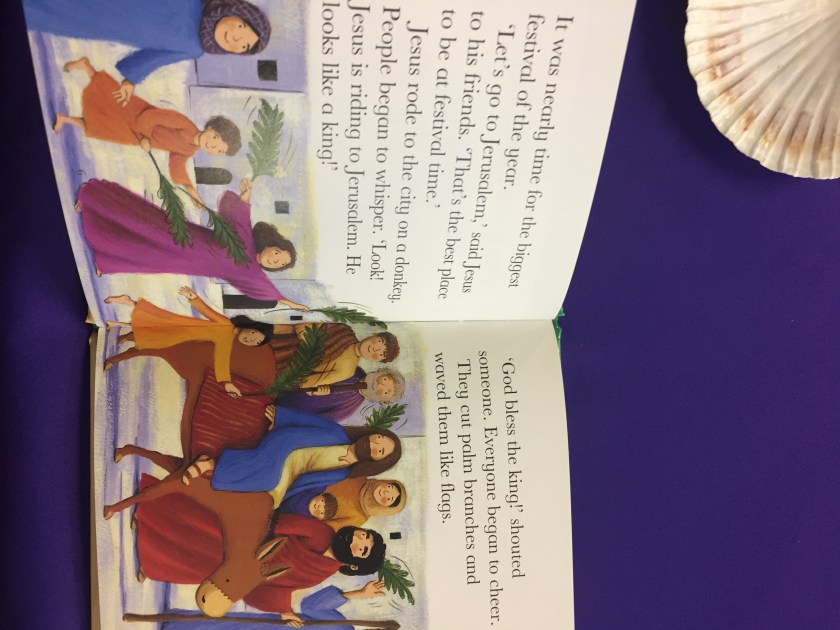
My mom gives Enoch and Evy all kinds of Christian books.  They have many “my first Bibles,” pre-school Bibles, and “big kids” Bibles.  We actually have two copies of My Very First Easter Story. 

IMG_7704

Oh, though it’s only 2 pages, Enoch and Evy filled in the details.  Evy said it was all about friendship.  Enoch said that it was a horse (some versions say this).  Evy said they had laid the palm branches and cloaks down because they didn’t want Jesus to walk in the mud.

You see, all of the Gospels (Matthew, Mark, Luke and John) have this story.  They included different details but the same overarching story.

I have chosen to stick with the Palm Sunday text.  You see the lectionary texts for today give us the options of choosing the Palm text and the Passion text.  I normally do some mixture of the two, however, I wanted to be intentional about sticking to the text and journeying through this week with Jesus.

The hesitancy of pastors is that if people only attend on Sundays, you get the celebration of Palm Sunday back to back with the Alleluias of Easter.  High point.  Even higher point.

You miss why in just 5 days the same people that shouted “Hosanna” and waved palm branches, shouted “Crucify him!  Crucify him!”  You miss Jesus ticking off the Pharisees in the temple when he turned over the tables and called them a brood of vipers.  You miss them plotting to kill him.  You miss Jesus’ teaching the disciples you have to be last to be first as they witnessed him washing their and their friends’ feet.  Their Rabbi that they had followed for three years, getting all of his radical dust on them, as he continually flipped the script.  Doing what is always least expected.  Who else would have people waving palm branches praising him and wanting to kill him less than a week later?

He was the One they had waited for.  He was the One whom the prophets foretold.  He is the One Herod was so afraid of that he slaughtered all of those innocent children.  He was the One who preached in his hometown and they said, “Who is this kid?  Is he Joseph’s boy?”  He was the One who called Peter, James and John just a bunch of fishermen and said they were the best of the best of the best as he asked them to be his disciples.  He was the One who cast out demons, healed the paralytic and the hemorrhaging woman, called Lazarus forth FROM THE GRAVE.  He was the One even the wind and the waves obeyed.  He was the One.  Not just Neo from the Matrix or Frodo from the Lord of the Rings or Harry Potter, but THE ONE.  And the people were PUMPED until … they realized he wasn’t a political or military conqueror.  He was not going to ride in on a float and wave and provide good sound bites.  He was not going to incite a revolt among people groups.  He was not going to be boxed in to a certain tradition.  He was not going to maintain the status quo or social norms.  He came to flip the script.  He came to set ALL people free.  He came to set us free from BOTH sin and death.  He came to set us free from all of the burdens and shackles of this world.

I spent the week talking to Donal Hook about salvation.  He was recounting what Harry said two weeks ago about Jesus wiping the slate clean and I said that nothing can ever separate us from God’s love and we’re all worthy, enough, and chosen.  He said he was like the man saying, “Help my unbelief!” I appreciated his honesty as I relate to the man and the words as well! Remember the story.  It’s immediately after the transfiguration and the disciples are in a tizzy.  In Mark 9:19-24 he says to the disciples, “19 “You faithless generation, how much longer must I be among you? How much longer must I put up with you? Bring him to me.” 20 And they brought the boy to him. When the spirit saw him, immediately it convulsed the boy, and he fell on the ground and rolled about, foaming at the mouth. 21 Jesus asked the father, “How long has this been happening to him?” And he said, “From childhood. 22 It has often cast him into the fire and into the water, to destroy him; but if you are able to do anything, have pity on us and help us.” 23 Jesus said to him, “If you are able!—All things can be done for the one who believes.”  24 Immediately the father of the child cried out, “I believe; help my unbelief!” I believe; help my unbelief.  We had many discussions over the past week and a half.  Most of the time it boiled down to me saying, that’s what’s so amazing about grace!  We have faith that God’s grace is real and ever abundant to cover anything we throw at God. I brought up singing “Amazing Grace” on Sunday night when I visited him, but I was too embarrassed to sing in front of his family, some of whom I had just met, with my off-key voice, but  I ended up singing it on Tuesday with his son Michael and Michael’s wife Marlene and that became our theme song over the last couple of days.  That and Psalm 23.  I frequently have Psalm 23 rolling around in my head as I pray.  It epitomizes to me the fullness of life.  God making us lie down in green pastures, anointing our heads with oil, and as I said to Donal and praying with he and his family, Jesus is the One who walks with us even through the darkest valley of the shadow of death.  Don joined the great cloud of witnesses yesterday and he is at peace and at rest.

You skip right over that lonesome and dark valley when you go from the triumphant entry of Palm Sunday to the glory of Easter and Resurrection.  You don’t get the dark days in between of doubt, fear, frustration, anger.  You don’t get the Garden of Gethsemane and Jesus asking God to take this cup from him.  You don’t see, hear, or feel his pain as he’s betrayed, denied, beaten, stripped, crucified.  You don’t get the agony and anguish or the simple humanity of it all, the muck and mire.  He was the Human One.  Not a super hero that could leap over buildings.  He took on the form of a baby, both fully divine and fully human.  He felt everything we feel and even when he was on that cross he was thinking of us as he says, “Father, forgive them because they don’t know what they’re doing.

If you don’t journey towards the cross, you miss out on the struggle and the deep pain of what it means to have an Emmanuel – God with us – even on the darkest night of our souls.  To have a savior who suffers right along with us.  Who knows the full extent of our pain and then some…

I encourage you to read the stories this week and meditate on them.  I encourage you to walk this journey towards the cross.  On Thursday we’ll gather here with Isle of Palms UMC for a joint Maundy Thursday service where we’ll celebrate Jesus’ Last Supper with his disciples.  On Friday we’ll have our Good Friday Tenebrae service.  If you’ve never been to a Tenebrae service, I encourage you to do so.  The word “tenebrae” comes from the Latin meaning “darkness.” The Tenebrae is an ancient Christian Good Friday service that makes use of gradually diminishing light through the extinguishing of candles as scriptures are read of that encompass the entire fullness of Holy Week.  This increasing darkness symbolizes the approaching darkness of Jesus’ death and of the hopelessness in the world without God. The service concludes in darkness and worshipers then leave in silence to ponder the impact of Christ’s death and await the coming Resurrection.  As Bob Goff, author of Love Does says, “Darkness fell.   His friends scattered.  All hope seemed lost.  But heaven just started counting to three.”

I invite us to count to three together as a faith community as One body.  We rejoice with one another.  We weep with one another.  We share in the mountaintops and the darkest of the darkest valleys and that is why it’s so special to have shared in this Holy meal together these past Sundays of Lent.  We have gathered bread, sustenance, strength to face together whatever life throws at us.   When we feel like giving up, when we need a helping hand or an encouraging word, we are there for one another with Jesus ever in our midst.  We live, move and breathe in Christ, our Rabbi, our One with us.  The One who calls each of us worthy, enough, beloved by God.  The One we celebrate when we celebrate this Holy Sacrament of Communion….

Posted in Abide, cactus, Center, Centering, core, energy, katharos, limitations, New Life, roots, seek, spiritual broccoli, spiritual disciplines, stronger, True Vine, trust in God, Uncategorized

3 Simple Rules: Stay in Love with God

We continue today in our series on the “3 Simple Rules,” the guidelines for living the Christian life in such a way that we will actually be changed by God’s grace.  Remember the image we’ve been using: if our sin and spiritual failures are like stumbling and skinning our knees, then we aren’t interested just in a faith that’s like a million band-aids; we’re interested here in a faith that invites us to grow into our spiritual legs so that we fall down less in the first place, so that, by God’s grace, we mature into being able to walk and maybe even run with God. So, the last two weeks we’ve looked at what it means to “Do No Harm,” and then to “Do Good.” That brings us to rule #3 which we’re going to translate a little, but first let’s look at the original text from back in the day:

General Rule #3

“Thirdly: By attending upon all the ordinances of God; such are:

  • The public worship of God.
  • The ministry of the Word, either read or expounded.
  • The Supper of the Lord.
  • Family and private prayer.
  • Searching the Scriptures.
  • Fasting or abstinence.

These are the General Rules of our societies; all of which we are taught of God to observe, even in his written Word, which is the only rule, and the sufficient rule, both of our faith and practice. And all these we know his Spirit writes on truly awakened hearts. If there be any among us who observe them not, who habitually break any of them, let it be known unto them who watch over that soul as they who must give an account. We will admonish him of the error of his ways. We will bear with him for a season. But then, if he repent not, he hath no more place among us. We have delivered our own souls.”

So the third rule is to attend upon the ordinances of God or, you could say, to observe the spiritual disciplines that help you abide in God.  Bishop Ruben Job, who wrote the book that inspired this series, describes rule #3 this way: Stay in love with God. Stay in love with God. For John Wesley and the Methodists, a list like this, these sorts of things, were the tools of intimately relating to the Lord. They called them the “means of grace” because they’re gifts from God, for the people of God to apply, and God promises that when we put ourselves wholeheartedly into these things, we are guaranteed to meet God’s grace there. God is just waiting there, if only we come looking. So, the Methodists said, let’s go looking, weekly, even daily, through spiritual practice like this.  Seek God.

Psalm 105:4 says, “4Seek the Lord and his strength; seek his presence continually.”  If you have not struck up a conversation with God in a while, do it.  I watched the movie The Shack a couple of weeks ago with my parents and I love how the little girl calls God “Papa.”  I don’t think that that would come authentically out of my mouth, but I love the intimacy.  If you’ve not been active in your relationship, it’s going to be a little awkward at first.  There will be starting and stopping, but keep trying and practicing.  Spiritual disciplines are simply about practicing our relationship with God, cultivating it.  It may be like going a first date.  One where you have one of your friends call for what is an “emergency” when conversation breaks down.  Push through.  Persevere.  The conversation, the dance, the relationship IS worth it.  You may be thinking, “It’s easy for you, Pastor.  Sure!  But I don’t have time.  I don’t even know how to pray.  I don’t know see God and I don’t even know if I trust God.  God is an unfair and unjust God.  God doesn’t care about me.”

As Matthew 7:7-11, “‘Ask, and it will be given to you; search, and you will find; knock, and the door will be opened for you. 8For everyone who asks receives, and everyone who searches finds, and for everyone who knocks, the door will be opened. 9Is there anyone among you who, if your child asks for bread, will give a stone? 10Or if the child asks for a fish, will give a snake? 11If you then, who are evil, know how to give good gifts to your children, how much more will your Father in heaven give good things to those who ask him!”

Seek – find.  Ask – it will be given.  Knock – door opened.  God is a good God.  God loves each of us with an abundant love.  There is NOTHING that can separate us from the love of God in Christ Jesus.  As Harry said last week, Jesus wiped the slate clean of any of our wrong doing and we are stamped Child of God.

I think we place our human hang ups on God.  We think God’s a punishing God, keeping a record of wrongs.  We think God is a genie God, a wish fulfiller.  God cannot be boxed in.  God is Yahweh, the Great I Am.  In our Monday Small Group we are reading Bob Goff’s book Love Does and he writes, “I used to think God wouldn’t talk to me, but now I know I’m just selective with what I choose to hear.”  So clean out the ear wax and hear the words of God.  “I love you.  You are bought for a price.  You are fearfully and wonderfully made for a purpose.  Nothing will ever separate you from my love.”  And if you live knowing that?  Nothing can stop you from radiating God’s love to everyone you meet.

Now, the thing is, you may have a hard time connecting to “stay in love with God” with a list like this. They can feel like spiritual chores, or eating our spiritual broccoli, and your love relationship with God can feel like rules and regulations, or something wild and personal and free.   The thing about spiritual disciplines is that they depend on your perspective.  They can either leave us feeling words like, “Boring. Difficult. Unattainable. Guilt” and, in our minds, we relegate spiritual discipline and holiness to only the few, aged maternal or paternal saints who are one-in-a-million Christians, the exception to the rule. Or we look at them like getting to know a friend better or cultivating a relationship with the lover of our souls.  We need to rest in that knowledge and form a core and center in it.  If we lead from our cores, if we act out of our cores, if we live in the live and grace of God that emanates out of our pours…than we will truly take this world by storm and bring God’s kingdom to earth.  If we abide in the vine our core…

John 15:1-11

‘I am the true vine, and my Father is the vine-grower. 2He removes every branch in me that bears no fruit. Every branch that bears fruit he pruned to make it bear more fruit. 3You have already been cleansed by the word that I have spoken to you. 4Abide in me as I abide in you. Just as the branch cannot bear fruit by itself unless it abides in the vine, neither can you unless you abide in me. 5I am the vine, you are the branches. Those who abide in me and I in them bear much fruit, because apart from me you can do nothing. 6Whoever does not abide in me is thrown away like a branch and withers; such branches are gathered, thrown into the fire, and burned. 7If you abide in me, and my words abide in you, ask for whatever you wish, and it will be done for you. 8My Father is glorified by this, that you bear much fruit and become my disciples. 9As the Father has loved me, so I have loved you; abide in my love. 10If you keep my commandments, you will abide in my love, just as I have kept my Father’s commandments and abide in his love. 11I have said these things to you so that my joy may be in you, and that your joy may be complete.”

Stay in love with God.  Abide in God’s love so that your joy may be complete.  If we keep our eyes and ears open, and our hearts, there’s a lot to this specific way of abiding, and if we’re brutally honest, some of the things that make it most special are the same things that, on occasion, make it really difficult.

First, not all of us at any given time like the idea of being pruned. Even metaphorically. In verses 2 and 3, Jesus describes how, with him, we’ll be pruned and cleansed, and it’s actually the same Greek verb both times, repeat after me: katharos. Katharos. A good English connection is catharsis. A catharsis is an expression of emotions that leaves us feeling deeply relieved. So, for instance, an ugly cry from time to time, whatever inspires it, that physically just cleans out your sinuses and emotionally unloads your burdens; that’s cathartic. Funerals are some of our biggest occasions for catharsis, to get everything out, and start to heal. This is the root of what Jesus says God the gardener does for us as branches in the vine: God prunes, gets the burdensome stuff out, purges the stunted growth, and leaves us whole by doing so. Great news, right?

Unfortunately, not all of us like to be pruned, we don’t always like self-denial, the idea of sacrificing things we’ve grown attached to. We look at God and say, “Can’t I just keep that one part of that one branch? I’ve gotten really comfortable with it. It’ll hurt if you remove that. Can’t I just send out a new branch in that direction, ‘cause I want to do that.” And pretty soon we’re a lot less like a fruit-bearing vine than a wild kudzu – more concerned with consuming in all directions than flowing with full life. Are you familiar with feeling that way? It’s why abiding is tough.

Second, not all of us at any given time really appreciate feeling tied down. Not only are parts of our lives open to pruning when we abide with Jesus, but he also says that we’re confined to the existence of branches. Now, again, sounds pretty great in a sense. Being intertwined with the Vine means having direction, having something to guide us. If you’ve ever ridden through a vineyard, these big gnarly stalks are usually carefully staked in, and supported on trellises, and there’s twine and gear everywhere to keep the branches properly placed to maximize production. It’s this big network of spider-web growth, orderly and efficient, and awesome. Even more, how awesome is it that Jesus is basically saying we get to live off his abundant, true life? Like, the very sap and richness and nutrients of God Almighty flows through the Vine directly into us. Really cool.

What some of us also hear in there is that abiding in the Vine means none of us gets to be a stand-alone plant. Nobody gets to be a towering trunk all on our own. We might start to fear that we won’t get to control our own destiny; or make our own decisions; or be creative and original. What if we won’t get to stand out from everyone else, or take credit for our own glory, or enjoy the spoils of OUR victories? Pretty soon we feel an itch to be, instead of a fruit-bearing vine all “tied up in knots,” a majestic oak that stands alone and knows no bounds. Are you familiar with any of that feeling?  It comes natural. It’s why abiding is tough.

Last, when it comes to abiding in the Vine, a more elusive truth is that not all of us always want to be fruitful.  We don’t always feel like it, don’t always think we’ve got it in us, don’t always appreciate the pressure of bearing fruit. But Jesus makes no bones: why does God prune?  What’s the end-goal of my life flowing through you? So that produce comes forth.  Not what you used to do.  Not the result you got 10 years ago.  I’m here living in you NOW.  Just open your eyes to the possibilities and don’t live in the used to’s of your past.  If we open our eyes to the unimaginable things God wants to do through us, then what can we not do?  What is our limitation? Again, it can sound like the glory of glories that the Lord of Heaven and Earth chooses to use humble old us to accomplish amazing, eternal, life-saving, earth-changing feats of power and love. But as soon as we admit that we have the capacity to bear much fruit for God, all of a sudden it makes me wonder: “So where is all the good fruit then? Why does it seem like I’m not seeing any? What, instead, am I wasting my time on selfishly? What other priorities are driving my life? What if I just don’t feel like dealing with other people sometimes, or putting myself out there, or going out on the limb (vine humor), or doing it all over again? What if I can just never believe that somebody like me could ever do anything to seriously contribute to what God’s doing?” And pretty soon, rather than abiding in a fruit-bearing vine I’d much rather be, say, a nice, self-contained little cactus. Unassuming, inwardly-focused, good to go unto my own survival, sure a little bit prickly but, hey, now God won’t need to worry about expecting anything from me. Are you familiar with any of those ideas, those feelings? Anybody else ever have a little cactus in’em? It’s why abiding is so tough.

What I’m saying is that, for everything that makes a relationship with Jesus sooo good, so unique and powerful and one-of-a-kind on earth, so life-giving and glorious, there’s something that rubs against our sinful nature. There’s a natural drawback, hesitation, and even a sense of “let me run in the opposite direction.” I think these are the same reasons why the spiritual disciplines, the means of grace, as beautiful, powerful, and life-giving as they are, are usually described as confining, boring, and impossible to attain: because they are the ways that we know how to abide, and abiding is tough for our human nature. We would sometimes rather do a thousand other things than these; we’d rather get to these things last if we have time; we’d rather choose all sorts of artificial substitutes over these things, in order to feel like we get to grow what we want to grow, the way we want to grow, as selfishly as we want to do it. Sometimes, the “disciplines” we have to stay in love with God just aren’t that attractive to the part of us that is rooted in the world, but there’s freedom in that as well. Bob Goff writes, “The cool thing about taking Jesus up on His offer [to abide in him] is that whatever controls you doesn’t anymore. People who used to be obsessed about becoming famous no longer care whether anybody knows their name. People who used to want power are willing to serve. People who used to chase money freely give it away. People who used to beg others for acceptance are now strong enough to give love. When we get our security from Christ, we no longer have to look for it in the world, and that’s a pretty good trade.”  That is a heck of a trade.  Not to get our value from the world.  Knowing and trusting God to give us the only value we need.

Y’all, as we close today, this passage isn’t supposed to be bad news. To the disciples’ ears, shortly before Jesus’ death, these words were meant to offer the hope of how they would get to remain in relationship with their beloved Lord and Master. Just listen to how Jesus wraps up in verse 11: I have said these things to you so that my joy may be in you, and that your joy may be complete.” The same is true for us. We know that when we pray, when we worship publicly, when we study scripture, when we fast and abstain, we have a chance to meet God, to know God, to be in love with God, and to stay in love. In these practices, God’s pruning helps us slough of the dead things that are draining our life; growing in Christ our Vine means living into holy design; and bearing fruit means taking part in the Lord’s redeeming work. As one of the three simple rules, abiding through the spiritual disciplines, means we are going to work on this together.  The mighty redwood trees of California’s Sequoia National Park are the largest life-forms on Earth; yet it is a rare thing to see a redwood standing alone. This is because the roots of the Sequoia do not extend deep into the earth, as most tree roots do; they snake along just beneath the surface of the soil. So shallow are the redwood’s roots that, when a tree is young, it is easily toppled by the wind.

The redwoods that survive — and that grow to such astounding heights — are the ones whose roots intertwine with those of other trees, forming a great interwoven mass of support. The storms that bluster their way through the valleys of the Sierra Nevada can work no harm on those trees: for they stand strong and tall together, in community.  We will walk with each other spurring each other on to good works.  We will stand stronger together because we are going to create a firm foundation as we all seek to abide in Christ.  We are asking and seeking to become more faithful followers of Christ and the Spirit of Christ will abide in us as we abide in him.  Praise be to God.


Posted in 3 Simple Rules, God's love, Harm, John Wesley, Love, repentance, Self harm, Uncategorized, Wesley

3 Simple Rules: Do No Harm

Galatians 5:14-15

14 For the whole law is summed up in a single commandment, “You shall love your neighbor as yourself.” 15 If, however, you bite and devour one another, take care that you are not consumed by one another.

Today is part two in a 4-part series on the “Three Simple Rules” or the General Rules of the early Methodists. Remember the three rules as Reuben Job states:  Do No Harm, Do Good, and Stay in Love with God.  Last week we introduced the idea that Methodists became a driving force in 18th-century England in large part because this spiritual revival movement was anchored into a system of small groups. Remember what Fred Barnes said, editor of The New Republic, on how it affected England, “Yes, it had tremendous economic, social, and political consequences, but it began as a spiritual revival – a spiritual awakening. And unless we get in this nation a spiritual awakening and a spiritual revival that will create these kinds of economic and political implication…in our day, it won’t work. It’s got to have a new generation of Methodists who will do for this day what they did in the 18th century.”

That’s where our scripture comes in.  Love God and love neighbor.  5 simple words, harder than anything to live out.  How do we love God with all our souls, with all our hearts and with all our minds?  Who is our neighbor?  I think Wesley was getting at that by his hard core belief in personal piety – doing all you can to abide in God and grow in grace and knowledge.  Wesley didn’t believe you should leave your brain at the door.  He was an Oxford don.  He believed what Albert Outler called the Wesleyan Quadrilateral that you had to look at things with Scripture at the base along with Tradition, Reason, and Experience.  But only when he was crossing back over to England from America did he witness the Moravian’s assurance of their salvation while his boat was tossed to and fro on the waves.  You see we are all on a life-long faith journey and we grow in our love of God each and every day.  We live and move and breathe in the Spirit of God and nothing we can do can ever separate us from God’s love.

The next thing is Love of Neighbor.  That’s why Wesley not only believed in personal piety – you can’t just cloister yourself in your own little prayer closet or in an ivory tower.  Jesus calls us to be in the world but not of it.  First we have to be IN it to bring God’s kingdom to earth – love, peace, joy, hope.  Social holiness is aligning your self with the least of these and setting the captives free – whether it be from prisons of their own creation and choices or coming alongside them helping any way you can.

We learned last week the use of small groups reflected the unique theology of the Methodists and the needs of their time. After all, theirs was a time when science and economics, philosophy and many theologies, supported the idea that people are pretty hard-wired in their animal instincts. Some folks, they thought, just naturally have more virtue than others, and overall a “leopard really can’t change his spots.” In other words, for the most part you were either born a good egg or not. From that perspective, it was believed that church should try to deter sin, but more than that its function was to be the channel through which people could be forgiven after inevitably giving into temptation time after time. And, too many times, that forgiveness was only available to the special few who had access to church.

But into this reality came the Methodists, who believed that any sincere follower of Jesus could be a changed person – in terms of one’s decisions, priorities and even behaviors. John Wesley, upheld that Jesus’ death and resurrection weren’t just meant to keep us on this merry-go-round of sin and pardon. Instead, he taught that being born into a new creation means, by the ongoing work of the Spirit, we have the potential for sanctification. We can and should strive to grow in holiness, and try to approach a perfect love for God and neighbor in which our sin doesn’t have room to thrive anymore. Or, think of it this way. I put I don’t know how much Neosporin I put on Enoch’s cuts, itch relief cream on his poison ivy, and a massive amount of bandaids last night.  He is constantly scraped up ALL over the place.  I had my share of scrapes because I was a klutzy, gangly, tom boy.   My knees were always scraped.  My two brothers and I grew up when there were no digital cameras, so how did we take family pictures? We went to the local department store and there would be a kind of pop-up Olan Mills area there. And, as was always the case, one of us at least, two of us most times had skinned knees or bite marks.  Do you relate to that at all?  Did you spend childhood with skinned knees?

Imagine our faith lives like this: imagine that every time we sin and fail and fall short spiritually, it’s like we stumble and skin our knees, just like when we were kids.  John Wesley would say our faith doesn’t just provide an infinite supply of band-aids. Our faith invites us, by God’s grace, to grow into our legs, to learn to walk with God, and maybe to start falling down less in the first place. Do you hear the difference? It’s what blew people’s minds about the Methodist movement. No wonder the Methodist altar call wasn’t just “believe today and be saved” it was, “believe in the Lord, be saved, and join a group today to support you in Christian transformation.”

That’s important to us because these groups, dozens and dozens of them, put their theories to the test, over and over. It was not just a façade to ask people how they were and they would immediately say “fine” and you both would go on your way.  It was, “How well is it with your soul?”  This question became a crucible or incubator for finding out exactly what works in order for Christian disciples to help each other change, to grow together, and be stronger in the faith together.  The result is these three simple rules. Rule #1 is Do No Harm.  I want you to hear it as the time-tested Christian counsel of our spiritual mothers and fathers. Do. No. Harm.

Now, I’d love to know exactly how you receive that as a rule. “Do no harm.” We all have different thresholds for harm, don’t we? For some of us, harm might seem rare or remote, especially by comparison to other places and times. Many of us are stable, secure Americans and spanking our children isn’t even allowed, right? Where’s the harm? For others of us, all we see is harm. In several articles for The Atlantic, psychologist John Haidt proposes that, more and more in America, our only criteria for whether or not something is morally wrong is if harm is caused. That can work alright, but Haidt says it’s also the root of some big problems, like an over-sensitivity on our college campuses if you’re familiar with terms like “micro-aggressions” and “trigger warnings.” Haidt calls the trend “vindictive protectiveness” because, at some point, these efforts to avoid harm end up inflicting harm themselves. My point is that we need a place to start lest this simple rule doesn’t turn out so simple. Let’s read what Wesley said what doing harm was.  First: By doing no harm, by avoiding evil of every kind, especially that which is most generally practiced, such as:

  • The taking of the name of God in vain.
  • The profaning the day of the Lord, either by doing ordinary work therein or by buying or selling.
  • Drunkenness: buying or selling spirituous liquors, or drinking them, unless in cases of extreme necessity.
  • Slaveholding; buying or selling slaves.
  • Fighting, quarreling, brawling, brother going to law with brother; returning evil for evil, or railing for railing; the using many words in buying or selling.
  • The buying or selling goods that have not paid the duty.
  • The giving or taking things on usury—i.e., unlawful interest.
  • Uncharitable or unprofitable conversation; particularly speaking evil of magistrates or of ministers.
  • Doing to others as we would not they should do unto us.
  • Doing what we know is not for the glory of God, as:
  • The putting on of gold and costly apparel.
  • The taking such diversions as cannot be used in the name of the Lord Jesus.
  • The singing those songs, or reading those books, which do not tend to the knowledge or love of God.
  • Softness and needless self-indulgence.
  • Laying up treasure upon earth.
  • Borrowing without a probability of paying; or taking up goods without a probability of paying for them.

I want you to notice something. They had an exhaustive way of defining harm. It’s robust, probably more than what you had in mind, and if you notice the majority of these fall under “such as.”  You are a free to write your own.  Some of them are more challenging than others.  Can I get a witness?   The “such as’s” are divided into two parts.  The sins or harm we do consciously and those we do unconsciously.   The sins of volition, the harm we cause consciously – making choices because “I want to” or think “I have to.” Like when I have an angry outburst with someone or look at someone lustfully or tell a little white lie or gossip about someone or I don’t pick up my litter. Conscious harm.  It’s just a small, little thing.  No one will know.  No one will know that it was me.  But even those little things do harm and sometimes they do a great deal of harm.  Then there’s unconscious harm which I inadvertently cause just by being naturally self-absorbed or by failing to see the impact of my decisions down the line. Like when I’m a wasteful steward of God’s resources, whether it be food, energy, water, while somewhere someone doesn’t have enough to live. You can argue that this isn’t exactly unconscious, because we all know good and well that our choices have impact, but nevertheless: when we don’t overtly mean to hurt anyone, unconscious harm.

You can see your harm through the lens of individual choices, the harm I personally inflict on myself, others, God’s heart and creation, all by myself. Individual harm. Do No Harm means you’re not hurting one of the least of these or yourself.  Self-harm is running just as rampant as harm to others.  You can take a long hard look at things in terms of the harm that we can only accomplish together. Corporate harm, through immoral group dynamics and institutional sin. The sins of society, of slavery, of economy. If we’re attentive to it, “Doing no harm” includes the conscious and unconscious, individual and corporate.  Reuben Job writes of harm, “Each of us knows of groups that are locked in conflict, sometimes over profound issues and sometimes over issues that are just plain silly. But the conflict is real, the divisions deep, and the consequences can often be devastating. If, however, all who are involved can agree to do no harm, the climate in which the conflict is going on is immediately changed. How is it changed? Well, if I am to do no harm, I can no longer gossip about the conflict. I can no longer speak disparagingly about those involved in the conflict. I can no longer manipulate the facts of the conflict. I can no longer diminish those who do not agree with me and must honor each as a child of God. I will guard my lips, my mind and my heart so that my language will not disparage, injure or wound another child of God. I must do no harm, even while I seek a common good.”

You may be thinking of the ways you do all sorts of harm.  There’s a reason that this is number one. The Methodists realized that in our fallen human state, harm is our natural language. After all, the good farmer in the parable is awfully direct with his servants. He doesn’t say, “Oh, in the midst of the beautiful, fruitful wheat that I’ve planted, another farmer with a different set of strategic interests planted an alternative species.” No, in reference to our sinful produce he calls a spade a spade, or rather a weed a weed, the lifeless stuff that’s hardly worth burning.  If we’re ever going to do no harm then first, we need to have the ability to be real with one another, to paint a distinct, outlined picture of the true state of our hearts.  In the Methodist groups, this happened through confession, and every single week the members knew that their first job was not to hold back but to speak their struggles out loud, before God and one another. It was the first step toward discerning the wheat versus the weed in their hearts, and it’s something we have got to find ways to do together. Holy, honest confession.  Doesn’t it help to say things out loud?  So they’re not rolling around in our heads filled with worry, guilt and fear.  Speaking it aloud casts out fear.  When we confess things aloud, we do so in humility acknowledging we don’t have it all together, we don’t have it all figured out.

What did the Methodists do other than confess each week? They prayed together.  They shared each other’s joys and struggles.  Life together. They set out to connect with one another’s hearts and with God’s heart. The next week they would report in and then hold each other accountable in mutual love when they failed or fell short.  God could speak through their human voices a word of encouragement, challenge, and forgiveness.  They could celebrate together, because they knew exactly what God was doing in their lives by God’s transforming grace.

God doesn’t leave us where we are.  God continues to mold us, shape us, and free us to live lives of transformation.  The old has gone.  The new has come.  Not to be good little Christian boys and girls, not to be sure we’ve stamped our passport for heaven, but to be disciples. To be followers of Jesus who even if they’ve got their knees scraped with sin, God’s grace has enough Neosporin in it to heal anew.

Which brings us to this meal we are sharing together every Sunday during Lent and the transformative power where if we confess the harm we have done to ourselves, to others and to God, God is faithful and just, and will cover a multitude of our sins.  Hear these words anew and afresh as I say them and we will sing our responses today as well as the Lord’s Prayer.

Posted in Community, Covenant, John Wesley, Koinonia, ordination, Personal Piety, Rabbi, Revolution, sanctification, small groups, Social Holiness, soul, Spiritual Awakening, Trinity, UMC, Uncategorized, Vulnerability, Wesley

A New Way

For the past 6 weeks, we have sat at the feet of our Rabbi Jesus.  We’ve learned he calls everyone who is willing to follow.  We have found freedom in the words from Matthew 11:28-30 (NRSV), 28 “Come to me, all you that are weary and are carrying heavy burdens, and I will give you rest. 29 Take my yoke upon you, and learn from me; for I am gentle and humble in heart, and you will find rest for your souls. 30 For my yoke is easy, and my burden is light.”  We have walked with our Rabbi Jesus and have gotten his resurrection dust all over us.  We heard a tremendous sermon basically flipping the script of life as we know it.  “Blessed are the poor in spirit, for theirs is the kingdom of heaven.  Blessed are those who mourn, for they will be comforted.”  Then when the disciples began peppering him with questions we learned about loving our enemies, keeping our promises, and storing up not treasures on earth that moth and rust destroy, but instead storing up treasures in heaven.  These are all powerful lessons that it would take several lifetimes to learn and perfect, but we know we have hope in Christ alone to take our place, to teach us the way, the truth, and the life, to teach us how to do life together in community.

For the next 4 weeks up until Palm Sunday, we’re going to be studying Reuben Job’s Three Simple Rules:  A Wesleyan Way of Living.  It’s based upon John Wesley’s General Rules which are in our Book of Discipline.  The rules are do no harm, do good, and keep the ordinances of God or as Job says, “stay in love with God.”  “These simple rules then and now applied to everyone,” Job said. “No one was left out. No one was too good, too mean, too rich or too poor, too educated, too illiterate.”

Drawing parallels between Wesley’s time and the world today, Job says the feelings of disenfranchisement, doubt and fear are much the same.

“Our world is deeply divided, highly cynical about its leadership, greatly disappointed in its structures and systems that seem so flawed, broken and corrupt, broadly conflicted and gravely afraid of tomorrow.”

With so many hurting, frightened people Job says a radical change must take place. “There are two enormously encouraging truths for us to remember,” Job said. “One, God is with us. God continues to woo us, seek us out, love us, speak to us, enable us and lead us into the future. Second, it has been done before.”

Wesley’s three simple rules transformed women and men and started a movement that became a denomination and transformed a forming nation in North America.

“Today we also need a message that can be clearly understood by persons of every age, every educational and economic level, every condition and circumstance of life,” he said. “And today these three simple rules provide that message.”

Rewind back two thousand years ago to the two great commandments that our Rabbi gave us.

Mark 12:29-31

29 Jesus answered, “The first is, ‘Hear, O Israel: the Lord our God, the Lord is one; 30 you shall love the Lord your God with all your heart, and with all your soul, and with all your mind, and with all your strength.’ 31 The second is this, ‘You shall love your neighbor as yourself.’ There is no other commandment greater than these.”

From day one, Scripture tells us that God is the God of community. First, God is Trinity, this mysterious fellowship of three-persons-in-one. Second, as we hear in the opening pages of Genesis, God describes how we as human beings inherit that communal nature, saying, “Let us make humankind in our image, according to our likeness…” (Gen 1:26). No wonder when Adam finds himself without companionship in the garden, God recognizes “it is not good that the man should be alone” (Gen 2:18). Last, the entire history of God’s devoted followers, from the very first days until today, is one of covenant-making where the people are united together in intimate relationship with one another and with the Father, Son, and Spirit.

In Moses’ day, that meant a Law that largely focused on how to live in right relationship, and also how to mend those relationships when broken. The Law (and circumcision as a physical sign of initiation) meant that, for the first time, a “people of God” was born – not only of the chosen Hebrews but also of those along the way like Rahab and Ruth and so many others who chose God wholeheartedly. This continued through the centuries, despite periods of rebellion and exile on the part of God’s people, until Jesus’ day. That’s when Emmanuel showed us once again how personal and near God meant to be with us. He spent his entire precious life living among, eating with, and serving whomever he met, whether in crowds or in smaller intimate circles. He called us not just to believe in the idea of him that he would set the captives free and bring liberation to his people, but to follow him in close contact, as a Rabbi, to join the throngs of those following him. The result was a new covenant and a new understanding of “God’s people” as all those who put their faith in the Messiah. In the early church, this meant a powerful focus on living in koinonia or living in sacred community like family (Acts 2:43-47).

These first Christians were bound together not only by their faith but by its consequences. In the Empire of their day, whether one was a Jew or Gentile, rich or poor, Roman citizen or slave, making a Christian profession of faith became a grave risk. The earliest confessions that they made were statements as simple as, “Jesus is Lord.” But to say such a thing was tantamount to treason since the Emperor intended to be the ultimate ruler, savior, and object of worship throughout the world. Those three little words, if found out, could mean a total loss of one’s legal rights, loss of citizenship, forfeiture of property and assets, beating, torture, being sold into slavery, and even death. If one member of a household was identified as a Christian, then every member of the household could be liable to the same punishments. After all, in the Roman world the family unit was a single, legal unit, united together under the head of the household. If one person in the home was a practicing Christian it was assumed that the head of household was as well, and if the head of household was a practicing Christian then that would be true for all. In other words, early Christians had a deep understanding of shared fate, shared victory as well as shared suffering. But this underground movement saw massive growth because a person only joined it if they had a sincere desire, if they were ready to sacrifice all for Christ’s sake, and if they were ready to truly share life together.

Fast-forward more than a thousand years, and this same level of community was scarcely found in the Church. Over time, the Roman Catholic church eventually reached a pinnacle of corruption, so much so that the Reformation was sparked to revive the authentic Christian faith. It took on a unique form in England in particular, thanks to Henry VIII’s scandalous life (if you’ve seen any of pop culture’s recent depictions of the story, like The Tudors, then you know we won’t go into detail here). To summarize, King Henry continually wanted to marry a new woman, but the Roman Catholic leadership continually refused him an annulment or divorce. So what did he do? Henry declared himself King of the church in his own country, seized the Church’s property, and renamed it the “Church of England” or Anglican Church. So what? Well, what do you think are the drawbacks to having a single, nationalized church ruled by the King? Right. All those good “separation of church and state” things go out the window. The church becomes so embedded in school and politics and the economy that Christianity suddenly becomes a pretty mandatory part of society. There are benefits to that, sure. Kind of like growing up in the American South, there’s something to be said for a culture that revolves around church and raises its children in that environment. But there are serious downsides, too. Like having people filling the pews who have little or no conscious faith, who only participate because their parents make them or because everybody else is doing it or because they want to be a part of an exclusive club, and who are familiar enough with the Gospel that it’s lost its fresh appeal and who may have never stopped to wonder whether or not they actually believe in Jesus. They’ve been inoculated against catching a real case of faith, and they don’t even know it. That was the state of the Church of England.

By the 18th-century in England, it had become a place reserved for the affluent and well-to-do in society, who were expected to be present every Sunday and support the Anglican institution, but oftentimes with little or no personal Christian devotion. People were “in church” for a thousand reasons – to network for their businesses, to meet their future spouses or arrange advantageous marriages, to have a hearty covered-dish meal, to reserve their future plot in the cemetery – but few were necessarily “being church” as disciples of Christ. It makes perfect sense, then, that when two young brothers who had been raised in Anglicanism came of age, they decided it was time for some massive changes. John and Charles Wesley recognized that, starting on a personal level, it was time to reclaim “Scriptural holiness” that included the two key ingredients that the English were missing: first, the spiritual devotion of someone who believes fully in Jesus and, second, the kind of Christian service that would actually lift up the lives of those in need. While still ultimately college students, they started a group that became known mockingly as “Methodists” because they seemed too serious, too methodical, about their faith. They were disciplined to daily practices like journaling, fasting, prayer and Holy Communion. They dove into Scripture as a living, authoritative text. They went into the dark bowels of society, like debtors’ prison, not just to speak to the people but to know them and later to help remedy their real-world issues. Then, John Wesley began to preach.

By this time he was an officially-ordained Anglican priest but did what few other dared to do: he took to field-preaching. It meant going in person to the places where the poor, unchurched masses were found – literally in fields, at the shipyards, outside coal mines. Suddenly, the “least of these” heard the Gospel, and heard their own stories in it, and they repented by the hundreds then thousands. They came forward to be saved, and the response was overwhelming. Based on his own experience, John grouped the new converts into small groups, classes and bands, so that salvation wouldn’t be a simple one-time rebirth but rather the beginning to Christian sanctification; and the movement ballooned. Christians were tasting real community for the first time in ages, and it was lighting the spiritual landscape on fire. But that’s not all.

Wesley realized quickly that the people needed to learn how to properly be community together. His journals reveal that, early in the movement, everyone started to notice a problem. His small group leaders would visit the homes of their class members in order to take up the weekly collection, and find their fellow disciples in all manner of spiritual disarray. One man would come to the door stone-cold drunk before 9:00 in the morning. Another woman was found with an “overnight guest” who was a man other than her husband. Another home was torn by domestic violence. In another, the children weren’t being properly fed. In other words, although the masses were converting and joining Methodist groups, the members of the groups weren’t actually sharing life together. They were entertaining one another with superficiality; they were wearing spiritual masks while darker realities lurked behind closed doors. They weren’t confessing to one another, or holding each other accountable. In the end, the Wesleys reshaped the “rules” for their groups. They refocused their efforts on deep relationship and vulnerability. The new question that became the focal point for Methodists, and it was designed to be answered in total honesty every single meeting, was this: How is it with your soul? And if anyone tried to respond with anything like “Pretty good” or “Just fine,” it wasn’t going to fly.  He set up these societies to truly share life together.

Every year at Annual Conference individuals who have felt the call of God to ordained ministry whether that call is to be a deacon or an elder in the United Methodist Church and wishes to be in full membership in the Annual Conference stands up before the Executive Session of the Annual Conference, all the ordained clergy, and has these questions asked of him or her by the Bishop. 1. Have you faith in Christ? 2. Are you going on to perfection? 3. Do you expect to be made perfect in love in this life? 4. Are you earnestly striving after it? 5. Are you resolved to devote yourself wholly to God and his work? 6. Do you know the General Rules of our Church? 7. Will you keep them? 8. Have you studied the doctrines o the United Methodist Church? 9. After full examination, do you believe that our doctrines are in harmony with the Holy Scriptures? 10. Will you preach and maintain them? 11. Have you studied our form of Church discipline and polity? 12. Do you approve our Church government and polity? 13. Will you support and maintain them? 14. Will you diligently instruct the children in every place? 15. Will you visit from house to house? 16. Will you recommend fasting or abstinence, both by precept and example? 17. Are you determined to employ all your time in the work of God? 18. Are you in debt so as to embarrass you in your work? 19. Will you observe the following directions: a. Be diligent. Never be unemployed. Never be triflingly employed. Never trifle away time; neither spend any more time at any one place than is strictly necessary. B. Be punctual. Do everything exactly at the time. And do not mend our rules, but keep them; not for wrath, but for conscience’ sake.

Do you know the General Rules of our church and will you keep them? Just three simple rules. It’s Wesley’s way of expressing the first and second commandment that are in Mark’s text for us today. Love the Lord your God with all your heart, with all our soul, with all your might, and your neighbor as yourself. Everything else is contained in these two. Rueben Job says that these rules have the power to change the world. “Do no harm, do good, and stay in love with God” are ancient simple words seldom put to the test, but words when lived out in this life, could transform the whole earth. We really do live in a world of divisiveness that separates, disparages, disrespects, diminishes, and leaves us wounded and incomplete.

Can you imagine the outcomes of our communities if every United Methodist worldwide would live into these 3 simple rules? If young and old, rich and poor, powerful and weak and those of every theological persuasion in the church would live out these words, we would have a transformed culture, we would together, change the world. Wesley believed this in his day so much that he took this as the blueprint of his societies, fleshed it out, taught it, and expected every Methodist to practice it. I’ve been told that it was the Methodism influence of living out these simple rules that kept England from breaking out in civil war against each other in those turbulent times of the industrial revolution.

“An interesting article was written in a journal called The Public Interest by Roger Starr, a professor at City College in New York. He is a liberal, Jewish Democrat. (Remember that; it is important to the story.)

Starr Concluded that there was only one other period in world history that matches the day in which we live. It was 18th century England. There was a problem of addiction – they had just discovered gin alcohol. Families were falling apart, Children were being abused. Domestic violence was rampant.
There were problems of pollution, crime, and violence – problems very much like our own.

When he discovered this, Roger Starr wanted to know what saved England, or brought them out of their situation. And would you believe? This liberal, Jewish, Democrat argues that the only thing that saved England was someone that he had not really heard much about – someone by the name of John Wesley who started a movement called Methodism.

“Now, I don’t even know any Methodists,” says Starr. “I don’t anything about them. But this Wesley started a movement that literally saved England. It was a movement that had profound social, economic, and political consequences and transformed and indeed saved that nation. Maybe what we need to do is to study those Methodists to find out how they did it, and to duplicate what they did back in the 18th century.”

About a month later, George Will wrote and editorial for The Washington Post. George Will is a conservative, Roman Catholic Republican. (Remember that; it is important to the story.)

Will wrote, “I never thought I’d agree with anything Roger Starr has ever written. But you know, this liberal has actually got a point. It is that in the 18th century you have the German and French revolutions, and other revolutions around the world; but you don’t have an English Revolution. But they did, you see. It was called the ‘Methodist Revolution,’ because these Methodists turned their world upside down. Maybe what we need to do is to take Roger Starr seriously and look at what was the secret of those Methodists.”

Then he added, “I know this is going to sound strange for me, saying that we need some more Methodists to save the world; and I hate to end the column this way, but does anybody out there have a better idea?”

About a month later, Fred Barnes, editor of The New Republic, wrote an article. Fred Barnes is an evangelical Episcopalian moderate. (Remember that; it is important to the story.)

He writes, “Can you believe this? We have George Will and Roger Starr agreeing on something. I can’t believe it! But the more you think about it, they are exactly right. But they forgot one thing. What they forgot was that basically the Methodist Movement was at heart, a spiritual awakening.”

Barnes continues, “Yes, it had tremendous economic, social, and political consequences, but it began as a spiritual revival – a spiritual awakening. And unless we get in this nation a spiritual awakening and a spiritual revival that will create these kinds of economic and political implication…in our day, it won’t work. It’s got to have a new generation of Methodists who will do for this day what they did in the 18th century.”

Even our witness to the redeeming love of God in Christ Jesus loses its authenticity and its power in the wake of so much division and hatred. Those who follow Jesus are asking, “is there not a better way to live with each other?” “Is there not a better way to practice our faith?” a way so simple that none are turned away because of its complexity, and all can practice it because of its simplicity.   These three simple rules are one of the ways we tap into that.  Are you willing to go on this journey of discovery of actually practicing what our Rabbi taught us in a framework that is easy to understand but we will spend a lifetime perfecting?

Posted in Ash Wednesday, fasting, Jesus, Prayer, Rabbi, repentance, Treasures, Uncategorized

At the Feet of the Rabbi – Matthew 6

Matthew 6:1-6, 16-21

 Concerning Almsgiving

“Beware of practicing your piety before others in order to be seen by them; for then you have no reward from your Father in heaven.

“So whenever you give alms, do not sound a trumpet before you, as the hypocrites do in the synagogues and in the streets, so that they may be praised by others. Truly I tell you, they have received their reward. But when you give alms, do not let your left hand know what your right hand is doing, so that your alms may be done in secret; and your Father who sees in secret will reward you.

Concerning Prayer

“And whenever you pray, do not be like the hypocrites; for they love to stand and pray in the synagogues and at the street corners, so that they may be seen by others. Truly I tell you, they have received their reward. But whenever you pray, go into your room and shut the door and pray to your Father who is in secret; and your Father who sees in secret will reward you.

Concerning Fasting

16 “And whenever you fast, do not look dismal, like the hypocrites, for they disfigure their faces so as to show others that they are fasting. Truly I tell you, they have received their reward. 17 But when you fast, put oil on your head and wash your face, 18 so that your fasting may be seen not by others but by your Father who is in secret; and your Father who sees in secret will reward you.

Concerning Treasures

19 “Do not store up for yourselves treasures on earth, where moth and rust consume and where thieves break in and steal; 20 but store up for yourselves treasures in heaven, where neither moth nor rust consumes and where thieves do not break in and steal. 21 For where your treasure is, there your heart will be also.

This is the Ash Wednesday text every lectionary year, probably because it talks about not being showy in one’s faith.  Lenten practices can sometimes be that way.  If you’re talking always about what you’re giving up or you’re talking about the day your fasting or you’re talking about the entire day of prayer, you’ve gotten your reward of those around you, those that you’re bragging to.  Our rabbi is teaching us to do things privately, not with pomp and circumstance.  He’s warning us of getting big heads playing I’m more religious than you are.

It’s not about that.  We don’t volunteer at the Lowcountry Orphan Relief or on work days in Nichols or Sellers or go to Ecuador to get pictures made, though it seems at times like we do, it’s because we want to give what we can or do what we can as we are able because that’s what Jesus calls us to do.  Simple as that.  The Message translation of the Bible seems to get at that idea.  Matthew chapter 6 is titled “The World is a Stage.”  Though I was an English major, I never fancied myself an actress.  Jesus wants us to be real and authentic in our faith.  He doesn’t want a full-fledged Broadway Show, an Oscar winning performance of Saint Narcie and yet the very action is not the thing that gets us into trouble, it’s being pious with the intention of looking down on others.  John Wesley said this, “The thing which is here forbidden, is not barely the doing good in the sight of men; this circumstance alone, that others see what we do, makes the action neither worse nor better; but the doing it before men, “to be seen of them,” with this view from this intention only.”

In his notes, Wesley writes, “In the foregoing chapter our Lord particularly described the nature of inward holiness. In this he describes that purity of intention without which none of our outward actions are holy. This chapter contains four parts, The right intention and manner of giving alms, ver.1 – 4. The right intention, manner, form, and prerequisites of prayer, ver.5 – 15. The right intention, and manner of fasting, ver.16 – 18. The necessity of a pure intention in all things, unmixed either with the desire of riches, or worldly care, and fear of want, ver.19 – 34.”  Let’s get to what our Rabbi was getting at.

“Beware of practicing your piety before others in order to be seen by them; for then you have no reward from your Father in heaven.

“So whenever you give alms, do not sound a trumpet before you, as the hypocrites do in the synagogues and in the streets, so that they may be praised by others. Truly I tell you, they have received their reward. But when you give alms, do not let your left hand know what your right hand is doing, so that your alms may be done in secret; and your Father who sees in secret will reward you.”

My grandfather was a man like that.  One time my grandmother let slip that he had paid for the carpet all throughout the Greeleyville UMC parsonage.  He helped lots of people, quietly and unobtrusively.

I’ll read you a story by Woody McKay, Jr. called “The Secret Benefactor.”

http://www.chickensoup.com/book-story/41639/the-secret-benefactor

Continuing in Chapter 6, “When you are praying, do not heap up empty phrases as the Gentiles do; for they think that they will be heard because of their many words. Do not be like them, for your Father knows what you need before you ask him.

“Pray then in this way:

Our Father in heaven,
hallowed be your name.
10     Your kingdom come.
Your will be done,
on earth as it is in heaven.
11     Give us this day our daily bread.
12     And forgive us our debts,
as we also have forgiven our debtors.
13     And do not bring us to the time of trial,
but rescue us from the evil one.

14 For if you forgive others their trespasses, your heavenly Father will also forgive you; 15 but if you do not forgive others, neither will your Father forgive your trespasses.”

Our Rabbi Jesus teaches us how to pray and gives us a model or example. The Jewish Encyclopedia notes both the practice of a Rabbi teaching the disciples a prayer, and the language of this prayer, place Jesus in the context of others rabbis of his time.   “From the Talmudic parallels (Tosef., Ber. iii. 7; Ber. 16b-17a, 29b; Yer. Ber. iv. 7d) it may be learned that it was customary for prominent masters to recite brief prayers of their own in addition to the regular prayers.”  The Lord’s Prayer as it is now commonly referred to is the world’s most famous prayer of all time.  We would say it in the locker room before basketball games, we said it at the bedside of my grandfather after he died, and I remembered it even after my second brain surgery robbed me of my speech.  Its powerful words could be a whole sermon itself.

Madeleine L’Engle writes this about prayer.

In prayer the stilled voice learns
To hold its peace, to listen with the heart
To silence that is joy, is adoration.
The self is shattered, all words torn apart
In this strange patterned time of contemplation
That, in time, breaks time, breaks words, breaks me
And then, in silence, leaves me healed and mended.

16 “And whenever you fast, do not look dismal, like the hypocrites, for they disfigure their faces so as to show others that they are fasting. Truly I tell you, they have received their reward. 17 But when you fast, put oil on your head and wash your face, 18 so that your fasting may be seen not by others but by your Father who is in secret; and your Father who sees in secret will reward you.

Announcement in a church bulletin for a national Prayer and Fasting Conference: “The cost for attending the Fasting & Prayer Conference includes meals.”  Martha Moore-Keish, a Presbyterian minister, writes, “Our culture does not know what to do with Ash Wednesday. We do a pretty good job with the feasting right before Ash Wednesday, mind you — more and more people even outside of New Orleans celebrate Mardi Gras with beads and floats, and more and more people devour pancakes and waffles at Shrove Tuesday celebrations. Any excuse for a feast is welcome! But what to do with the depressingly titled Ash Wednesday? A few years ago I saw a restaurant sign that summed up our cultural uncertainty about this date on the Christian calendar: “Ash Wednesday Seafood Buffet: All You Can Eat!” …

The paradox of Ash Wednesday, and of Lent, is that we take on particular disciplines — fasting, prayer, service — in order to repent and conform ourselves more closely to the life and death of Christ, all the while recognizing that Christ has already come to us before we sought him. This is the paradox of the baptized life. We have been joined to Christ once, but we spend the rest of our lives trying to live into that union.

Turning to Christ means turning also to all our neighbors who suffer. According to Isaiah, fasting and praying that brings us to act on behalf of these neighbors is the fast that is acceptable to God.”

19 “Do not store up for yourselves treasures on earth, where moth and rust consume and where thieves break in and steal; 20 but store up for yourselves treasures in heaven, where neither moth nor rust consumes and where thieves do not break in and steal. 21 For where your treasure is, there your heart will be also.

Sister Wendy Beckett in The Mystery of Love: Saints in Art through the Centuries  writes, “When I was young, I longed to be a saint. What was I longing for? I think it was for certainty that my life had been, in the most profound sense, a “success” — that great and glorious success that is sanctity. We revere the saints. We imitate them. Theirs is the true and lasting glory. Very clearly, this desire is, unconsciously, as worldly as that of the writer who wants to write a masterpiece or the politician who yearns to be prime minister or president. None of these ambitions has the least to do with what Jesus preached — that lowliness, that love for last place, that readiness to die and be forgotten … . To be concerned with oneself in any way, to watch one’s growth in “holiness” or “prayer,” to be spiritually ambitious, all this Jesus earnestly sets his face against.”

We’re not holy because we know we store up crowns in heaven.  There is not a giant sticker chart for who says the longest prayers or who fasts the most.  We’re holy because Jesus is holy and he calls us to be holy, little by little, step by step.

There’s an old story about a man from the city who was out driving one day, in the country. The signs on the road weren’t very good, and he got lost. So he stopped at a farmhouse to ask directions. “Can you tell me how far it is to the town of Mill Pond?” he asked.

“Well,” said the old farmer, “the way you’re goin’ it’s about 24,996 miles. But if you turn around, it’s about four.”

And therein lies a lesson. If we want to follow our Rabbi we have to repent.  We have to turn around and see him for who he really is — our Rabbi, the example to follow, but more than that we learned last week in the Transfiguration that he is the Great God of the Universe come down in the form of a baby, our Emmanuel, wading through the muck and mire of our sin and reaching down into the mess of our lives to set our feet on solid ground.  Amen?  Our Rabbi Jesus, first proclaimed the Good News with the Beatitudes and that we are to be salt and light in the world and then expounded on the “real stuff,” when the rubber meets the road and when the ship hits the sand.  Real, practical life applications that are certainly not easy to practice but God gives us the grace, strength and courage to go out into the world and our very own hearts to practice what we preach, not in ostentatious ways, but with humility, standing our ground but shirking from the spotlight.  Wesley treated the commandments of the Sermon on the Mount and other passages as “covered promises.” That is, they are commands that we can obey because God provides the grace to empower us to fulfill what is required.  It’s God’s grace freely given.  As we go through the confession of Communion hear the words anew and afresh, search your hearts, see if anything has taken root there – bitterness, fear, anger, doubt, hatred, judgment –  but hear the rest of it as well.  Hear the Good News, “Christ died for us while we were sinners.  That proves God’s love for us.  In the name of Jesus Christ you are forgiven.”  Then hear God, our Creator, Jesus, our Redeemer, and the Holy Spirit’s mighty works in the Great Thanksgiving.  We’re going to practice Communion every Sunday of Lent.  I invite you to pray the words…

Posted in Ash Wednesday, Diamonds, Dust, Lent, Sermon, Uncategorized

God works wonders from dust…

As we face our own mortality, it can be scary…ominous even.  But I think we need it.   In this crazy, busy culture we need 40 days to contemplate, pray, and take a step out of the routine.  It is in Ash Wednesday that we are called upon to pause and reflect.  “Remember you are dust and to dust you will return.” Mary Oliver says about this life “Tell me, what is it you plan to do with your one wild and precious life?”  Ash Wednesday gives us the chance to question our priorities, our motivations, and our own sinfulness.  Dust to dust.

Here’s an old, cute story:

A little boy came home from Sunday school and went into his room to change his clothes. When he emerged he asked his mother, “Is it true we come from dust?”

“Yes, sweetie,” replied his mother, a knowledgeable and deeply religious woman. “That’s absolutely right.”

“Is it true that when we die we go back to the dust?”

“Yes, dear, that’s right. Why all these questions?”

The little boy ran into his room and came out all excited.

“Mom, I just looked under my bed and there’s someone either coming or going!”

It doesn’t have to be scary.  There’s beauty in that the great God of the universe breathed us into life and then because he defeated sin and death, they no longer bind us, even if when we return to dust.  We know that we’re going to return to dust sooner or later.  It’s how we live our lives that matters.  I like how Nadia Bolz-Weber, Lutheran priest, explains Ash Wednesday, “If our lives were a long piece of fabric with our baptism on one end and our funeral on another, and us not knowing what the distance is between the two, well then Ash Wednesday is a time when that fabric is pinched in the middle and then held up so that our baptism in the past and our funeral in the future meet. With these ashes, it is as though the water and words from our baptism plus the earth and words from our funerals have come from the future to meet us here today. And in that meeting we are reminded of the promises of God. Promises which outlast our piety, outlast our efforts in self-improvement, outlast our earthly bodies and the limits of time.”  Promises that tell us if we run fast enough, we just might outrun death.  Say no to the fancy, shiny, new, plastic things of this world and hold tight to the true promises of God.

You see Lent is a time in which we’re seeing our own mortality clearly in our failings, in our sins, but that only points us still more to the One who never fails us and scatters our sins from the east to the west.  Ann Voskamp says this about  giving things up for Lent, “I can’t seem to follow through in giving up for Lent. Which makes me want to just give up Lent.  Which makes me question Who I am following.  Which may precisely be the point of Lent.”  If you’re following Jesus that is the only thing that matters.  Hear me again, if you’re following Jesus that’s the ONLY thing that matters.  If you put your trust in yourself, in your own goodness, or in your ability to exercise self-control than you’re bound for disappointment, however, Jesus will never disappoint.

I’m not saying you shouldn’t try to give up something or add spiritual practices like a daily quiet time or writing things that you are thankful for or fasting one day a week.  Those are all great additions.  Giving things up like chocolate, caffeine, or social media is meant to symbolize when Jesus was tempted in the wilderness for 40 days.  Adding things is just what we need before Easter and maybe they will turn into habits.  Just by being intentional this Lenten season, you are practicing a “Holy Lent.”

Jo Ann Staebler in her book “Soul Fast,” says, “In the deep stillness of prayer my soul fasts.  Fasting, at its heart, is turning away from what keeps me from God.  Two things I must leave:  the walls I build around the space that was made to be God’s dwelling; the absurdities I keep in that space, so jealously hoarded.  Taking down the wall that protects the false self I have been building, all these years…risking exposure, emptiness, loneliness.  The fast is silence, ocean-deep and prolonged.  Shard by shard, the wall begins to fall.  Inch by inch, the space clears, and Love lights the shadows.  I come unprotected, and learn that God alone is safety.  I come unaccompanied, and find that Christ alone is Friend.  I come hungry, and receive the only food that satisfies.  In letting go is abundance.  In emptying I am filled.  This is not denial, but freedom.  Fast is feast.”

It doesn’t matter to me what you do, I just want you to be intentional in this Lenten ritual.  As most things in life, what you put into it, is what you’ll get out of it.  It’s only a tool, a ritual, to draw us closer to Jesus when *WE’RE* deep in the wilderness of life.

Hear these powerful words from the artist and poet, Jan Richardson, in her poem “Blessing the Dust,”

All those days
you felt like dust,
like dirt,
as if all you had to do
was turn your face
toward the wind
and be scattered
to the four corners or swept away
by the smallest breath
as insubstantial—

did you not know
what the Holy One
can do with dust?

This is the day
we freely say
we are scorched.

This is the hour
we are marked
by what has made it
through the burning.

This is the moment
we ask for the blessing
that lives within
the ancient ashes,
that makes its home
inside the soil of
this sacred earth.

So let us be marked
not for sorrow.
And let us be marked
not for shame.
Let us be marked
not for false humility
or for thinking
we are less
than we are

but for claiming
what God can do
within the dust,
within the dirt,
within the stuff
of which the world
is made
and the stars that blaze
in our bones
and the galaxies that spiral
inside the smudge
we bear.

God can work wonders from dust.  God made you in your mother’s womb.  Psalm 8:3-4 says, “When I look up at your skies, at what your fingers made — the moon and the stars that you set firmly in place — what are human beings that you think about them . . . that you pay attention to them?”

God can do mighty things through us.  Our Rabbi Jesus can lead us to do some crazy, awesome things as we follow his teachings.  The Holy Spirit can fan the fire to make diamonds out of dust.  God can take your one, wild and precious life and work wonders out of it.

I will say while putting ashes on your forehead.

“God can work wonders with dust.

Remember that you are dust, and to dust you will return. Amen.”


  •  I read many commentaries, blogs, articles to gather these quotes including this one not directly quoted:  http://www.saltproject.org/progressive-christian-blog/2015/2/18/ash-wednesday-meditation.
Posted in Crazy, Enemies, Forgiveness, Hate, Jesus, Love, Other, Rabbi, Retailiation, Roman Occupation, Star Wars, The Message, Uncategorized, yoda

Jesus Commands Crazy

Continuing on in our “At the Feet of the Rabbi” sermon series, I found these in the Jewish Standard.  Some people think that Yoda from the movie Star Wars sounds a lot like a Jewish Rabbi.  We’re going to play a game where you raise your hand if Yoda said it and you don’t raise your hand if one of the Jewish Rabbis said it.  Even if you’re not big Star War fans, you can get some of these simply because they’re embedded in pop culture.

  1. “In a dark place we find ourselves, and a little more knowledge lights our way.” Yoda
  2. “Accept the truth, you must, from whatever source it comes.” Rabbi
  3. “On three things, the world stands: On judgment, on truth and on peace.” Rabbi
  4. “Do, or do not. There is no try.” Yoda
  5. “Truly wonderful, the mind of a child is.” Yoda
  6. “For myself, if I am not, for me, who will be?” Rabbi
  7. “Size matters not.” Yoda
  8. “Preferable, the risk of a wrong decision is, to the terror of indecision.” Rabbi
  9. “Wicked, do not be, in one’s own eyes.” Rabbi
  10. “At the flask, look not, but at what is therein.” Rabbi
  11. “Once you start down the dark path, forever will it dominate your destiny, consume you it will.” Yoda
  12. “Wars not make one great.” Yoda
  13. “A master, assume for yourself, a friend, acquire for yourself, and every man, judge to the side of merit.” Rabbi
  14. “Luminous beings are we, not this crude matter.” Yoda
  15. “A man, you must strive to be, in a place where there are no men.” Rabbi
  16. “Always two there are, no more no less. A master and an apprentice.” Yoda
  17. “Fear is the path to the dark side…fear leads to anger…anger leads to hate…hate leads to suffering.” Yoda
  18. “That which to you is hateful, to your neighbor do not.” Rabbi

It’s all good advice.  Maybe Yoda is a Rabbi of sorts?  He’s definitely a spiritual teacher of the force.  Yoda and the other Rabbis couldn’t compare to Jesus, our Rabbi.  He teaches us all.  It’s not a lineage thing a la the Jedi nor a skill at memorizing thing like the typical Rabbi’s pupil.  He invites all of us to come sit at his feet.  He calls all of us to walk in his dust.  He calls each of us with authority and our response it to get up off of our mat and walk, just like paralytic.  We have to get over our fears and take that leap of faith and step out of the boat.  We have to leave the fishing nets of our old lives and follow Jesus our Rabbi.  No matter the cost.  No matter what.  Because what this Rabbi, this Jesus, is teaching is definitely counter-cultural.  No one teaches like this Rabbi.  Love you enemies?  Love the people who persecute you?  Don’t retaliate.  Don’t get even.  That goes completely against human nature. Hear now what our Rabbi, teaches us today.

Matthew 5:38-48

Concerning Retaliation

38 “You have heard that it was said, ‘An eye for an eye and a tooth for a tooth.’ 39 But I say to you, Do not resist an evildoer. But if anyone strikes you on the right cheek, turn the other also; 40 and if anyone wants to sue you and take your coat, give your cloak as well; 41 and if anyone forces you to go one mile, go also the second mile. 42 Give to everyone who begs from you, and do not refuse anyone who wants to borrow from you.

Love for Enemies

43 “You have heard that it was said, ‘You shall love your neighbor and hate your enemy.’ 44 But I say to you, Love your enemies and pray for those who persecute you, 45 so that you may be children of your Father in heaven; for he makes his sun rise on the evil and on the good, and sends rain on the righteous and on the unrighteous. 46 For if you love those who love you, what reward do you have? Do not even the tax collectors do the same? 47 And if you greet only your brothers and sisters, what more are you doing than others? Do not even the Gentiles do the same? 48 Be perfect, therefore, as your heavenly Father is perfect.

You have to understand the context in Jesus’ time.  Jesus’ words are radical today for sure, but they were particularly radical in his day when the Roman Empire ruled Israel.  Roman soldiers could ask you carry their stuff up to one mile.  They could ask you to make them meals just like quartering during the American Revolution.  They could publicly beat you without the slightest provocation and it wasn’t against the law; it was perfectly legal.  Our Rabbi Jesus wasn’t talking generically about being nice and turning the other cheek, he was talking right then and there what was happening.  They were an occupied nation and many times we don’t take that into account when we read the Bible.  He’s specifically talking about their context when he says, “Go the second mile,” because that was unheard of.  The Roman Soldiers already had made you walk one mile and to think Jesus wants you to walk a second mile?  Our family went for a walk yesterday and before we were even out of the neighborhood, Enoch was complaining about how tired he was.

Like any occupiers, the Romans weren’t all bad.  The Roman Empire had conquered many, many lands and had shipped their troops far from home.  They were typically between the ages of 17 and 46 and it was an opportunity to prove oneself.  They had to be picked and fit to serve.  It was an honor to be picked and be set apart, but much like in the Hunger Games, they were frightened to go and they did all they could to survive.  They swore an oath of allegiance called the sacramentum that changed them from Roman citizens to Roman soldiers.  Once they had taken the oath, they were subject to their general’s authority.  Just the like the Empire in the Star Wars movies, they looked fierce.  A massive amount of men, like ants, all wearing the same uniforms, just like the storm troopers.

Wouldn’t you despise the soldiers that occupied you?  They could make you walk for a mile, they could beat you in public, they could do anything to you, and it was legal.  Doesn’t that give Jesus’ words an entirely different context.  However, the typical Jewish person dehumanized the Roman soldiers also, because they all looked the same, it was easy to make assumptions.  THIS is what our Rabbi Jesus is speaking to.  He’s COMPLETELY flipping the script.

Matthew 5:38-48 The Message (MSG)

38-42 “Here’s another old saying that deserves a second look: ‘Eye for eye, tooth for tooth.’ Is that going to get us anywhere? Here’s what I propose: ‘Don’t hit back at all.’ If someone strikes you, stand there and take it. If someone drags you into court and sues for the shirt off your back, giftwrap your best coat and make a present of it. And if someone takes unfair advantage of you, use the occasion to practice the servant life. No more tit-for-tat stuff. Live generously.

43-47 “You’re familiar with the old written law, ‘Love your friend,’ and its unwritten companion, ‘Hate your enemy.’ I’m challenging that. I’m telling you to love your enemies. Let them bring out the best in you, not the worst. When someone gives you a hard time, respond with the energies of prayer, for then you are working out of your true selves, your God-created selves. This is what God does. He gives his best—the sun to warm and the rain to nourish—to everyone, regardless: the good and bad, the nice and nasty. If all you do is love the lovable, do you expect a bonus? Anybody can do that. If you simply say hello to those who greet you, do you expect a medal? Any run-of-the-mill sinner does that.

48 “In a word, what I’m saying is, Grow up. You’re kingdom subjects. Now live like it. Live out your God-created identity. Live generously and graciously toward others, the way God lives toward you.”

I think this speaks A LOT to us today.  We’re griping about the cost of medical care.  We’re griping about Donald Trump.  We’re griping about the liberal Hillary lovers.  We’re griping about the state of our world.  We’re griping but not doing anything, accept talking.  All blow and no go.  When Enoch was griping on our walk yesterday, I must have said 3 or 4 times that if he put his energy into walking and not in complaining, he would have the energy to walk.

Do not let fear of the other, lead you to the dark side.  Yoda says, “Fear is the path to the dark side. Fear leads to anger. Anger leads to hate. Hate leads to suffering.”  Hate leads to suffering. Isn’t it exhausting to hold onto that critical, bitterness all the time?  I’m not saying we don’t have opinions, but opinions are like belly buttons, everyone has them.  I’m saying, couldn’t we use half the energy we waste on the 24 hour news cycle and channel it in to clothing, feeding and housing our neighbors?  That’s what our Rabbi calls us to do.  “Grow up.  You’re kingdom subjects. Now live like it. Live out your God-created identity. Live generously and graciously toward others, the way God lives toward you.”  We, as Christ-followers, that have the dust of our Rabbi, all over us are called to Love not Hate.  It’s part of our God-created identity.  It’s part of our DNA.  It’s who we are.

Jesus wants us to give what we can to our neighbors, not retaliate, and LOVE our neighbors as well as our enemies.

The following was purportedly posted on the Craigslist personals:

To the Guy Who Tried to Mug Me in Downtown Savannah night before last. Date: 2009-05-27, 1:43 a.m. EST. I was the guy wearing the black Burberry jacket that you demanded that I hand over, shortly after you pulled the knife on me and my girlfriend, threatening our lives. You also asked for my girlfriend’s purse and earrings. I can only hope that you somehow come across this rather important message.

First, I’d like to apologize for your embarrassment, I didn’t expect you to actually soil your pants when I drew my pistol after you took my jacket. The evening was not that cold, and I was wearing the jacket for a reason. My girlfriend had just bought me that Kimber Model 1911 .45 A CP pistol for my birthday, and we had picked up a shoulder holster for it that very evening. Obviously you agree that it is a very intimidating weapon when pointed at your head … isn’t it! I know it probably wasn’t fun walking back to wherever you’d come from. … I’m sure it was even worse walking barefooted since I made you leave your shoes, cell phone and wallet with me. (That prevented you from calling or running to your buddies to come help mug us again.)

After I called your mother, or “Momma” as you had her listed in your cell, I explained the entire episode of what you’d done. Then I went and filled up my gas tank as well as four other people’s in the gas station on your credit card. The guy with the big motor home took 150 gallons and was extremely grateful! I gave your shoes to a homeless guy outside Vinnie Van Go Go’s, along with all the cash in your wallet. (That made his day!) I then threw your wallet into the big pink “pimp mobile” that was parked at the curb … after I broke the windshield and side window and keyed the entire driver’s side of the car.

… [On your cell phone] I managed to get in two threatening phone calls to the DA’s office and one to the FBI, while mentioning President Obama as my possible target. The FBI guy seemed really intense, and we had a nice long chat (I guess while he traced your number, etc.). … I feel this type of retribution is a far more appropriate punishment for your threatened crime. I wish you well as you try to sort through some of these rather immediate pressing issues, and can only hope that you have the opportunity to reflect upon, and perhaps reconsider, the career path you’ve chosen to pursue in life.

Remember, next time you might not be so lucky. Have a good day!

Thoughtfully yours, Alex.

I’m not saying that wasn’t awesome in some ways.  Most of us would say that person got what he deserved.  Most of us would feel pretty good and satisfied with ourselves after that Craigslist post, but would Jesus see it that way?  Did Alex have to do that other stuff?  Would it be so crazy if he handed the guy the jacket, the purse, and the earrings, and then threw in his wallet?  That would really be crazy!  But Narcie, the guy held them up at knife point.  And I would answer, Jesus called all of us to do crazy things like that. Most of us would have a hard time walking that extra mile for a Roman enemy…..but if we did, wouldn’t that be a surprise for them.  Wouldn’t that maybe make the Roman question all of the times he’s “messed” with the Israelites?  If it happened over and over again, wouldn’t his heart grow bigger and bigger just like the Grinch’s in the Christmas cartoon.   Showing a mere glimmer of humility, kindness, and love when you’ve been wronged, will eventually break through to anybody’s hardened heart.  And isn’t there lots of reasons why somebody’s heart is hardened?  Prisoner turned President Nelson Mandela says this, “No one is born hating another person because of the color of his skin, or his background, or his religion. People must learn to hate, and if they can learn to hate, they can be taught to love, for love comes more naturally to the human heart than its opposite.”

Loving our enemies and praying for those who persecute us can lead to changes, most of all, in ourselves.  It’s uncanny.  Even when people lose loved ones in the most violent of crimes, they see the need to forgive.  Not just for the other people, but for themselves, to free themselves of the burden of hate and revenge.  I’m not at all saying that such a Christlike response is easy. Heck no.  It takes courage and deep determination. In Uganda, Angelina Atyam’s daughter was abducted in 1996. According to Divinity magazine (Winter 2010), rebel troops took her and 29 other girls from a Catholic boarding school. Angelina met weekly with the parents of the other girls to pray for their daughters’ release.

“I was confused, bitter and very deep in my heart I was thinking, ‘How do I avenge this?’” says Angelina. “Yet we continued to pray and call upon the [rebels] to release our children, protect them, bring them home and make peace again.”

One day, a priest was leading the group of parents in the Lord’s Prayer. When they got to the words “Forgive us our sins,” the parents suddenly stopped. They couldn’t say “as we forgive those who sin against us.” Realizing they were asking for the forgiveness of their sins yet were unable to forgive the rebels for stealing their children, the parents filed silently out of the church. It was simply too difficult. They couldn’t be Christlike enough to forgive the rebels’ sins.

The parents went home and began to examine themselves. And something amazing happened: By the next meeting, they started to pray to forgive the rebels. They also began sharing their story of forgiveness with others and became leaders in a national movement to secure the release of abducted children. After seven years of captivity, Angelina and her daughter were reunited.

In his book The Magnificent Defeat, Frederick Buechner, theologian, says, “The love for equals is a human thing — of friend for friend, brother for brother. It is to love what is loving and lovely. The world smiles.

“The love for the less fortunate is a beautiful thing — the love for those who suffer, for those who are poor, the sick, the failures, the unlovely. This is compassion, and it touches the heart of the world.

“The love for the more fortunate is a rare thing — to love those who succeed where we fail, to rejoice without envy with those who rejoice, the love of the poor for the rich, of the black man for the white man. The world is always bewildered by its saints.

“And then there is the love for the enemy — love for the one who does not love you but mocks, threatens, and inflicts pain. The tortured’s love for the torturer.

This is God’s love. It conquers the world.

We need to search each of our hearts and take these lessons very seriously because we are all guilty of making assumptions, demonizing the other, and of having our default be hatred and judgement because of fear and misunderstanding.  Jesus is very clear on this.  No excuses.  No explanations.  No rationalizations.  We are to love our enemies.  Our Rabbi Jesus wants our default, our resting state to be love and grace and we see this love most clearly on the cross.  The fact the Great God of the Universe came to live among us and we whipped, stripped, and persecuted him, should be grounds for him saying, “Beam me up, Scotty!  Get me out of here.”  Instead, he says, “Father, they do not know what they are doing.”  That is the biggest act of non-violence, that is the biggest love for enemies ever because we’ve all fallen short of the glory of God and sinned against our Rabbi Jesus, but he turns the other cheek and loves us anyway.  He loves us no matter what.  He died for us no matter what.  And for that, we say, THANKS BE TO GOD!

Posted in Cancer, Community, Healing, Love, Shelter, The City Harmonic, Uncategorized, Vulnerability

Love, Heal Me

Mike and I got turned on to the band The City Harmonic because they had their song “Mountaintop” on one of the CD’s that he gets in Worship Leader Magazine.  We immediately were fans.  I don’t know if you know this about me yet, but if I’m blasting my iTunes on the computer in my office, I’m being productive.  I’m in the groove.  I love music.   Music is one of the ways I tap into God’s voice.  Music has a way of moving you out of your own way so that you can see the kernel of truth.  We hear music.  We sing along.  We think about the words.  It taps into the deep well of our souls in a way nothing can and it can come to us in our times of need.  I remember bits of hymns or praise songs or scriptures when I’m at my most vulnerable and raw.

This morning a song from The City Harmonic came on my iTunes.  It’s called “Love, Heal Me” and it has a powerful story behind it.  One that I knew about, but I didn’t discover the youtube video until today.  As a congregation, many have been battling cancer and everyone has been touched in some way by cancer.  I know this for sure and for certain that God doesn’t cause cancer or any other disease.  God doesn’t want any of God’s children to suffer.  “Everything happens for a reason” is no where in scripture, but God working all things for good (Romans 8:28) is definitely there.  The Psalms are full of people crying out to God in grief, in anger, in desperation….and God was with each of them then and God is with each of us now, no matter what battle we face.

Eric describes his bandmates, their families and the fans coming alongside him as he journeyed through cancer.  He says, “I kept saying I can’t write this right now. I can’t say these things right now.  I believe them, but I can’t say them right now. He said (talking about lead singer Elias) I think you need to write it.  I think we just need to do it.  And in that, in and of itself, him as a brother forcing me to deal with what I was processing at the time. That’s what we’re hoping to do with our music to the larger body because the truth is, I was in a really vulnerable and raw place and it really helped to get the songs out and to state what I knew I believed and what I knew to be true even if I couldn’t feel it at the time.”

My desire is that for the Church to come alongside people, to not give cliched answers, but instead to listen, embodying love and grace for all.  I want the church to be vulnerable and raw and for that to be okay.  Jesus doesn’t call the perfect.  He calls the messy people that don’t have it all together.  Don’t worry….that’s each and every of us.  As Roberta Porter writes in her poem Transforming Love, “God wants our lives — not Sunday morning shiny, but all the fragments of our failures, shards of struggle and sin we’ve gathered, hidden, on our way.  And in Jesus’ transforming love, his willing brokenness, sacrifice, rising, our sorrow and pain become gifts to be used for others, our weakness the dwelling place for the Spirit’s strength, our broken-open lives bearers of God’s grace.”  Even those who have been turned off by the church.  Even those who are angry at God.  Even those that feel like God has forgotten them and is not listening.  The world doesn’t need all of the “right” answers, the world needs a Church that is authentically caring about each of us, loving each of us exactly where we are, taking the time to build relationships with each of us.  As we sit at the feet of the Rabbi, as we learn to be true disciples that walk the way that leads to life, may we take off our masks.  May we let the scales of stress and expectation fall away.

Most of all, let us never forget GOD IS WITH US.  Every step of the way.  Through good times and bad.  Sometimes we need our Christian community to remind us of who we are and Whose we are, for them to help us sing when we can’t make a sound, for them to lift us up when we fall.  There’s an old Irish proverb that I think exemplifies what I believe the image of Christian community to be. “It is in the shelter of each other that people live.”  It is in the shelter of each other that people live.  My prayer is that as we continue to battle whatever adversity life throws at us, we draw closer to one another and to the One whose mercies are new every day, even when it’s hard for us to believe that.

“Love, Heal Me”

I’m broken down
I’m on my knees
I’m crying out in my disease
I’m so worn down
So won’t You speak
and tell me how
You care for me?
’cause You are God
You heal all things
Your name is Love
So Love, heal me
I’m broken now
Won’t always be
Yes, I’ve seen pain
I’ve seen grief
But how it fades
When I sing
These songs of love:
They help me see that
You are God
You heal all things
Your name is Love
So Love heal me
And I’ll hold on
‘Cause You heal all things
Your name is Love
So Love, heal me
I’m falling down
I’m on my knees
I’m singin’ out: You’re what I need
I’m seeing now You’re here with me

“Praise The Lord”

Praise the Lord when it comes out easy
Praise the Lord on top of the world
Praise the Lord ‘cause in every moment Jesus Christ is Lord
Even in the middle of the joys of life
There is always grace enough today to
Praise the Lord
Praise the Lord
Praise the Lord
Won’t you praise the Lord?
Praise the Lord with the world on your shoulders
Praise the Lord when it seems too hard
Praise the Lord ‘cause in every moment Jesus Christ is Lord
Even in the middle of the long, dark night
There is always grace enough today to
Praise the Lord
Praise the Lord
Praise the Lord
Won’t you praise the Lord?
Praise the Lord if you can sing it at the top of your lungs
Praise the Lord like every moment is a song to be sung
Praise the Lord: though it might take blood, sweat and tears in your eyes
There is grace for today so praise the Lord
Praise the Lord
Praise the Lord
Praise the Lord
Won’t you praise the Lord?
There is grace for today so praise the Lord
Posted in Adultery, Anger, Authority, Confucius, Divorce, Jesus, Rabbi, repentance, Truth, Uncategorized

At the Feet of the Rabbi: Part 3

Everything has its beauty, but not everyone sees it.

It does not matter how slowly you go so long as you do not stop.

Our greatest glory is not in never falling, but in rising every time we fall. 

I want you to be everything that’s you, deep at the center of your being. 

I hear and I forget. I see and I remember. I do and I understand. 

Choose a job you love, and you will never have to work a day in your life.

Wheresoever you go, go with all your heart.

By three methods we may learn wisdom: First, by reflection, which is noblest; Second, by imitation, which is easiest; and third by experience, which is the bitterest.

When anger rises, think of the consequences.

Real knowledge is to know the extent of one’s ignorance.

I remember Mrs. Rhodes in 6th grade teaching us about Confucius.  I remember distinctly her teaching us about, “Confucius say.” Confucius was a Chinese teacher, editor, politician and philosopher of the Spring and Autumn period of Chinese history.  The philosophy of Confucius emphasized personal and governmental morality, correctness of social relationships, justice and sincerity. He espoused the well-known principle “Do not do to others what you do not want done to yourself”, i.e. the Golden Rule.

We’re continuing in our sermon series “At the Feet of the Rabbit.”  Remember what was said last week, 17 “Do not think that I have come to abolish the law or the prophets; I have come not to abolish but to fulfill. 18 For truly I tell you, until heaven and earth pass away, not one letter, not one stroke of a letter, will pass from the law until all is accomplished. 19 Therefore, whoever breaks one of the least of these commandments, and teaches others to do the same, will be called least in the kingdom of heaven; but whoever does them and teaches them will be called great in the kingdom of heaven. 20 For I tell you, unless your righteousness exceeds that of the scribes and Pharisees, you will never enter the kingdom of heaven.” He speaks with authority, not just moral sayings.  He doesn’t just list “the rules,” he fulfills them.  He speaks authoritatively on the word of God because he’s not only a part of the Triune God, he is God’s son, whom God broke through the Heavens at his baptism and said, “This is my Son, my Beloved, with whom I’m well pleased.”  This is our Rabbi, whom we’ve chosen to follow, whose dust gets into the nooks and crannies of our hearts and lives, who shows us the way to live.

In today’s gospel lesson, Jesus preaches some pretty harsh-sounding warnings to us about the consequences we face should we fail to practice righteousness within every aspect of our lives.  This is not the Beatitudes and not the aspirational salt and light passage, this is where our Rabbi gets gritty. 

Matthew 5:21-37

Concerning Anger

21 “You have heard that it was said to those of ancient times, ‘You shall not murder’; and ‘whoever murders shall be liable to judgment.’ 22 But I say to you that if you are angry with a brother or sister, you will be liable to judgment; and if you insult a brother or sister, you will be liable to the council; and if you say, ‘You fool,’ you will be liable to the hell of fire. 23 So when you are offering your gift at the altar, if you remember that your brother or sister has something against you, 24 leave your gift there before the altar and go; first be reconciled to your brother or sister, and then come and offer your gift. 25 Come to terms quickly with your accuser while you are on the way to court with him, or your accuser may hand you over to the judge, and the judge to the guard, and you will be thrown into prison. 26 Truly I tell you, you will never get out until you have paid the last penny.

Concerning Adultery

27 “You have heard that it was said, ‘You shall not commit adultery.’ 28 But I say to you that everyone who looks at a woman with lust has already committed adultery with her in his heart. 29 If your right eye causes you to sin, tear it out and throw it away; it is better for you to lose one of your members than for your whole body to be thrown into hell. 30 And if your right hand causes you to sin, cut it off and throw it away; it is better for you to lose one of your members than for your whole body to go into hell.

Concerning Divorce

31 “It was also said, ‘Whoever divorces his wife, let him give her a certificate of divorce.’ 32 But I say to you that anyone who divorces his wife, except on the ground of unchastity, causes her to commit adultery; and whoever marries a divorced woman commits adultery.

Concerning Oaths

33 “Again, you have heard that it was said to those of ancient times, ‘You shall not swear falsely, but carry out the vows you have made to the Lord.’ 34 But I say to you, Do not swear at all, either by heaven, for it is the throne of God, 35 or by the earth, for it is his footstool, or by Jerusalem, for it is the city of the great King. 36 And do not swear by your head, for you cannot make one hair white or black. 37 Let your word be ‘Yes, Yes’ or ‘No, No’; anything more than this comes from the evil one.

Have you seen those “Stop Smoking” commercials?  They were much more frequent in Florida because of a statewide initiative “Tobacco Free Florida.”  Every time I hear or see one of those commercials, I want to change the channel or mute it and not watch because I don’t want to put the images in my head of the effects of smoking.  It’s much like this passage, it’s like Jesus giving us real talk, not putting into a list of rules, but explaining why we should do or not do something because of the EFFECTS.  He wants us to lead righteous lives.  Even more graphic are the remedies Jesus prescribes as treatments for our righteousness-deficiency. We are wrong if we read Jesus’ words about cutting off our right hand or plucking out our eye as just the reflection of some ancient barbaric code of justice. Jesus’ directives are violently vivid metaphors that tell us that we must simply stop doing the things that harm others or ourselves before those old behaviors or destroy us.

Speaking of those old behaviors, how are those new year’s resolutions going?  Many of our resolutions and our Lenten practices of giving something up or adding something are about creating habits.  It’s easy for us to throw away a broken piece of furniture or shoes that need to be resewn or resoled.  It’s much harder to fix it.  It’s much a harder to take it to the carpenter or the cobbler and give them our broken pieces.  Have you ever restored a car or painted a piece of furniture or the kitchen cabinets and it feels like it’s transformed?  It’s like it’s a whole new thing.  As it says in 2 Corinthians 5:17, Therefore, if anyone is in Christ, the new creation has come: The old has gone, the new is here!”  It takes the hard work of putting in place life-giving and life-transforming habits, and not nasty, will only lead to you hurting yourself or others habits.

– If you want to be healthy, … stop doing those things that harm you or inevitably will hurt you.

– If you want harmony in your life, … stop doing those things that cause discord and agitation.

– If you want peace in the world, … stop doing those things that lead to war in your relationships and within yourself.

– If you want a closer relationship with your children, … stop doing those things and saying those things that build up walls between you and spend quality time with them.

– If you want to rekindle the romance in your marriage, … stop doing those things that create animosity and monotony, drop the masks and start really connecting.

– If you want to live in a close-knit, caring community, … stop hiding behind your front door or your masks and get out there in the land of interpersonal risks.

– If you want a spiritual life that fills you up, … stop pouring all your energies everywhere but toward God and the rest of life will fall into place.

Sure it’s easier to say, than do, but if you have the right motivation, you can do anything.

Ida was recovering from a heart attack. “Doctor,” she pleaded with her cardiologist, “you must keep me alive for the next two years. I want to attend my grandson’s bar mitzvah.”

“We’ll try,” he replied. And in due course, Ida did indeed attend the joyous rite of passage.

Sometime later she again spoke to her doctor. “My granddaughter is to be married in 18 months. Please help me to be able to attend her wedding.”

“We’ll do our best,” he replied.

Sure enough, 18 months later, Ida proudly presided over the reception in a sparkly gown.

Ten years passed. Ida continued to thrive. She visited her cardiologist regularly and carefully followed all his instructions. One morning she called him. “Doctor,” she began, “I’m feeling fine, but I have another request to ask of you. Remember how you saw me through to my grandson’s bar mitzvah?”

“Yes.”

“And, later, how you helped me attend my granddaughter’s wedding?”

“Yes, that was a great day for you.”

“Well, as you know, I’ve just celebrated my 80th birthday. And I just bought myself a new mattress.”

“And …?”

“It has a 20-year guarantee.”

Jesus wants us to follow and act and live as his disciples because he wants the best for us.  He wants us to jump into the deep end of the pool, not so that we can tread water all our lives, but because he wants us to swim and then float and rest in his grace.

Concerning anger, Jesus says that the rules of the shallow end are “you shall not murder” and “whoever murders shall be liable to judgment” (v. 21). These seem like completely sensible rules, especially since no one wants to swim in a pool in which people are drowning each other. He moves into the deep end where it gets harder: “If you are angry with a brother or sister, you will be liable to judgment” (v. 22). For Jesus, avoiding murder is not enough. We are also supposed to control our anger. For Jesus, the goal is not revenge but reconciliation. He always wants us to work for peace. “When you are offering your gift at the altar,” says Jesus, “if you remember that your brother or sister has something against you, leave your gift there before the altar and go; first be reconciled to your brother or sister, and then come and offer your gift” (vv. 23-24). In a similar way, Abraham Lincoln advised that the best way to destroy an enemy is to turn him into a friend, and Mahatma Gandhi said, “An eye for an eye makes the whole world blind.”

Concerning adultery, Jesus says that the rule of the shallow end are that “you shall not commit adultery” (v. 27). This is a very sensible rule, since faithfulness in marriage is the glue that holds families together. When the covenant of marriage is broken, people suffer — men, women and especially children.

But Jesus is not content to enforce the rule against adultery. If we are going to swim with him in the deep end, we need to see that “everyone who looks at a woman with lust has already committed adultery with her in his heart” (v. 28). Jesus is warning us that it is not healthy to do one thing with our minds and another thing with our bodies as it is in Platonic dualism. Instead, we are to keep the two together.

Bromleigh McCleneghan, the author of a book called Good Christian Sex, believes that the rise of “emotional affairs” proves that Jesus knew what he was talking about. When you hold mind and body together, says McCleneghan, “you don’t actually have to commit adultery to sin against your partner.” This is a tough goal, for sure, but it leads to healthier relationships.

Concerning divorce, Jesus reminds us of the shallow end rule: “Whoever divorces his wife, let him give her a certificate of divorce” (v. 31). This rule seems reasonable, although it does make divorce a rather easy thing for a person to do.

But in the deep end, Jesus says that “anyone who divorces his wife, except on the ground of unchastity, causes her to commit adultery” (v. 32). Here, Jesus is saying that divorce should not be an easy thing for a person to acquire, because marriage is one of the foundations of family and community life, and it’s a loss in way or another.

Finally, concerning oaths, Jesus notes that the rule of the shallow end is that “You shall not swear falsely, but carry out the vows you have made to the Lord” (v. 33). Once again, this is a very sensible rule that encourages people to keep their promises.

But Jesus offers a higher challenge: “Do not swear at all” (v. 34). Instead, “let your word be ‘Yes, Yes’ or ‘No, No’; anything more than this comes from the evil one” (v. 37). Jesus is saying that all words should be truthful, not just words spoken under oath. When we jump into the deep end with Jesus, everything we say should be the truth, the whole truth and nothing but the truth — not just the things we say with our hand on a Bible.

A cleaning woman who’d been converted at a Salvation Army meeting was asked what difference Jesus made in her life. She said, “I don’t sweep dirt under the carpets anymore.”  There should be a change.  There should be repentance.  Anger, adultery, divorce and oaths. The words of Jesus on each of these can challenge us, stretch us and sometimes make us feel inadequate. But the good news is that Jesus is always swimming right beside us, helping us float in his love and grace. He will stretch us a little more each day, until we are able to achieve the goals he sets out for us: Working for reconciliation, being faithful to our partners, strengthening our marriages, and speaking the truth.  As Oswald Chambers says in My Utmost for His Highest, “A gilt-edged saint is no good; he is abnormal, unfit for daily life and altogether unlike God. We are here as men and women, not as half-fledged angels, to do the work of the world, and to do it with an infinitely greater power to stand the turmoil because we have been born from above.”  It’s a high calling, sure, but God’s grace is enough to cover all of our mistakes and he spurs us ever on to repentance.  Even when we’re afraid to jump into the deep end, even when we can’t remember how to swim, it’s always enough.

Amen.


Posted in BE, Groundhog Day, Rabbi, Salt/Light, Uncategorized, Yoke

At the Feet of the Rabbi: Salt & Light

Let thy house be a meeting-house for the wise;
and powder thyself in the dust of their feet;
and drink their words with thirstiness.

The source of this saying is the Mishnah, Avot 1:4. The Mishnah is a collection of rabbinic thought from 200 BC to 200 AD that still forms the core of Jewish belief today. The second line is sometimes translated as “sit amid the dust of their feet,” and is understood as humbly sitting at the feet of one’s teacher.  From this arose a widely-used idiom for studying with a rabbinic teacher, that you “sat at his feet.”  Paul says he was educated “at the feet Gamaliel” (Acts 22:3)  Mary “sat at Jesus’ feet” in Luke 10:39 suggests that he was her rabbi too.  Read literally, the saying sounds more like it’s describing the idea of “powdering yourself,” like a woman powdering her face.  I played with my grandmother’s powder as a child and it got all over the place and covered everything.  Like Ganny’s powder, the disciples were walking through clouds of dust billowing up along a dirt roadway, the dust was getting into all the nooks and crannies of their hearts and lives.

That is the whole point of this sermon series, to be at the feet of our Rabbi, Jesus, and to walk in his dust.  Our text today is part of the larger Sermon on the Mount and one of the more famous portions.

Hear now the word of God at the heart of Jesus’ teaching:

Matthew 5:13-20

13“You are the salt of the earth; but if salt has lost its taste, how can its saltiness be restored? It is no longer good for anything, but is thrown out and trampled underfoot. 14“You are the light of the world. A city built on a hill cannot be hid. 15No one after lighting a lamp puts it under the bushel basket, but on the lampstand, and it gives light to all in the house.16In the same way, let your light shine before others, so that they may see your good works and give glory to your Father in heaven.

17“Do not think that I have come to abolish the law or the prophets; I have come not to abolish but to fulfill. 18For truly I tell you, until heaven and earth pass away, not one letter, not one stroke of a letter, will pass from the law until all is accomplished. 19Therefore, whoever breaks one of the least of these commandments, and teaches others to do the same, will be called least in the kingdom of heaven; but whoever does them and teaches them will be called great in the kingdom of heaven. 20For I tell you, unless your righteousness exceeds that of the scribes and Pharisees, you will never enter the kingdom of heaven.

Remember my saying last week that the “Sermon on the Mount” is an artificial construct?  Jesus didn’t know they would call the first section “The Beatitudes,” he was just teaching the disciples the way they should be in the world.  The Beatitudes start off really impersonal.  “Blessed are those…” But verse 11 gets more personal, “11 “Blessed are YOU when people revile you and persecute you and utter all kinds of evil against you falsely on my account. 12 Rejoice and be glad, for your reward is great in heaven, for in the same way they persecuted the prophets who were before you.” Then chapter 5 continues, “YOU are the salt of the earth…YOU are the light of the world.”  We each sit at the feet of our Rabbi and he personally calls us to be salt and light to all the world.

Raise your hand if you ever read the play Romeo and Juliet or have seen the many film adaptations?  I admit that it isn’t one of my favorite Shakespearean works.  I find it melodramatic and completely unnecessary, but I digress.  You know the story, these two teenagers start a relationship and find out they belong to opposite sides of a huge family feud.  Juliet is a Capulet, and Romeo is a Montague, and they’re falling so deeply in love that they’re ready to throw away all of those labels, and lose their last names if necessary. That’s when Juliet famously says: “What’s in a name? That which we call a rose, by any other name would smell as sweet.”

I love that line because Shakespeare is hinting at a much bigger idea. It’s the idea that what we name something or call something doesn’t determine what it is. If we called a rose a “Stink-daisy,” wouldn’t it still be one of the most beautiful, delicate and sweet-smelling of plants? Yes. Wouldn’t a bunch of us hope to have a yard full of Stink-daisies? Absolutely. Because what we name or call something doesn’t determine what it is. Instead, the true essence or character determines it.

That’s big, y’all, because the first thing that comes out of Jesus’ mouth, this is directly from God in flesh, from our personal Rabbi, is this: you are priceless and have great purpose; there’s power in you like no other. Maybe you didn’t hear it that way, but in Jesus’ context, that’s exactly what salt and light represented. Their essence was to be these unique, rare, valuable things, that were incredibly useful. Our Rabbi looks at us straight in the eye and says, “I have called YOU.”  My yoke is easy and my burden light.  If you follow in my ways, you will ALWAYS be enough. I want you to hear that from Jesus. As salt and light, YOU are no accident, but God-made, with God-purposes in mind.

The crowd didn’t know what to say. Why? Because in their world, they’d been drilled by how sinful and naturally evil they were. The scribes and Pharisees had taught that only the most devout who kept every rule could earn God’s favor, and these crowds near Galilee were not in that club.  They didn’t make the cut. I think that’s why Jesus feels the need to say this whole second section here – to reassure the people that he isn’t rewriting the law or inventing a new religion, but that he is the ULTIMATE fulfillment and the scribes and Pharisees themselves aren’t truly holy enough, not in the right way, for this yoke.  Remember Matthew is writing for a particularly Jewish audience and Jesus IS the fulfillment of all the prophets foretold.

Notice that Jesus doesn’t say “If you want to be salt and light, you’re going to need to DO, DO, DO.” Instead, he tells us this is what we are, and our only job is to “BE.” Doesn’t it sound heavenly to simply be?  Be with no pretense, with no façade, not worrying about public opinion or how it will look or will they understand.  Simply resting in God’s love.  Knowing who you are and Whose you are.  That would be a relief to so many people.

The truth is that salt and light don’t DO a lot, in and of themselves. When we enjoy a great meal and want to compliment the chef, we don’t say, “You know, that was the best salt I ever tasted?” or “Do you think you can give your recipe for that salt?” No. Because the salt isn’t made to do the DOING of the meal, it’s meant to compliment the main course by being there in the mix, and as my grandmother has always said, you can always add more salt, but you can’t take it away. If someone visits your newly-renovated, newly-decorated home, how would you feel if they said, “Well, now, the thing I really love is your light. Where did you get that lovely light that’s shining through the windows?”  You want to hear about the colors you painted or a particular piece of artwork or the accents or how you set the furniture…maybe the windows and fixtures but not the LIGHT itself. Because the light isn’t the focal point, it’s what allows us to experience the main attraction. In the same way, I think Jesus is letting us know that all we have to do is BE, and in fact if we think our job is to DO and DO and DO then we’re probably just trying to eclipse the real focus, which is God Almighty. If we can just rest on God’s grace alone, then we are BEING who God designed us to be, we’re merely helping enhance the world’s experience of God, and draw attention to God.  If we move and breathe and follow our Rabbi than we ARE going to BE salt and light.

AMC was showing a marathon of the movie Groundhog Day on Groundhog Day.  I never knew how much Mike loves the movie.  It was in the middle and I tried to stay awake, but inevitably the monotony put me to sleep.  I knew the concept of Groundhog Day that the weather man played by Bill Murray lives the day over and over, but I didn’t know how he got it to stop or why, so we watched it on Saturday. Mike did say a lot of the lines and he started laughing before it would get to a funny part because he was remembering along with the movie.  As much as I’ve teased him about the movie being annoying,I ended up really liking the movie.  Part of that, was when he let go and just simply was, taking opportunities as they come, he didn’t have to DO anything to impress Andy McDowell’s character.  He doesn’t need to showboat to get the girl.  He’s not even trying.  At the end of the movie, it just comes naturally.  It flows naturally from him in a humble way.

I want following Jesus to be as natural to us as breathing.  I want us to recognize how much Jesus invites us just to be, to live out of our God-given essence.  He’s real with us. He lets us know we have a choice.  To be the essence and nature of what God means for us or not. In other words, even though God’s grace saves us and redeems us into roses, we can still choose to look and smell and act more like a Stink-daisy. It’s really easy to do. So, our Rabbi issues our greatest warning: don’t choose to lose your true taste. Don’t choose to dilute your true flavor. Don’t choose to cover your God-given light. Don’t do it. Just BE, through and in me.

That, my friends, is just one part of a pretty powerful yoke.

The question is, will this be a yoke that we take up for ourselves? Will we call ourselves “Christians” only in title or label or name, or will we BE disciples who live out of the God-given, Christ-redeemed essence and character that follows the way of our true Rabbi?

Mary Louise Rowand, writes an article titled “We Know the Words – We Need Lives to Match!,” in Bread Afresh, Wine Anew, “It is very easy in our eagerness to serve Christ through our complicated organizational structures, through what we call (ugh!) “the business of the church, ” through our conventions and assemblies and proclamations and creed … it is very easy in all this to forget the primary reason for our existence. Hence the need for Dostoevski.

“Dostoevski, that most outstanding of all modern Russian writers, in his finest novel The Brothers Karamazov [San Francisco: North Point Press, 1990], recognized this condition in the church of his day. In the chapter “The Grand Inquisitor” [249-262], he expresses his feelings in a chilling and terrifying story. The setting: the days of the Spanish Inquisition, in Seville. Jesus has just returned to earth. He has come to Seville and is walking toward the massive Gothic cathedral in the vast square. A funeral procession is also slowly moving toward the cathedral steps. The only child of a noble citizen has died. Her little casket is being carried to the cathedral. Suddenly, the people see Jesus and they recognize him immediately. He has come back as he promised. Here he is among them now, the one to whom all their prayers and hopes have been directed. He can give new life to this innocent little girl as he did long ago in Palestine.

“The people call to him, and he goes to them. They cry out, ‘Heal this child!’ The mother falls on her knees in front of him. ‘Have mercy on me. If you will, you can put new life into my child.’ He pauses, then raising both hands high into the air, he cries out to his God, ‘Let this child live!’ And to the utter amazement of everyone, the child moves, sits up surrounded by all the flowers, smiles and calls out to her mother. The people begin to chant, ‘He has come to us! He has come! He has come!’

“However, standing in the shadows of the cathedral is the Grand Inquisitor, the powerful cardinal of the church. What he has seen he does not like. He sees Jesus’ arrival not as an occasion for rejoicing, but as a threat to his authority. So the cardinal has Jesus arrested and placed in a solitary prison cell. Late that night, the cardinal comes alone to visit his royal prisoner.

“‘Why have you come?’ he demands. ‘We no longer have need of you! We are now in charge of your church. We know how to run it well. Why have you come back to disturb our peace and authority? Leave us now. Do not come back. We have no need of you!’ Dostoevski has Jesus look long and lovingly into the empty eyes of the cardinal … and then, Jesus stands, walks across the cell, and kisses the cardinal lightly on his thin, bloodless lips. Then Jesus walks out of the cell, leaving the cardinal alone with his great cathedral ….

“Why do we come here to worship, Sunday after Sunday, 52 Sundays a year, for five, 10, 30 years – or a whole lifetime? Getting up early Sunday morning, getting ready, getting the children dressed, driving over in all sorts of weather, sometimes not feeling too well ourselves, angry at the government, worried about our health and financial problems, dressed in our best and on our best behavior, walking into the building, greeting friends, singing hymns, praying prayers, reading scripture, listening to sermons, bringing our offering, taking the bread and cup. … We call it the worship of God, but why do we do this?

“I’m sure there are many reasons, but deep down inside I feel we do this in the hope that we might get to know Jesus of Nazareth better. We are seeking our primary source! And to know him better, perhaps our lives will be better, perhaps the world will be a better place. In reality, are we not here seeking Jesus?”

We ARE seeking Jesus.  We choose to sit at the feet of our Rabbi.  We are chosen by name to give salt to people whose lives are bland until they hear the Good News of Jesus.  To bring light to a world of darkness.  The British Art Critic John Ruskin lived in the days when English villages were lighted by lamps along the street. One evening, he watched with a friend as a lamplighter moved slowly on a distant hill, lighting the lamps along the street. Ruskin said, “There is what I mean by being a real Christian. You can trace his course by the lights that he leaves burning.”  If we have our Rabbi’s dust on us, his yoke, we will be love.  We will be hope. We will be peace.  We will be joy.  We will be salt.  We will be light.