Posted in C.S. Lewis, Love, Scriptures, Sermons

The Four Loves

Romans 5:6-8
For while we were still weak, at the right time Christ died for the ungodly. Indeed, rarely will anyone die for a righteous person—though perhaps for a good person someone might actually dare to die. But God proves his love for us in that while we still were sinners Christ died for us.

Mark 12:30-31
You shall love the Lord your God with all your heart, and with all your soul, and with all your mind, and with all your strength.’ The second is this, ‘You shall love your neighbor as yourself.’ There is no other commandment greater than these.”

I love the smell of a new car. It’s beyond clean. Uncontaminated by food smells. Uncontaminated by dirt and grime. Uncontaminated by children’s sticky fingers on the windows. I have been driving around with the smell of broccoli, carrots, and cauliflower for months because some vegetable medley got sloshed in my car on the way to fall festival. I ask people when they enter my car for the first time if they smell it and they politely say no, but I smell it every time I get into the car. And it smells quite lovely!

I love my husband Mike, who I’ve been married to for almost 12 years. He’s my best friend. He’s my companion for life. He’s the one that I can be my truest, authentic self. I’m not saying it’s easy, but I choose to love him every single day. He’s my partner in crime, but more than that, he knows me, and chooses to love me anyway.

I love my kids, Enoch and Evy. I never “not” love them. It’s innate like breathing. I love them and there’s literally nothing they can do about it. Even when Enoch’s running around Wesley hyped up on sugar from my candy bowl or Evy is “tricking” my mom into blow drying her hair last night, which she never has blow dried, though she told Mom that Mike blow dries her hair every night.

I love my job. But I like to think of it as a vocation or calling. Everyone has one; that which you were uniquely made to do. That which blends together the gifts, skills, and abilities God has given you. I love being a campus minister. I love this age group. I love providing a variety of ways that your faith can come alive: worship, discipleship, service, advocacy, prayer, leadership development, and communicating the love and grace of God.

The English word love conveys such a wide variety of things and most people are wise enough to deduce from certain context clues the real meaning of the word. I LOVE this song is much different than I LOVE my brothers. I LOVE Leonardo’s pizza is much different than I LOVE Enoch or Evy.
There are many words in Greek that are translated into love, but I’ll talk about 4. The four loves that C.S. Lewis wrote about in his work appropriately titled, The Four Loves. They are storge, philia, eros, and agape.

Storge means “affection” in ancient and modern Greek. It is natural affection, like that felt by parents and their children. It’s rarely used in ancient works, and then almost exclusively as a descriptor of relationships within the family. So I have storge for Enoch and Evy, for Josh and Caleb, my brothers, and for my mom and dad.

Philia is the love between friends. It means affectionate regard or friendship in both ancient and modern Greek. This type of love has give and take, an equal sharing. One person is not putting in everything to sustain the friendship, but both are. It includes loyalty to friends, family, and community, and requires virtue, equality and familiarity. I think of this love, as a group of college friends watching Scandal, The Bachelor, Downton Abbey, Reign or Once Upon A Time together. Or the show we were obsessed with in college, it gives y’all extra fodder to make fun of me – Dawson’s Creek. I can say much about friendship that’s in essence written on the Love Campaign banners. Several people wrote about friendship when answering the “What is Love?” question. C. S. Lewis immediately differentiates Friendship Love from the other Loves. He describes friendship as, “the least biological, organic, instinctive, gregarious and necessary…the least natural of loves” – our species does not need friendship in order to reproduce – but to the classical and medieval worlds the more profound precisely because it is freely chosen. A couple of verses that accentuate this are,

Proverbs 17:17
A friend loves at all times, and kinsfolk are born to share adversity.

John 15:13
No one has greater love than this, to lay down one’s life for one’s friends.

Eros is a “physical” passionate love, with sensual desire and longing. I would say this is not always a rational love. Pure emotion and romance and “love at first sight” classify this kind of love. Romantic, pure emotion without the balance of logic could be said of this kind of love. “Love at first sight.” The Modern Greek word “erotas” means “intimate love;” however, eros does not have to be sexual in nature. Eros can be interpreted as a love for someone whom you love more than the philia, love of friendship. It can also apply to dating relationships as well as marriage. Two verses that accentuate this idea.

Ephesians 5:25-28
Husbands, love your wives, just as Christ loved the church and gave himself up for her, 26 in order to make her holy by cleansing her with the washing of water by the word, 27 so as to present the church to himself in splendor, without a spot or wrinkle or anything of the kind—yes, so that she may be holy and without blemish. 28 In the same way, husbands should love their wives as they do their own bodies. He who loves his wife loves himself.

Genesis 29:20
So Jacob served seven years for Rachel, and they seemed to him but a few days because of the love he had for her.

Agape love is the love we’ve been talking about all week in the Love Campaign. We’ll see the Love Campaign video next Sunday. That’s what the Romans 5 and Mark 12 texts are all about. The heart of the Romas passage is verse 8, “But God proves his love for us in that while we still were sinners Christ died for us.” Nothing can separate us from the love of God. Agape means love in a spiritual, true unconditional love kind of way. It’s a sacrificial spiritual love, accentuated by Christ’s giving his life up for us. We’re also called to love the world with agape love. As it is written in Mark 12:30-31, “You shall love the Lord your God with all your heart, and with all your soul, and with all your mind, and with all your strength.’ The second is this, ‘You shall love your neighbor as yourself.’ There is no other commandment greater than these.” We’re called first to love God and to love our neighbors as we do ourselves. Sharing that agape love with all the world. This type of love is embodied in the 1 Corinthians 13 passage.

1 Corinthians 13:4-8
Love is patient; love is kind; love is not envious or boastful or arrogant or rude. It does not insist on its own way; it is not irritable or resentful; it does not rejoice in wrongdoing, but rejoices in the truth. It bears all things, believes all things, hopes all things, endures all things. Love never ends. But as for prophecies, they will come to an end; as for tongues, they will cease; as for knowledge, it will come to an end.

We’re going to watch different clips from Rob Bell’s Nooma video “Flame” about the Hebrew words for love. The Hebrew in the Old Testament has at least 3 different words for love.

(Flame – 2:11-2:48, 3:02-4:06, 4:30-10:10)

So what do we do with all of those different types of love? What do all these Greek or Hebrew words matter to our lives now? Know which flame you’re fanning. If it’s the flame of friendship, by all means keep fanning. If it’s the flame of storge or affection between you and your family members, by all means keep fanning. If it’s the flame of agape, fan ALL the time!! If it’s the flame of eros, by all means keep fanning – if it is a healthy, balanced relationship, and there’s give and take, and healthy communication and we will delve into healthy relationships next week. We will talk about protecting our hearts, we will talk about what I mean by the words “healthy” and “balanced,” we will talk about communication and we will talk about dating, marriage, singleness. I’m not sure I can fit all that I want to say into one sermon, but I’ll make a valiant attempt. May you become aware of the flames your fanning in your own lives and may God reveal to you in God’s discernment what flames you should keep fanning and what flames you should pour water on.

Posted in Anne Lamott, Campus Ministry, Fears, LungLeavin' Day, Sermons

Facing Your Fears – LungLeavin’ Day

Today

Isaiah 41:10
New Revised Standard Version (NRSV)
10 do not fear, for I am with you,
do not be afraid, for I am your God;
I will strengthen you, I will help you,
I will uphold you with my victorious right hand.

John 3:16-21
New Revised Standard Version (NRSV)
16 “For God so loved the world that he gave his only Son, so that everyone who believes in him may not perish but may have eternal life.
17 “Indeed, God did not send the Son into the world to condemn the world, but in order that the world might be saved through him. 18 Those who believe in him are not condemned; but those who do not believe are condemned already, because they have not believed in the name of the only Son of God. 19 And this is the judgment, that the light has come into the world, and people loved darkness rather than light because their deeds were evil. 20 For all who do evil hate the light and do not come to the light, so that their deeds may not be exposed. 21 But those who do what is true come to the light, so that it may be clearly seen that their deeds have been done in God.”

We’re going to talk about our greatest fears today. Some of you are thinking immediately, “Is she going to make us share them out loud?” And may be working on one to say out loud, as well as the real one. Others of you, may be genuinely trying to figure yours out. It’s not a test. You don’t get an A+ or an F, although that leads me to failure. I fear failure. I fear that I’ll never make a difference. I fear that I will never do meaningful work. I fear that people won’t like me. I fear making people mad. I fear that I will spend my life doing what needs to get done, and not enjoy it. I fear that I’m putting things off….I will do that tomorrow, I will do that after I graduate from college, I will do that after I graduate with my master’s, I will do that after I graduate with my PhD, I will do that after I get a grown up job, I will do that when I buy a house, I will do that when I get married, I will do that when I get my first promotion, I will do that when I have kids, I will do that by the time I turn 30, 40, 50, 60, 70, and so on.

What are your greatest fears? Do you fear that you will never figure out what you’re “supposed” to do? What God has specifically called you to do? Do you fear getting older? Do you fear being dependent on others? Do you compare yourselves to others, fearing that God forgot you when God was giving out all the gifts, graces or abilities?

Kimberly Burge writes in an article “Crooked Little Faith” in Sojourners, “Anne Lamott is a 44-year-old white woman with dreadlocks who worries about her thighs. And she talks about loving Jesus as freely and fiercely as my 6-year-old self did. I may be giving myself such airs, but I think that I’m supposed to spread the Word of the Gospel, she says. I think that my work as a writer is of no cosmic importance except that I can spread the Word of God’s love and salvation. Anne Lamott is just brave, or foolhardy, enough to call herself a Christian evangelist. I can almost imagine her sitting down in the wilderness with John the Baptist to munch on some locusts and wild honey. But somewhere during the meal, she would probably begin to worry about how many calories are actually in a locust. Because she’s imperfect enough to think about such things — and honest enough to share her fears with the world, however mundane or absurd.”

God calls each of us to answer our greatest fears with, “I am fearfully and wonderfully made” and I’m not afraid to be honest about my doubts and struggles because it brings them to the light. Anything’s better having been in the light. Things don’t seem to have the same power once brought into the light of Christ. Or the lens of Christ.

I like this quote by William Sloane Coffin in The Courage to Love, “Fear distorts truth, not by exaggerating the ills of the world . . . but by underestimating our ability to deal with them . . . while love seeks truth, fear seeks safety.” Fear distorts the truth. That reminds me of the song by Casting Crowns, The Voice of Truth. I know it’s incredibly old, yeah, yeah, yeah, it’s super old, but the words still resonate with me. “But the voice of truth tells me a different story, The voice of truth says, “Do not be afraid!”, The voice of truth says, “This is for My glory”, Out of all the voices calling out to me, I will choose to listen and believe the voice of truth.” If we turn our fears into prayers, asking God to reveal where the seed of fear came from and asking God to heal us and answer our greatest fears then the word of God says, God will be faithful and true, scattering our sins from the east to the west and the darkness will flee from its light.

We just finished reading book 1 of the Harry Potter series to Enoch and Evy. Enoch has seen the first 3 movies, though he tricked Uncle Aaron into showing him the third, saying he had seen it before. Rookie mistake. So he saw the dementors, these wraith-like creatures that have some resemblance to the grim reaper without the hook, as they are portrayed in the third film, The Prisoner of Azkaban. Professor Lupin taught Harry to combat the dementors with a patronus spell. The dementors make you cold and they strip away all of your happiness, but even the dementors flee the light. Enoch has a wand with a light on the end that he got for Christmas, and I told him that if he has bad dreams to picture himself holding up that wand as Harry did at the dementors and crying out, “I believe in Jesus and Jesus protects me.” He doesn’t need a complicated prayer, just one, he’ll remember. Oh to have faith like a 6 year old. But what have we to fear? As Romans 8 says, “38 For I am convinced that neither death, nor life, nor angels, nor rulers, nor things present, nor things to come, nor powers, 39 nor height, nor depth, nor anything else in all creation, will be able to separate us from the love of God in Christ Jesus our Lord.” Nothing can separate us from the love of God. As Archbishop Desmond Tutu writes, “Good is stronger than evil; love is stronger than hate; light is stronger than darkness; life is stronger than death. Victory is ours, through Him who loves us.”

Your fears are your fears. There’s nothing inherently wrong or right about them as long as you’re voicing them and as long as you’re giving them over to God. Marianne Williamson writes, “Our deepest fear is not that we are inadequate. Our deepest fear is that we are powerful beyond measure. It is our light, not our darkness, that most frightens us. We ask ourselves, who am I to be brilliant, gorgeous, talented and fabulous? Actually, who are we not to be? You are a child of God. Your playing small doesn’t serve the world. There’s nothing enlightened about shrinking so that other people won’t feel insecure around you. We were born to make manifest the glory of God that is within us. It is not just in some of us; it is in everyone. And as we let our light shine, we unconsciously give other people permission to do the same. As we are liberated from our fear, our presence automatically liberates others.” As we are liberated from our fear, our presence automatically liberates others. I dream of a day society is liberated from our collective fears. Wouldn’t that be great?

Though fear is a natural part of life, even healthy sometimes, like when we face deadlines. Does anyone here NOT procrastinate? But I want y’all to remember these two scriptures, the first is 2 Timothy 1:7, “7 for God did not give us a spirit of cowardice (fear), but rather a spirit of power and of love and of self-discipline” and the second is from John 16:33, “33 I have said this to you, so that in me you may have peace. In the world you face persecution. But take courage; I have conquered the world!” Jesus has overcome the world, whom or what shall we fear? Our parent’s expectations, our own expectations , that particular class that we’re struggling with us, if we will ever be happy again, how do we get out of that unhealthy relationship, how do we break the cycle of abuse, how do we get help or much less ask for it? God knows our fears. God knows our hearts. Give them to God.

So why are we doing this sermon on fear because Cameron Von St. James asked me to. I have never met Cameron, but he commented on my blog and followed up with email. He shares, “Eight years ago, my wife Heather was diagnosed with mesothelioma; a rare cancer that kills most people within 2 years of diagnosis. She had just given birth to our daughter Lily, and was only given 15 months to live. After a life-saving surgery that included the removal of her left lung, LungLeavin’ Day was born. This will be the 8th year that we celebrate! The purpose of LungLeavin’ Day is to encourage others to face their fears! Each year, we gather around a fire in our backyard with our friends and family, write our biggest fears on a plate and smash them into the fire. We celebrate for those who are no longer with us, for those who continue to fight, for those who are currently going through a tough time in their life, and most importantly, we celebrate life! We created an interactive page mesothelioma.com/heather/lungleavinday that tells the full story of our special day.”

http://mesothelioma.com/heather/lungleavinday

I thought about playing the song by Eminem and featuring Rihanna, “The Monster,” because that would fit, “I’m friends with the monster, That’s under my bed, Get along with the voices inside of my head” but I decided on Francesca Battistelli’s “Free to Be Me.”

We’re not going to burn plates because I’m afraid that it would set off the sprinklers or the fire alarms. But we’ll take the piece of paper and write our fears on there. Naming them so that they no longer have power over us. Bringing them out in the light. Giving them to God.

Posted in Barth, Prodigal, Sermons, Spark, Ukrainian Methodist Church

Prodigal Son Sermon a la the Ukraine

Preached at St. John United Methodist Church, L’viv, Ukraine

Luke 15:1-3, 11b-32

Our text from Luke today is a familiar text to many of us. As soon as we hear the intro, “There was a man who had two sons…” some of us begin to think – oh, I know this story. This is a good one. It’s like those old favorite hymns – you know them backwards and forwards and they speak to you whether because of their foundational and transformative messages or because of their familiarity and the feelings and memories they evoke. I remember listening to the story as a child and being fascinated by the younger son feeding the pigs and wanting to eat what the pigs were eating. Could have been my love for animals or it could have been the funny pictures of pigs that we put on the felt board in Sunday School, but for some reason, that was what stood out to me in the story. My romanticized view of getting to sit with the pigs quickly changed as I got older and sitting in the mud with pigs stopped being so appealing.

One of things about the familiar is that sometimes it’s really easy for us to let the words and the meaning slip by us. When it comes to the routine, it’s easy to go on autopilot and miss what God is speaking to us today.

Because we know this story so well, we have lost some of the shock and horror at the behavior of the younger son. Since we know the beautiful ending that is coming and can almost hear the orchestra tuning up the celebratory music, we forget the harshness of the younger son’s words and the father’s great hurt. The broken relationship that is clearly present.

Culturally, in Jewish tradition a son was allowed to obtain possession of his inheritance, only after his father died or the son got married. As his father is still alive, he had no right to dispose of it. He’s demanding what he wants when he wants it, disrespecting his father and cultural tradition and acting like his father is dead. He’s all geared up for rebellion – no matter the cost or whom it hurts.

Several studies have shown people that have won the lottery or somehow received a great deal of money, for the most part end up right back where they started, no matter the amount, and some even worse off than they were before. There are a lot of reasons for this – an extravagant lifestyle, thinking the money will never run out, a false sense of reality, not thinking things through. The prodigal son easily could fit the profile of one who gambles it all away – the text tells us “he squandered his property in dissolute living” and “he spent everything.” Here he was a Jew tending pigs for a Gentile and longing to eat their slop. He had lost everything. Both his wealth and his integrity.

Just because Jesus eats with sinners, it doesn’t mean that he doesn’t take sin very seriously. As seen in the consequences of the younger son’s actions – sitting in filth and coveting pig food. Sin does have serious consequences and can lead down a devastating and degrading path. Not only has the son been led to a physically desperate place, his sin is also seen as broken relationship with God and the community, as he is left in self-imposed isolation in his pigsty.

I like the phrase, “when he came to himself” in verse 17. It’s as if he’s been in this stubborn and disobedient state and he’s finally beginning to snap out of it. Praise God for those lightbulbs of awareness – the Holy Spirit – coming to us and helping us to realize how lost we are, helping us to come to ourselves. It’s not easy to face the reality of our disobedience, but it’s definitely necessary to move forward.

The road back is paved and well lit, because we have traveled this story many times. We forget how scary it is for the prodigal to come home. The shame, the feelings of unworthiness, the lack of hope. I read of a man who had committed a crime for which he was deeply ashamed. When he’d served his prison sentence and was about to be released he wondered if his family would reject him because of the scandal he’d caused and the shame brought on the family. He wrote his parents saying that he would be coming back by bus but didn’t want to embarrass them with his presence if they didn’t want him back. He asked them to tie a yellow ribbon on the ooak tree at the beginning of their street if it was all right for him to return home. If there was no ribbon on the tree when the bus passed he wouldn’t get off the bus. He was nervous on the bus and as he got closer and closer to his street he couldn’t bear to look so he asked the driver to look for him. But, he needn’t have worried because the tree was covered with yellow ribbons!

The father in this passage offers his son yellow ribbons, and following his lead, the community joins in the celebration as well. It is clear in this passage that the father is representing God. God does not stop us from making choices or from the consequences of those actions, but as our loving parent God is ready and waiting for us to come home. In the passage, the father also goes above and beyond to show his love and forgiveness to his son. The son had dishonored his father and the village by taking everything and leaving. When he returns in tattered clothes, bare-foot and semi-starved, he would have to get home by walking through the narrow streets of the village and facing the raised eye-brows, the cold stares, the disgusted looks of the village. So when the son is still far off, the father sees him and decides immediately what he must do. In compassion for his son and to spare him the pain of walking through the gauntlet of the town alone, he runs to him, falls on his neck, and kisses him. The expected thing for his father is to wait in the house and let the young man be brought before him. Let the boy fall down on his face before his father and grovel in the dust. The father may then reluctantly accept his apologies and put him on probation. This father does not do any of that. Instead, he not only runs to his son but also falls on his neck and kisses him.

A man was commissioned to paint a picture of the Prodigal Son. He went into his work fervently, laboring to produce a picture worthy of telling the story. Finally, the day came when the picture was complete, and he unveiled the finished painting. The scene was set outside the father’s house, and showed the open arms of each as they were just about to meet and embrace. The man who commissioned the work was well pleased, and was prepared to pay the painter for his work, when he suddenly noticed a detail that he had missed.

Standing out in the painting above everything else in the scene, was the starkly apparent fact that the father was wearing one red shoe and one blue shoe. He was incredulous. How could this be, that the painter could make such an error? He asked the painter, and the man simply smiled and nodded, assuring the man, “Yes, this is a beautiful representation of the love of God for His children.”

“What do you mean?” he asked, puzzled.

“The father in this picture was not interested in being color-coordinated or fashion-conscious when he went out to meet his son. In fact, he was in such a hurry to show his love to his son, he simply reached and grabbed the nearest two shoes that he could find.”

“He is the God of the Unmatched Shoes.”

Praise God that our God is a God of the unmatched shoes.

The great God of the universe came down and dwelt among us, took our sin upon himself, and died on the cross for each of us. Wow. Talk about grace in the face of disobedience. We believe deeply in God’s grace. God’s prevenient grace – that God loved us even before we knew it and God draws us to God’s self even when we don’t realize it. God’s justifying grace – where we realize the great gift of God’s salvation for us – that he died for our sins so that we can be again in right relationship with God. And lastly, God’s sanctifying grace – that God doesn’t leave us where we are, but we’re on a journey constantly growing and stretching in our faith and our understanding of God and discipleship. Grace. Nothing we’ve earned, but we’ve been given freely.
Before we close the book on the story, let’s look at the elder brother. The elder son was in the field and heard music and dancing as he approached the house. After he hears what has happened, he is angry and refuses to join the party. Again, the father could have easily reacted in anger, but he goes to his son, rushes out to him, and begins to plead with him. The son is extremely rude to his father. This son begins his speech with a Greek word that is often translated “Behold!” This version of the Bible has correctly caught the mood of the son by translating the word as “Listen!” His bitterness and anger are clear in his response. He sees himself as a slave working for his father rather than a son who is taking care of his own property.
Henri Nouwen, one of the great spiritual writers of the twentieth century, commented on the “lostness” of both sons in the story of the Prodigal Son. He wrote, “Did you ever notice how lost you are when you are resentful? It’s a very deep lostness. The younger son gets lost in a much more spectacular way — giving in to his lust and his greed, using women, playing poker, and losing his money. His wrongdoing is very clear-cut. He knows it and everybody else does, too. Because of it he can come back, and he can be forgiven. The problem with resentment is that it is not so clear-cut: It’s not spectacular. And it is not overt, and it can be covered by the appearance of a holy life. Resentment is so pernicious because it sits very deep in you, in your heart, in your bones, and in your flesh, and often you don’t even know it is there. You think you’re so good. But in fact you are lost in a very profound way.”

The thing is, whether we think we have it all figured out or if we have blatantly been living a life of disobedience, as Romans says, we have all fallen short of the glory of God. None of us has an edge on the sin market. We’re all in need of God’s grace. We are each part prodigal and part elder brother. As Karl Barth wrote, “If Jesus himself had not left the Father and traveled into the far country to share a table with sinners, we would still be there, eating those pig pods.”

And that is what we are to remember. Our text for today does not begin with the parable, but with Jesus interacting with the Pharisees. Our parable and the two that precede it, that of the lost sheep and the lost coin, are in direct response to this opening grumbling made by the Pharisees, “This fellow welcomes sinners and eats with them.” We are called to do the same thing. I feel like I’ve been saying this all weekend, but we have got to share the light of Christ to all the world, to be the salt, to eat with sinners and Pharisees alike. If we share our little sparks in our daily walk with Jesus, may they become a raging fire, fanned by the flame of the Holy Spirit.

Spark by The City Harmonic

Posted in Campus Ministry, Friendship, Mark, NEXT Conference, Sermons

Jesus Can Use YOU to do Great Things

Preached at talk 3 of 3 at the Greater Things Conference for students in L’viv, Ukraine.

Greater Things picture

Mark 2:1-12
Jesus Heals a Paralytic

2 When he returned to Capernaum after some days, it was reported that he was at home. 2 So many gathered around that there was no longer room for them, not even in front of the door; and he was speaking the word to them. 3 Then some people came, bringing to him a paralyzed man, carried by four of them. 4 And when they could not bring him to Jesus because of the crowd, they removed the roof above him; and after having dug through it, they let down the mat on which the paralytic lay. 5 When Jesus saw their faith, he said to the paralytic, “Son, your sins are forgiven.” 6 Now some of the scribes were sitting there, questioning in their hearts, 7 “Why does this fellow speak in this way? It is blasphemy! Who can forgive sins but God alone?” 8 At once Jesus perceived in his spirit that they were discussing these questions among themselves; and he said to them, “Why do you raise such questions in your hearts? 9 Which is easier, to say to the paralytic, ‘Your sins are forgiven,’ or to say, ‘Stand up and take your mat and walk’? 10 But so that you may know that the Son of Man has authority on earth to forgive sins”—he said to the paralytic— 11 “I say to you, stand up, take your mat and go to your home.” 12 And he stood up, and immediately took the mat and went out before all of them; so that they were all amazed and glorified God, saying, “We have never seen anything like this!”

They were determined to get their friend access to Jesus. To have such strong determination or perseverance you’ve got to have something within you or around you that spurs you on. For some, it’s the dream, their heart’s desire, for others it’s the support of family and friends cheering at home, for others it’s the memory of someone or an important event that keeps them going, and for others it’s their faith – faith in themselves and in their own community.

This morning we’re going to look at people who went the extra mile or went the distance to help a friend. The thing that spurred them on and gave them the strength to keep going, was their faith. Faith in God. Faith in the healing power of Jesus.

Remember the leper? In Mark chapter 1, verses 40 – 45. “40 A leper came to him begging him, and kneeling* he said to him, ‘If you choose, you can make me clean.’ 41Moved with pity, Jesus stretched out his hand and touched him, and said to him, ‘I do choose. Be made clean!’ 42Immediately the leprosy left him, and he was made clean. 43After sternly warning him he sent him away at once, 44saying to him, ‘See that you say nothing to anyone; but go, show yourself to the priest, and offer for your cleansing what Moses commanded, as a testimony to them.’ 45But he went out and began to proclaim it freely, and to spread the word, so that Jesus could no longer go into a town openly, but stayed out in the country; and people came to him from every quarter.”

The leper proclaimed his healing freely and spread the word. It reminds me of Acts 4:20 that says, “We cannot help speaking about what we have seen and heard.” His life was changed, and he could not suppress the Good News inside of him. The Good News that Jesus had seen him and healed him.

So, thanks to the proclamation of the former Leper, Jesus had a full house when he got home. Another section only in Mark, “So many gathered around that there was no longer room for them, not even in front of the door; and he was speaking the word to them.”

So where is this located in Jesus’ ministry? It’s still pretty early. He’s been preaching for about a year. Luke 4 tells us that when Jesus went back to Nazareth, after his baptism and temptation in the wilderness, he was so thoroughly rejected by the people that he grew up with, so he left Nazareth and made Capernaum, which was a fishing village on the Sea of Galilee, his home base for the three years of his public ministry.

Okay, so now we know where he was and how he got there, and we also know why the word had spread. This home was so crowded that it was standing-room-only. People in the United States for the most part are avid movie watchers. So when I was a teenager the nearest movie theater was an hour away by car, so we would pile in to my mother’s mini-van, squeezing in every person we could. The most people we got in at one time is 14 by folding down the backseat and fitting 8 people on it and the most it would legally hold is 7. It was ridiculous, but we wanted to get every person we possibly could in there. And that was for a movie. Not for getting a chance to hear Jesus speak the word. Needless to say, the place was packed.

The people were, whether they knew it or not, there to worship God and hear God, in the person of Jesus, “speak the word.” Maybe they were curious about the crowd or what all the fuss was about. Maybe they had heard about his healing of the leper and they wanted to see this Jesus, this healer. Maybe they didn’t quite understand how they had gotten there – whether with a friend or a neighbor or just randomly walking over.

While the crowd struggled to get closer to Jesus, these four men came bringing a paralyzed man on a stretcher. A friend recently visited what was then Capernaum, in his group included a couple of people in wheelchairs and he noticed that even today, Capernaum is not an easy place in which to maneuver if you are disabled. The roads are not paved smoothly, stairs and vertical rises make it difficult to get around, and you really have to rely on your friends to help you travel there if you can’t walk.

If you had been in their place, what would you have done if you had arrived at the house and seen all those people crowded and overflowing out into the street? You might think – hey we must be in the right place – what a great thing is going on here. Or would you sit back and wait for the crowd to leave? Would you think – let’s just go home. We’ll never get in. We’ll try again the next time he’s in town.

If they had quit at this point, they would have a really good reason for going home. But these guys were determined. They had heard that a healer was in town and they want to bring their friend healing. They were on a mission. They had to see Jesus.

Who do you say that I am?

These men believed that Jesus was the Great Healer, God come to earth, the Son of Man.

Matthew 11:4-5 “Go and tell John what you hear and see: the blind receive their sight and the lame walk, lepers are cleansed and the deaf hear, and the dead are raised up, and the poor have good news preached to them.”

This was a bold move of faith.

These four men weren’t thinking of themselves. They did not need a miracle for themselves, but they had a friend who did. They went to a whole lot of trouble to get him the help that he needed. Because he was important to them and they cared about him.

Thoughts on friendship:

• A real friend is one who walks in when the rest of the world walks out.

• Everyone hears what you say. Friends listen to what you say. Best friends listen to what you don’t say.

• A friend is someone who knows the song in your heart and can sing it back to you when you have forgotten the words.

A friend perseveres.

This wasn’t an easy task. It’s not like they thought – oh, cool a crowd – let’s jump up on the roof, lower him through and call it a day. In Palestine, the roofs were flat. They would be used for rest and quiet, for drying clothes and storing things. In 1 Kings 17, we read about Elijah living on the roof. In Acts 10, Peter is up on the roof praying. So generally there were stairs going up along an outside wall. Although they were determined, and possibly had outside stairs, they weren’t supermen. This wasn’t easy.

They actually had to tear up the roof to let him down. I never noticed that or remembered that before from this passage, and part of that is because in the accounts of this story in Matthew and Luke, they don’t say that they had to dig through the roof. To me, though, there’s something really powerful and special about them having to actually dig through and get dirty to help make this miracle happen.

According to some scholars, the roof was usually made of beams about 3 feet apart. These beams would be filled with twigs, then packed with clay and covered with dirt. So as you can probably imagine, as these four are pulling away chunks of clay, bits of dirt, and dried leaves are falling all over those below.

And the people who stood in the room, who most likely had some small rubble or debris dropped on their heads were no doubt probably a little upset. The men had to know this when they concocted their plan. They risked a lot because they had faith in who Jesus is and what a tremendous impact he could have on the life of their friend.

I wonder what Jesus was doing during this creation of a skylight in his home? Does he stop speaking the word or does he just continue going just like a preacher does when there’s many distractions during church? Does he stop and watch maybe with an amused look on his face, or does he began to shake his head and chuckle to himself at the enthusiasm or boldness of these guys?

How would you feel if you were one of the crowd? You’re sitting there during an exhilarating afternoon listening to Jesus, when all of a sudden some crazy guys start tearing open the roof over your head and get you all dirty. You waited and maneuvered a while to get your spot in the house, and here these people are skipping all the steps to get to the front of the line. Or more appropriately, through the roof!

I think sometimes we see the obstacles and how much it will cost us or offend other people, and we go ahead and decide what’s not going to work and who’s not going to respond and what and why something can’t be done. And we’re defeated or making excuses before we even start. Before we even get off the ground. Or get up the steps carrying our friend. We decide that we know best and it totally won’t work.

I’m not saying that God doesn’t want us to use our brains or that we should not reason out the situation first, but I am saying, that sometimes the impossible is made possible. God does work miracles. Bring the dead to life. Give sight to the blind. Heal the leper. So in continuation of that, God calls us to also envision the possibilities to see miracles around our community and world. We’re called to dream and work to make miracles a reality as the hands and feet of God. Just as we did this afternoon, feeding the hungry and helping any way we can in the cause of the revolution. God’s work is done by people who believe in the power of God, who do what they can, relying on God to supply the rest.

The central ingredient is faith, and faith is so important to this story, both as the motivation of these men that empowered their determination and as the starter for Jesus’ healing of the paralytic. Four short words in verse 5, “Jesus saw their faith.” Most people would say, “You can’t ‘see’ faith. Faith isn’t in the physical, visible realm.” But it is. And Jesus saw the faith of these four men. Their faith was evident. It shone through their actions.

These four friends had the faith to believe that Jesus would welcome them and that Jesus could change their friend’s life. What a gamble. They took a bold step of faith to make sure their friend had a chance for healing.

Their friend couldn’t walk – so they carried him.
The crowd blocked their path and access to Jesus – they went around or by passed them.
The roof was in the way – they ripped a hole in it.
They are people on a mission. They were determined. Spiritually and physically they were determined.

Verse 5 says, “when Jesus saw their faith, he said to the paralytic, “Son, your sins are forgiven.” They had faith, Jesus saw it, and did the miracle and worked the healing that they had faith would take place.

Do we have that kind of spiritual determination? We all have people we know, friends, neighbors, co-workers, family members who are in need of healing. What are we doing to be present with them in that often lonely and desperate place? Sometimes we need to intercede, whether by prayer, through encouragement, or by our actions.

I wonder, if the salvation of the people around me depended on my faith and my direct actions, how much more seriously and intentionally I would take my time with God and the Christian community and to what extent would I live out my faith?

Sometimes it means doing what one writer calls, “getting your hands dirty in other people’s lives.”

James writes in chapter 2 verses 14 thru 16, “What good is it, my brothers and sisters, if a person claims to have faith but has no deeds?…Suppose a brother or sister is without clothes and daily food. If one of you says to him, ‘Go, I wish you well; keep warm and well fed,’ but does nothing about his physical needs, what good is it?”

God loves us so much that God took extreme measures to provide an opportunity for healing for each one of us. God loves us so much that God came and dwelt among us showing us and providing us with that healing. God loves us so much that God draws us to God’s self, guiding us and leading us.

As the body of Christ today, as I shared last night, we have to use our particular gifts that God has given each of us to show God’s love to the world. Some in the body are particularly gifted to service or prophesy or exhortation or whatever it is that God has called you. In Romans 12:15, Paul wrote, “Rejoice with those who rejoice, weep with them that weep.” In other words, we are to care for one another. To love one another. To truly empathize and connect with the other. This connection means that we move outside of the box of our own concerns and problems and become open and present to the needs of the other, the community around us.

What a tremendous difference it would make if we would just spend a bit of each day looking for someone who has a need. How do we meet these needs? How do we intercede? By both meeting physical needs, like the feeding ministry or sorting the first aid supplies, but also spiritual needs. Our lives truly lived are how the world knows God. Imperfect as we may be, the world needs to know that we’ve all sinned and fallen short of the glory of God.

Lawrence Kushner in Honey from the Rock writes, “We understand that ordinary people are messengers of the Most High. They go about their tasks in holy anonymity. Often, even unknown to themselves. Yet, if they had not been there, if they had not said what they said or did what they did, it would not be the way it is now. We would not be the way we are now. Never forget that you too yourself may be a messenger.”

We are all new creations in Christ Jesus and the transformation doesn’t stop there. John Wesley believed in God’s prevenient, justifying, and sanctifying grace. In prevenient grace, God draws us to God’s self even before we know it, in God’s justifying grace, we see that Jesus died for us – for you and me – and that becomes real to us, and in God’s sanctifying grace, God does not leave us as we are. God makes all things new. Once we’re Christians, the work doesn’t end at the point of salvation. It’s only just begun. We are continually striving to be more like Christ, walking in his ways as disciples and sharing the personality of Jesus. You don’t snap your fingers and become perfect or a perfect example of the Christian faith. It’s a continual process, a life-long journey, where you will inevitably stumble and fall. Christians aren’t perfect, just forgiven. God’s grace extends to all people, you just have to ask for it.

Ann Lamott, who is a former addict and alcoholic, writes, in her book Traveling Mercies, “It’s funny: I always imagined when I was a kid that adults had some kind of inner toolbox, full of shiny tools: the saw of discernment, the hammer of wisdom, the sandpaper of patience. But then when I grew up, I found that life handed you these rusty, bent, old tools – friendships, prayer, conscience, honesty – and said, Do the best you can with these, they will have to do. And mostly, against all odds, they’re enough.”

Do the best you can with the gifts God has given YOU and they will be MORE than enough. Wesley encourages, “Do all the good you can. By all the means you can. In all the ways you can. In all the places you can. At all the times you can. To all the people you can. As long as ever you can.” May we be lights in the world sharing Christ’s light with everyone we encounter. Archbishop Desmond Tutu writes, “Good is stronger than evil; love is stronger than hate; light is stronger than darkness; life is stronger than death. Victory is ours, through him who loves us.” Let me repeat that. John 1:5 says, “The light shines in the darkness and the darkness did not overcome it.”

Let us pray…Holy God, may you give us the courage to step out in faith like the four friends did. May you give us to share our lights with all the world. May you reassure us that we don’t have to be perfect to receive your grace. We can do no thing to earn your love and grace. May we feel secure that you’re making all things new and may we feel your love and grace for each of us. May your Holy Spirit rest upon the Ukraine right now and all of us gathered in this place that we would unite with the prayers of all of the world gathered earnestly seeking your presence and your movement. In Jesus’ name, I pray. Amen.

Brilliant! They won’t be expecting that!

 Prince of Peace

Isaiah 9:2-7

New Revised Standard Version (NRSV)

The people who walked in darkness
have seen a great light;
those who lived in a land of deep darkness—
on them light has shined.
You have multiplied the nation,
you have increased its joy;
they rejoice before you
as with joy at the harvest,
as people exult when dividing plunder.
For the yoke of their burden,
and the bar across their shoulders,
the rod of their oppressor,
you have broken as on the day of Midian.
For all the boots of the tramping warriors
and all the garments rolled in blood
shall be burned as fuel for the fire.
For a child has been born for us,
a son given to us;
authority rests upon his shoulders;
and he is named
Wonderful Counselor, Mighty God,
Everlasting Father, Prince of Peace.
His authority shall grow continually,
and there shall be endless peace
for the throne of David and his kingdom.
He will establish and uphold it
with justice and with righteousness
from this time onward and forevermore.
The zeal of the Lord of hosts will do this.

These are familiar words that we often hear at a Christmas Eve service.  These are some of my favorite words of the Advent season.  You see, because we all have walked in deep darkness, the color of ink, and we have felt the light of Christ pierce that darkness.  Our darkness.  The world’s darkness.

It doesn’t feel like Christmas to me.  Christmas is supposed to be cold.  Evy, my 5 year old, is really expecting it to snow on Christmas Eve.  I don’t know where she’s gotten that information, whether from a book or a song or a movie, but she’s convinced of this.  Guess where we’re spending Christmas?  In lovely Gainesville, Florida.  The likelihood that she’ll see snow on Christmas Eve is slim to none.  Mike didn’t feel like it was Christmas yet with the 80 degree whether that we’ve been having so he started playing Christmas music in the house, much like the radio stations that try to cram Christmas music down our throats until we’re being sufficiently festive.  But I have to admit, in my Grinch-like heart, to feeling slightly in the Christmas spirit, on Friday and Saturday as we finally had a chance to decorate and as Amy Grant’s Christmas albums played on the itunes.

You see, Advent is that time of preparation.  Of preparing our hearts, whatever way that gets us to turn the world off for a second, whatever hook we need to expect the unexpected.  This is a preparation that’s not just about the everyday hustle and bustle but also about getting ready for something completely out of this world—something revolutionary, new, an in-breaking of the kingdom of God.  We get ready for the coming of God in the form of a baby—a God who dwells among us and with us.  But we also get ready for the second coming of our savior—a time when there is good news and great joy for ALL people.  This is good news not just for the pretty ones or smart ones or the ones lucky enough to be born on the right side of the tracks or in the wealthy country, but for all of God’s children.

I think of Mary and Joseph, the shepherds, the wisemen, the angels – a mix of folks.  I think of the words of the prophet—to look to the star and that there is One who is coming who is beyond our imagining.  This story is not just one of familiar and beautiful manger scenes and it’s certainly not just a good children’s story.  These were trying times and people were being taxed and children lost lives as Herod began his search for the Christ child.

How many of you have seen Catching Fire?  This is the second movie in The Hunger Games trilogy.  I’ve still not seen it yet.  Suzanne Collins does an amazing job bringing this post-apocalyptic world to life.  She got the idea from flipping through channels on her television and seeing on one channel a reality tv competition and on the next channel footage of the Iraq war.  Her stories are not for the faint of heart.  They are violent and graphic and terrifying.  It’s people being forced to send their children off to fight to the death.  Mike and I looked forward to the first movie, but we both felt uneasy after watching that being portrayed on screen.  And you’re supposed to be uneasy with it.

But that’s not much different from the context Jesus arrived in.  Here these people were under Roman control, not knowing what was going to be demanded of them next—their money, their children, their lives.  The thing about the books—there’s no savior at the end.  For some of us, we relate to some of these horrors.  There are hard things that we see every day whether it be children going without food or the loss of a friend or loved one or the loss of one’s job or home.  For some this isn’t just a hustling and bustling time of year, but it’s a painful time.  That’s there.  That’s part of the story.  Pain and hurt and fear are there.  For so many their Christmas traditions have a missing void as new traditions are made and a new normal is established.

We take comfort in that we are told very clearly, “Fear not, for behold, I bring you good news of great joy that shall be for all people.  For unto you is born this day a savior who is Christ the Lord and has name shall be called Wonderful Counselor, Prince of Peace…”  This Prince of Peace can give us that peace that transcends all understanding whether it be as we are awaiting that class exam that is for our particularly hard class, grades or exam results, health questions, job changes, life decisions or larger questions like what are we going to be when we grow up and what’s my purpose and what is the meaning of life.

This kind of peace can transform the world.  Nelson Mandela, who died on Thursday, said “And as we let our own light shine, we unconsciously give other people permission to do the same.”  We give others the courage to do the same.  Mandela lived his life in a way that inspired others to let their light shine.  Not just people in this place, in this community, or in this land—but all the world.  My hope over this Christmas break is that in the midst of everything as students are catching up on sleep and connecting with family and friends and as all of us frantically try to make it through, that we can find time to stop and breathe and take in what it means to be a people who believe in this Emmanuel, a people who believe and live out this peace.

Alex Miller sent me this video this past week.

“I feel so far away from my kids down there.”

God almighty, God the creator of the universe, God that was, and is, and is to come – came to earth as a tiny baby.  The most vulnerable thing on Earth.

I LOVE it when the kid says, “Brilliant!  They won’t be expecting that!”

I also love the little girl’s question to God, “Lord, how will people know he’s there, what if they don’t notice?”  God answers, “Those who are looking will find him and his mission will bring all people closer to me, even if they do something really wrong.  When the Prince (of Peace) is done, nothing will get between them and my love.”

Love came down on Christmas.  Amen and amen.

“Peace On Earth” – Casting Crowns

Extended Version of the Christmas Story


Posted in Advent, Bear Grylls, Black Friday, Campus Ministry, Duck Dynasty, Jesus, John the Baptist, Modern Family, Pope Francis, Sermons

Christ the WAY

img_jesus_is_the_way

Isaiah 11:1-10

11A shoot shall come out from the stump of Jesse, and a branch shall grow out of his roots. 2The spirit of the LORD shall rest on him, the spirit of wisdom and understanding, the spirit of counsel and might, the spirit of knowledge and the fear of the LORD. 3His delight shall be in the fear of the LORD. He shall not judge by what his eyes see, or decide by what his ears hear; 4but with righteousness he shall judge the poor, and decide with equity for the meek of the earth; he shall strike the earth with the rod of his mouth, and with the breath of his lips he shall kill the wicked. 5Righteousness shall be the belt around his waist, and faithfulness the belt around his loins. 6The wolf shall live with the lamb, the leopard shall lie down with the kid, the calf and the lion and the fatling together, and a little child shall lead them. 7The cow and the bear shall graze, their young shall lie down together; and the lion shall eat straw like the ox. 8The nursing child shall play over the hole of the asp, and the weaned child shall put its hand on the adder’s den. 9They will not hurt or destroy on all my holy mountain; for the earth will be full of the knowledge of the LORD as the waters cover the sea.

10On that day the root of Jesse shall stand as a signal to the peoples; the nations shall inquire of him, and his dwelling shall be glorious.

Matthew 3:1-6

3In those days John the Baptist appeared in the wilderness of Judea, proclaiming, 2“Repent, for the kingdom of heaven has come near.”3This is the one of whom the prophet Isaiah spoke when he said, “The voice of one crying out in the wilderness: ‘Prepare the way of the Lord, make his paths straight.’” 4Now John wore clothing of camel’s hair with a leather belt around his waist, and his food was locusts and wild honey. 5Then the people of Jerusalem and all Judea were going out to him, and all the region along the Jordan, 6and they were baptized by him in the river Jordan, confessing their sins.

In verse 4 of Matthew chapter 3 it says, “Now John wore clothing of camel’s hair with a leather belt around his waist, and his food was locusts and wild honey.” Call me crazy. I discovered this purely by accident. But when John the Baptist is described I happen to envision my brother Josh. As I sat thinking about how I would describe John the Baptist, Josh immediately came to mind, for whatever reason. Perhaps that’s to do with my spending Thanksgiving in South Carolina with my family. Perhaps you think everyone from South Carolina is straight off of Duck Dynasty. My uncle Ralph recently said at a football tailgate that he HATES the show. He quickly followed that up with the comment, “Because I live it!” His words, not mine. Josh went to Clemson (y’all would expect me to talk about the game last night – but I won’t) where he fell in love with waterfalls and lakes and hiking in the mountains. Josh is what I would describe as rugged? Scraggly – with his cut off khakis and flip flops? Fearless? Let’s just say Josh thrives on adventure. His love of Bear Grylls was on full display at our Fall Retreat where he talked about survival. I didn’t know that Bear was a man of faith until the retreat, but I could have assumed by the way he lives that he was a man after God’s own heart.

Before I show this clip, it’s not for the faint of heart or people with weak stomachs, so be forewarned….

Now, I realize those weren’t locusts. These bugs were juicier and oozier, if that’s even a word, and locusts would be crunchier. But what that entire description of John the Baptist tells me is that he was not afraid to march to the beat of his own drummer. He was not afraid to be different. He was not afraid to be prophetic – no matter the cost, no matter the friends he lost, no matter what.

The beginning of the Gospel of Mark begins with a quote from Isaiah about John the Baptist.

Mark 1:1-4
1 The beginning of the good news of Jesus Christ, the Son of God. 2 As it is written in the prophet Isaiah, “See, I am sending my messenger ahead of you,

who will prepare your way; 3 the voice of one crying out in the wilderness:
‘Prepare the way of the Lord, make his paths straight,’” 4 John the baptizer appeared in the wilderness, proclaiming a baptism of repentance for the forgiveness of sins.

Mark and Matthew both explicitly name John the Baptist as the one the prophet Isaiah talked about.

Fast forward through Jesus’ baptism by John the Baptist, through the temptation of Jesus, and the start of Jesus’ public ministry to John the Baptist’s imprisonment. In Matthew chapter 11, verses 2-6, “2When John heard in prison what the Messiah was doing, he sent word by his disciples 3and said to him, ‘Are you the one who is to come, or are we to wait for another?’ 4Jesus answered them, ‘Go and tell John what you hear and see: 5the blind receive their sight, the lame walk, the lepers are cleansed, the deaf hear, the dead are raised, and the poor have good news brought to them. 6And blessed is anyone who takes no offense at me.’”
Jesus wanted to continue John the Baptist’s legacy, making it complete, in him. The prophets had foretold this. Jesus’ wanted to build on John’s teaching, baptizing not just by water but by the spirit also. Jesus wanted to continue the revolution that John had started. Jesus also stepped to the beat of a different drum so he understood. He asked John’s disciples to take back what they could hear and see. And if Jesus came back today, what would he hear and see?

HOLIDAY SPIRIT: SHOOTINGS, STABBINGS, BRAWLS

2 Arrested In Walmart Parking Lot Stabbing… Las Vegas Shopper Shot On Way Home… New Jersey Man Pepper Sprayed… PHOTO: Madness At Macy’s… Staff Holding Back Shoppers… $300 Purses In Shambles… 2 Hurt After Shoplifting Call… Kmart Workers Strong-Armed… 110 Arrested At Walmart Protests…

Not to mention the guy that told off the lady on the airline flight and who later slapped him.

There’s got to be a different WAY.

We lit this candle on the Advent wreath symbolizing Christ the Way.

Do we know the way? In John 14:6 says, “Jesus said to him, “I am the way, and the truth, and the life. No one comes to the Father except through me.” That’s pretty clear. I am the way. I am the truth. I am the life. Model my behavior. Be my light to the world.

Pope Francis on Tuesday released “Evangeli Guadium” or The Joy of the Gospel. It’s the first official document written entirely by Pope Francis. He writes, “I prefer a Church which is bruised, hurting and dirty because it has been out on the streets, rather than a Church which is unhealthy from being confined and from clinging to its own security.”

He writes, “More than by fear of going astray, my hope is that we will be moved by the fear of remaining shut up within structures which give us a false sense of security, within rules which make us harsh judges, within habits which make us feel safe, while at our door people are starving.”

He writes, “I beg the Lord to grant us more politicians who are genuinely disturbed by the state of society, the people, the lives of the poor.”

He writes, “Everyone can share in some way in the life of the Church; everyone can be part of the community, nor should the doors of the sacraments be closed for simply any reason. The Eucharist, although it is the fullness of sacramental life, is not a prize for the perfect but a powerful medicine and nourishment for the weak.”

Prophetic and powerful words that have much to teach us.

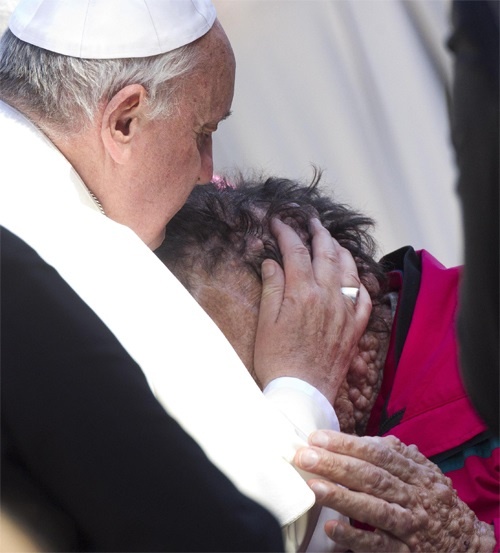
And, who can forget this picture?

pope francis

Pope Francis knows something of what the prophet Micah spoke of in Micah 6:8, “He has told you, O mortal, what is good; and what does the LORD require of you but to do justice, and to love kindness, and to walk humbly with your God?”

Is that epitomized in our society? Is that epitomized within the flight incident? Jesus would have called her out – sure. But he was not passive aggressive. He would have done it in love.

Rivalry Saturday brings out the absolute worst in human nature, especially on facebook posts. Don’t even get me started on local politics because there was a lack of respect/decorum/common courtesy at the City Commission meeting I recently attended. I was appalled that adults acted that way.

We may pile up all sorts of opinions and points in an argument or debate, but in the end, with Jesus, love is the last word of all – God’s love for US, for all the world, and all of creation. During this season talking about the last word has a lot of connotations for me. For some, we’re coming off a holiday week and family brings out the best and the worst in each of us. We may wonder if we’ll ever get the last word on anything. For others, we think of some of our friends or family or co-workers or maybe even ourselves as ones who thrive on having that last word and can’t imagine life without getting it. I think of the television show Modern Family and the hilarity that ensued during the holiday episode between the “Realists” and the “Dreamers.”

Start at 17:00 – Stop at 21:34

But as the episode pointed out, you need a little bit of both. We need each other – both realists and dreamers. We have to find a middle way. We have ones who are ready to concede the argument and ones that will fight to the bitter end trying to get the last word – but we all need to be somewhere in the middle. We shouldn’t bowl over just because we’re “Christians” and let people walk and talk all over us, but we also shouldn’t be the ones that are raising our voices so that we’re the loudest so that our point can be heard over all the masses not caring about the casualties that may surround us. AND we can speak up for the voiceless. It often doesn’t feel like we get a say in anything and we’re merely reacting to what happens, instead of setting the course. I learned this advice in defensive driving class that I always carry with me, “You can only control your car. You can’t control what another driver does, how he or she acts, or whether or not they tailgate you and speed around you. You can only control how YOU react to the situation.”

So walk the talk this Advent season. Walk it. Do justly, love mercy, and WALK humbly with your God. And that is the WAY of Christ Jesus our Lord. Are we ready to jump in and live out the WAY of Christ in our last two days of classes? Are we ready to rock our final exams? All the tests, essays, or final group projects? Or jumping ahead to the break – family plans or packing up the residence hall room or bills or how we’re going to pay for next semester or the future or health or the glorious graduation celebration for our December graduates that thought this day would never come. Are we ready to walk in the WAY of truth, the WAY of grace, and the WAY of love?

We will answer with a big, resounding YES.

Posted in Advent, Advent Conspiracy, Brown Thursday, Campus Ministry, Evangeline, Gator Football, Sermons

The First Sunday in Advent

isaiah61

Isaiah 60:2-3

New Revised Standard Version (NRSV)

For darkness shall cover the earth,
and thick darkness the peoples;
but the Lord will arise upon you,
and his glory will appear over you.
Nations shall come to your light,
and kings to the brightness of your dawn.

 Hebrews 11:1-3

New Revised Standard Version (NRSV)

11 Now faith is the assurance of things hoped for, the conviction of things not seen. Indeed, by faith our ancestors received approval. By faith we understand that the worlds were prepared by the word of God, so that what is seen was made from things that are not visible.

We’re sticking with our tradition of starting Advent early, but the way the calendar falls this year, we’re just starting a week early.  So this is the first Sunday of Advent or Hope, the second Sunday of Advent or Christ the Way or Love will be next Sunday, the third Sunday of Advent or Peace will be on December 8th, and the fourth Sunday of Advent or Joy will be celebrated on December 15th.  We will celebrate Christmas Eve on Reading Day which is December 4th.  Is that confusing for anyone else?  We’re committed to celebrating the full season of Advent as we prepare our hearts for the coming of our Savior.

When I noticed the Christian radio stations starting to play Christmas music, I was indignant because I thought it was still mid-October.  I stopped and thought a minute before realizing it was the week before Thanksgiving.  So for some of you sticklers out there that don’t listen to any Christmas music pre-Thanksgiving, you would agree with my indignation.  But considering that the Charlotte and Columbia Christian radio stations would play Christmas music starting on Halloween, I’ll take the week before Thanksgiving any day.  Thank goodness that our Halloween decorations were Harvest-themed because we still haven’t taken them down.  Who knows when we’ll decorate for Advent/Christmas?  And the kids have already started asking.  We’re decorating here at Wesley during our leadership meeting next Sunday.  Better late than never.  We’re only going to be halfway through Advent at that point.

It’s hard to get into the spirit of Advent because we’re skipping over holidays and in the life of students this is definitely crunch time.   If I start running down my list of thing to do, buy, and parties to attend I’ll want to stay in bed and pull the covers up over my head and let this Advent/Christmas pass on by.  Speaking of getting prepared – tell me you haven’t heard of Brown Tuesday.  It ISN’T a thing.

http://www.youtube.com/watch?v=9g0T-f71AY4

(start at 1:24 and stop at 2:31)

Brown Thursday?  Where you get a jump on shopping for Christmas presents?  Or HDTV’s for yourself?  Note:  Four years ago, Mike and I decided to get up early on Black Friday for the specific purpose of buying a TV.  So I’m not hating or judging or pointing fingers.  Well, maybe I am, but I’m guilty too!

But what if we did things a little differently this year?  Give a goat for just $120 to Heifer International, dig a well for just $35 through Church World Service, or give to UMCOR for the typhoon in the Philippines or the communities recently hit by tornadoes in the Midwest, knowing that the money you give is going 100% to the victims of these natural disasters because United Methodist Churches all over the world give money to pay UMCOR’s administrative costs.  What if we do Advent differently?

Advent is one of my favorite times in the church calendar.  But this year, as I’ve spent all morning describing, I’m completely not ready for it.  It’s much more than just getting ready for Christmas and knowing how many shopping days you have left.  We have to pace ourselves.  Advent is the season that past and future collide in the present.  A time of already (as in Christ did come and is here) and not yet (Christ will come again).  The word Advent comes from the Latin verb advenire, which means “to come toward, to draw near, to approach.”  This is the time when we remember God’s drawing near to us in Jesus Christ in the past, in the present, and in the age to come.  Just like the Alpha and the Omega – the kingdom of God is the already and not yet – here amongst us, but also something that we long to come to completion.

I guess it’s that sense of expectation and hope that draws me in.  It’s a time of preparation, different from Lent, when there’s a sense of anticipated joy and hope not just from the ashes but at the end of a long journey.  Maybe those are similar in your minds but to me there’s a difference.  Take the Gators.  I know, I know.  In many ways it feels like you’re living a life of Lent.  From dust you came and to dust you will return and to witness the game yesterday was demoralizing.  But then there’s that sense of hope that comes with being a true fan.  The hope that we’ll have a better season next year.  Or maybe we’ll end the season on a high note?  Advent teaches us to expect the unexpected and nothing would be more unexpected than if the Gators beat the Noles next Saturday.  A brief commercial for the Gator Seminole Showdown….one way that we can beat the Seminoles on Saturday is if we win the pledge per point contest so go to www.gatorwesley.com/showdown.

No one expected the savior of the whole world to be born as a baby.  No one could foresee the Great God of the Universe coming in the form of the most vulnerable thing on earth – a baby.

http://www.youtube.com/watch?v=vuAUI_0knfk

Although we may be more comfortable with a “baby Jesus” because he’s cute and we can find some semblance of controlling him.  We may be more comfortable with Christmas Jesus versus Easter Jesus.  But if you’ve ever had children you know from the time that they enter the world they’re on their own schedule and you can expect the unexpected.

And no one knows “expectant waiting” like a pregnant woman.  I will never forget the first Sunday of Advent in 2008.  My mom, dad, grandmother, Josh, Caleb, and my sister-in-law Karen, and of course Enoch and Mike, had all come to our town house to celebrate Thanksgiving.  Because I was about to pop with Evy.  My due date was a month away, but Enoch had come a month early, so Thanksgiving happened at our house that year.  It was baby watch.  Have you ever heard the phrase, “a watched cake never bakes” or “a watched pot never boils.”  My grandmother, Ganny (I couldn’t say my r’s when I was little, so because I was the first grandchild they became Ganny and Gandaddy) kept asking me throughout the weekend if I was feeling anything.  If I was feeling anything like contractions.  I repeatedly told her I was not and could she leave me alone!

I was preaching that Sunday at St. John’s in Fort Mill, the next town over, where Mike did the music for the non-traditional service.  That was the first Sunday of Advent.  I have never forgotten how it felt to do the first Sunday of Advent as a pregnant person – the anticipation, the waiting , the expectancy, the perceived urgency…I don’t remember what exactly I said that day.  Who knows.  I blame it on pregnancy brain.  But as soon as I was done preaching and Mike and the band started playing the closing song, I began to have contractions.  I didn’t tell Mike or my Mom right away.  I needed some confirmation first.  As we got into the car a song I had never heard before was playing.

The song was “Jesus Born on This Day” by Avalon that was originally done by Mariah Carey.  It had just come out in November 2008.  That was just the confirmation I needed.  So we dropped Mom and a sleeping Enoch off back at our house with instructions to let the rest of the family know because they had been worshipping at Josh’s church.  And we drove back in the other direction for Charlotte calling the doctor on the way.  I’ll spare you the details, but as soon as the Carolina Panthers game was over, Mike and the doctor turned around and within two pushes Evangeline Grace Jeter made her way into the world at 4:30 in the afternoon.  Evangeline means “Good News or the bearer of Good News” and Grace is self-explanatory, but what a name to start the Advent season right, and we planned the name, before realizing how appropriate it would be.

Good news.  Good news of great joy.  Grace.  God with us.

This is Advent.  Not just a time of talking about dreams or what if’s or one day’s, but getting ready right now.  Putting yourself out there, right now.  Going for it, right now.  It’s easy in the consumerism and the narcissism and the pessimism to let the weight of the world fall heavy on our shoulders.  It’s hard in student land to get in the spirit of Advent as you feel the full weight of the semester with assignments, tests, papers, group projects, etc., with most of you exhausted, sick and ready to have a break and I’m not just talking about Thanksgiving when you’ll be doing school work in the midst, I’m talking about a nice, long Winter’s break.  It’s hard in the lives of teachers and parents trying to get through these last few weeks before Santa, Santa, Santa.  It’s hard for those who have lost loved ones, who have lost jobs, who have no idea where money is going to come for electricity much less gifts.  It is hard.

But Advent is so much more than just our personal worlds.  It’s the in-breaking of the kingdom of God as God Almighty, the Great God of the Universe, became One of us.  It’s the waiting not only for this child (the already) but for the Triumphant King (the not yet).  It’s the waiting for justice and righteousness and all of the beautiful words in Isaiah 9:6-7 “For a child has been born for us, a son given to us; authority rests upon his shoulders; and he is named Wonderful Counselor, Mighty God, Everlasting Father, Prince of Peace.  His authority shall grow continually, and there shall be endless peace for the throne of David and his kingdom.  He will establish and uphold it with justice and with righteousness from this time onward and forevermore.  The zeal of the Lord of hosts will do this.”

So in this season of Advent I’m doing my best to focus on the thanksgivings.  Which is ironic.  I’m doing my best to open my eyes and my heart to the unexpected all around me.  I’m trying to not let the to do lists or the gifts to still be gotten or the Christmas cards that probably won’t happen or the people that cut you off in traffic or the things that constantly go wrong in the midst throw me off track in centering my heart and being present to the journey towards the stable.

I am asking God to wipe away my cynicism and my weariness and to fill my heart with the joy and wonder and Christmas spirit that’s more than a cheesy Christmas song or tv movie, but that is life giving and life changing.  Come, Lord Jesus, Come.

As we enter into a season that often looks a lot more like Brown Thursday or Black Friday with the rush, bustle, mayhem, and angst than the arrival of our Savior into the world, may we remember, may we know, may we connect, may we take time to explore this Advent season anew and afresh.

May God open our eyes to some of our disconnect.  May we realize when we’re drawing from the Source or when we’re just running on fumes.  May we see and know and feel God’s rhythm in our bones as we go about our day to day resting in God’s love, strength, patience and wisdom and not our own will, arrogance, or seeming energy.

I am grateful for a God who loves me even when I’m spinning my wheels.  I am grateful for the Spirit who leads and guides and gives us the nudges and awakening when we need it.  I am grateful for the inspiration of Christ to show us how we are to live, bringing God’s kingdom to earth.

As we go forward with a different kind of Advent, may we hear the words anew and afresh from Matthew 5:16, “Jesus said, ‘Let your light shine before others, so that they may see your good works and give glory to your Father in heaven.

I’ll leave you with Amy Grant’s “I Need a Silent Night.”  Reflect on how you want to start this Advent season.  Set some goals so as to not let the season pass you by.  May we do Advent a little bit differently this year.

– I Need a Silent Night by Amy Grant

Posted in Campus Ministry, Communion, God's love, Jesus, Revelation, Sermons, Song, Zacchaeus

Zacchaeus – You Need a Reject but we’re ALL Rejects

Today, we’re talking about Zacchaeus and this particular chapter of Len Sweet’s 11 indispensable relationships you can’t be without, our sermon series this Fall, asks the question – “Who’s Your Zacchaeus?  You Need a Reject.”

Did you ever climb trees as a kid?  We had a magnolia tree in a neighbor’s backyard that was perfect for climbing.  If you know anything about magnolia trees, their branches are close together, which makes it an easy tree to climb. We spent many afternoon of my childhood climbing trees.  That’s why the story of Zacchaeus has always fascinated me.

Not to mention the song we learned in Sunday school, “Zacchaeus was a wee little man, a wee little man was he.  He climbed up in a sycamore tree, for the Lord he wanted to see.   Jesus said, “You come down for I’m coming to your house today, for I’m going to your house today.”    I can’t believe after all these years I still remember that.  Which leads us to our scripture reading for today…

Luke 19:1-10

New Revised Standard Version (NRSV)

Jesus and Zacchaeus

19 He entered Jericho and was passing through it. A man was there named Zacchaeus; he was a chief tax collector and was rich. He was trying to see who Jesus was, but on account of the crowd he could not, because he was short in stature. So he ran ahead and climbed a sycamore tree to see him, because he was going to pass that way. When Jesus came to the place, he looked up and said to him, “Zacchaeus, hurry and come down; for I must stay at your house today.” So he hurried down and was happy to welcome him. All who saw it began to grumble and said, “He has gone to be the guest of one who is a sinner.” Zacchaeus stood there and said to the Lord, “Look, half of my possessions, Lord, I will give to the poor; and if I have defrauded anyone of anything, I will pay back four times as much.” Then Jesus said to him, “Today salvation has come to this house, because he too is a son of Abraham. 10 For the Son of Man came to seek out and to save the lost.”

Sweet says, “One of the oddest people Jesus ever befriended was a short, wealthy, self-made entrepreneur named Zacchaeus.  He was the chief tax collector which made him one of the most hated people.  Have you ever heard people say nice things about the IRS?  And Biblical tax collectors were even worse.  If there were pictures with definitions of words, he would be the one with the caption “ostracized.”    Are you surprised that Jesus decided to go over to his place for lunch?  Not at all.  Jesus was at home with social outcasts, lepers, women of ill repute, AND the chief tax collector.  Jesus didn’t care much for the hyper religious or the wealthy.  So this was not out of the norm for Jesus.  But have you noticed that it always disturbs/upsets the crowd.  They are surprised every time.  What company do we keep?  Would the crowd be surprised with whom we hang out?

Most of the characters within the series have something to give us – Jethro – the butt kicker, Jonathan – the true friend, Deborah – the back coverer.  But Zacchaeus is different than these.  It all begins with fully seeing Zacchaeus for what he is, and inviting him down from the tree.  If we let them, the Zacchaeus’ of our lives help to illuminate our own need for grace.  Because we’re all in fact a little bit messed up.  Not one of us is perfect.  Romans 3:23 says, “For all have sinned and fall short of the glory of God.”  All of us are walking and talking “steaming cauldrons of moral failures and ambiguities.”

Zacchaeus doesn’t need to be told he’s a sinner.  Society’s already made that clear.  He doesn’t need people to tell him he’s an outcast.  He already feels it.  Most people know that the Inuit have a hundred words for snow.  The English word sin is used to translate at least six Hebrew and seven Greek words.  Soren Kierkegaard defined sin this way.  “Sin is the steadfast refusal to be your one true self.”  That is a very different understanding than the typical definition of sin.  Evigras of Pontus’ understanding of sin is that sin is a “forgetfulness of God’s goodness.”  Hmmm…Jesus actively sought out sinners and made room at the table for them, maybe he was searching them out reminding them of God’s love specifically for them.

Jesus didn’t seem to mind that he was getting a “reputation” for hanging out with tax collectors and prostitutes.  Everyone that he encountered, he saw as a person in need of God’s love.

There are no outsiders because no one is out of the reach of the love of God.  Nothing can separate us from it, actually.  Romans 8:38-39 says, “For I am convinced that neither death, nor life, nor angels, nor rulers, nor things present, nor things to come, nor powers, nor height, nor depth, nor anything else in all creation, will be able to separate us from the love of God in Christ Jesus our Lord.”

Jesus taught us to see others not as “others” but as “one of us” as “oneanothers.”  So y’all don’t know about my LOST obsession.  Scores of students were subjected to this madness as sermon illustrations poured forth each week for years and years.  They had the ability to weave their way into my sermons.  Josh alluded to it on our Fall Retreat but you’re about to see a clip of Jack’s live together, die alone speech.

I imagine Jesus would have given a similar speech and he would be befriending con man Sawyer and criminal Kate.  What made LOST special was that it delved into the messy-ness of the survivors lives.  It showed in real and tangible ways the flaws of each one.  Characters were never pure evil or purely good.  But they were REAL.  And you pulled for their redemption.

This episode ended the first season.  And it was here that a motley crew of people triumphed.  A community.  Michael and his son Walt, and their complicated relationship of abandonment and reunion.  Jin and his wife Sun – their evolution as characters from Jin working for Sun’s father to their estrangement and to their eventual homecoming.  The reason that LOST worked so well for those who watched it and dare I say were obsessed with it, was because you bought into the characters’ stories, and you saw a little bit of yourself in each of them.  It helped to have a full orchestra that performed each score – conveying emotions!

We have quite a few “characters” in our lives.  People that are either larger than life or a bit peculiar or a bit “off” or those that march to the beat of a different drummer.  What “characters” do we have at Gator Wesley?

Often we have to find the Zacchaeus’ of our lives.  Sweet writes, “We have tried to “live in” rather than “live out” the gospel.  It is time for Christians to “Get out more,” to try alfresco forms of faith and community.  The Christian church is too “in here” and not enough “out there.”  Late fourth century philosopher Caius Marius Victorinus was afraid to show up in church with his pagan friends and said this about the church, “Do walls make Christians?”  That’s the reason for Wesley lunches on Tuesday and Friday, Love Campaign, and leadership team discussing whether to do Evensong on the Plaza of the Americas once a month – TO GET OUT OF THE BUILDING!  This outward focus is a natural part of the Christian faith.  We are to be the church in the world.  SO WHY ARE WE NOT OUT THERE?

In essence, moving from inward to outward is central to the revelation of Christ by the church to the world.  John Wesley, founder of the Methodist movement, called the sacraments of baptism and Holy Communion an “outward sign of inward grace, and a means whereby we receive the same.”

Thus leading us to an obvious segue to Communion that we celebrate each week.  But I want to make sure you get something.  It bears repeating.  Zacchaeus’ are obviously “out there” – the social misfits, the anarchists, the people on the fringes or outside society’s norms, BUT there’s a bit of Zacchaeus in all of us.  We’re all Zacchaeus.  Jesus would have come into the world for any one of us.  Like the parable of the good shepherd who leaves the 99 to find the one lost sheep.  All for one.  So this scene from the Rise of the Guardians is a turning point.  You see Pitch, the villain in the movie, has wiped out the whole world’s belief in the Guardians (Santa, the Tooth Fairy, the Easter Bunny, the Sand Man, and a new guardian Jack Frost) and only one boy is left that believes.

All for one.

I’m not saying all of those things are real, even though Enoch and Evy believe them to be, and I find it problematic that as parents were supposed to enlighten our children one day that they’re not real, however saying at the same time that God, Jesus and the Holy Spirit also that they can’t tangibly see – are real?  I’ll let you know how that conversation goes down.  However, I know what I will say, that God will give you the evidence you need to help you believe.  Like in Luke 9:24, when the man of the child that Jesus is healing says to Jesus, “I believe, help my unbelief.”  Just ask.  Jesus desires a personal relationship with each one of us.  That’s why before we even have understanding of it, God searches us out and draws us to God’s self in God’s prevenient grace.  We recognize we’re in need of God’s grace – that that grace is for us – in justifying grace.  God doesn’t leave us where we are in the mire and the muck.  In God’s sanctifying grace, God helps us to grow and mature as Christians.  Growing in grace and growing the depth of our faith that the world may see and know that our God reigns and God’s grace is available to them.  Tax Collectors.  Prostitutes.  You and Me.  Amen.

Posted in Back Coverer, Campus Ministry, Deborah, Grey's Anatomy, I've got your back, Sermons

Deborah – Who’s got your back?

Who’s got your back?  That’s your Deborah.   Urban dictionary defines the words “got your back” these two ways.  The first way, is an expression assuring someone that you are watching out for them. It comes from making sure you are safe by watching what’s behind you, when you’re busy looking ahead. Example:  I don’t know about this.  Don’t trip, son.  I GOT YOUR BACK. The second way is when your friend, colleague, cheerleader, or someone of a close affinity is by your side (either figuratively or literally) making sure that you make it through the troublesome, difficult, or tedious times or predicaments you are currently in.  Urban dictionary used Craig and Arianna of Saturday Night Live fame, in their example.  Craig says, “Oh, Arianna, are you ok?”  Arianna answers back, “I just can’t get this cheer down. I don’t think I’ll be able to do the perfect cheer.”  Craig responds, “You can do it! I know you can! I got your back.” 

Urban dictionary is quick to note that it can be converted to a threat, “Watch your back,” from the possibility someone might injure or kill you from behind when you aren’t looking.  They protect you from getting stabbed in the back.

Have you ever called someone your guardian angel?  They seem to protect you from outside forces – like a friend’s betrayal.  Or missing that student loan payment.  Or if you don’t know when you will get your next meal, and you’ve eaten your last left-over and everything else in the cabinet, a Deborah’s already got you covered.  Or if it’s something internally you’re struggling with, for example, who you are after x, y, z situation (break up, loss of job, change of major, maybe you’re struggling with even staying in school, a death in the family, grief at life).  Maybe you’re questioning your faith, how much of a difference you’re making, or you’re experiencing a dry season in your relationship with God.  Maybe you need to get back on track spiritually and you need someone to ask you the hard questions and not let you off the hook until you answer them.  That’s your Deborah.

Author of the book we’re studying this semester, 11 indispensable relationships you can’t be without, Len Sweet says, “Everyone who has made a dent or a difference for God in history has had ‘protectors’ – people who have said to them, “I’ve got your back!” 

I would take it a step further.  Everyone – all people – need protectors.  You need someone to have your back if you are going to realize your dreams and push forward when those that seek to tear you down are increasing in number.  Likewise you need someone to protect you when the doubts pile up inside your head. 

So who was Deborah and what did she do that was so special?

Judges 4:4-10

New Revised Standard Version (NRSV)

At that time Deborah, a prophetess, wife of Lappidoth, was judging Israel. She used to sit under the palm of Deborah between Ramah and Bethel in the hill country of Ephraim; and the Israelites came up to her for judgment.She sent and summoned Barak son of Abinoam from Kedesh in Naphtali, and said to him, “The Lord, the God of Israel, commands you, ‘Go, take position at Mount Tabor, bringing ten thousand from the tribe of Naphtali and the tribe of Zebulun. I will draw out Sisera, the general of Jabin’s army, to meet you by the Wadi Kishon with his chariots and his troops; and I will give him into your hand.’” Barak said to her, “If you will go with me, I will go; but if you will not go with me, I will not go.” And she said, “I will surely go with you; nevertheless, the road on which you are going will not lead to your glory, for the Lord will sell Sisera into the hand of a woman.” Then Deborah got up and went with Barak to Kedesh. 10 Barak summoned Zebulun and Naphtali to Kedesh; and ten thousand warriors went up behind him; and Deborah went up with him.

So what do we know about Deborah?  She was a prophetess our text says.  She was the fourth Judge of pre-monarchic Israel and she was the only female judge.  The Bible tells us nothing of her family except who her husband was. In the history of Israel, only three people combined the offices of prophet, judge and military leader:  Moses, Samuel, and Deborah.  Deborah was one of the early judges of Israel.  The judges were charismatic leaders who by their wisdom oversaw the simple and rather disorganized government of Israel during the first couple of centuries of its existence.  One of the greatest contributions of the early judges was their ability to stir up a sense of national unity and great loyalty to the rule of Yahweh among a fiercely independent and generally ignorant people, who had not long before been Egyptian slaves.

What exactly is happening in the scripture passage that I just read?  Deborah summons the general Barak to give him an oracle from God ie. a message from God.  She tells him to bring 10,ooo men from two tribes of Israel, and she will draw out Sisera, the general of Jabin’s army.  Barak answers her that he’ll only go if she goes with him – if she’ll cover his back.

Barak’s request of the presence of Deborah has given interpreters and commentators headaches for years.  Some see Barak here as cowardly, afraid, and distrusting of God.  Other interpreters see Barak’s request as a gracious and insistent invitation to Deborah as God’s prophet to join him so that she might bless the military expedition and share in the glory of the Lord’s victory over the Canaanites. It’s ambiguous.  Either way Deborah delivered.  Not a single man of Sisera’s army survived, except Sisera himself (and another strong, gutsy woman took care of Sisera, Jael drove a tent peg into his head, killing him).  The narrative of what happened is told in Judges chapter 4 and the “Song of Deborah” is told in Judges chapter 5, one of the earliest examples of Hebrew poetry.

Bottom line, Barak would NOT go without Deborah. 

It is certainly not true that “behind every good man is an even better woman.”  That’s sexist garbage.  It is true that behind anyone who has had any “success” whether personal or professional, you need someone who has your back.  Or a whole community of people.  That’s why in any Oscar speech people thank the one’s that got them there.  Who’s in your corner.  TV shows abound with this.  Scandal, the workers of Olivia Pope and Associates, willing to take a fall if any of the team get hit.  Once Upon a Time’s unlikely alliance busy finding Henry and begrudgingly covering each other’s backs along the way. Grey’s Anatomy – this season as the interns realized they didn’t know each other and if they were to “fall/collapse/die” they would be left alone to face it because they had not reached out and realized they didn’t know each other. If you watched it in the olden days with the original 5 – Alex, Meredith, Izzie, George, and Christina – they invented delving into drama and gossip with who was hooking up with who and they pushed people like my brother Josh away with their shenanigans but made me love them all the more because they cared about each other.  It may not have been from the moment they met, but they became each other’s family, each other’s “person” as seen in this clip. 

http://www.youtube.com/watch?v=d9bFnrSp998

Your family can offer good protection.  Your adopted family can offer good protection.  Your friends that become like family offer good protection.  Who’s got your back, is not someone who in an argument or dispute automatically sides with you.  It’s much more than that.  Deborah was a judge.  She was fair.  Your Deborah can help you see things about yourself that no one else sees.  They can point out your blind spots.  The areas where you’re not exercising your best judgment.  They can handle your vulnerability.  Your laughter.  Your tears.  And they can give you a good kick in the pants.  And you’ll accept it, because you know they have your best interest at heart.  But be discerning, don’t let just anybody give you a kick in the pants.  Because people will line up for that job.  People offer criticism freely.  But guarding your heart and being a back coverer, it will be a shorter line. 

I posted this on the “Encouragement Board” a facebook group that seeks to offer encouragement, birthdays, and prayer requests of Gator Wesley.  William Arthur Ward writes, “A true friend knows your weaknesses but shows your strengths; feels your fears but fortifies your faith; sees your anxieties but frees your spirit; recognizes your disabilities but emphasizes your possibilities.”  Read those words again. 

Sweet writes, “The world is full of people who like nothing better than to kill—your reputation, your spirit, your mission.”  Have you ever heard of being attacked on all sides?  Have you ever felt like your world is falling down all around you?  If you are a right-handed quarterback – one of your most trusted allies is the left tackle on the offensive line.  This is your blind side, and the best defensive linemen are put here to intimidate you and make you mess up – your success depends on your left tackle. 

Deborah didn’t fight next to Barack – but she covered his back with the fire of her words, her spirit, and her courage – she was always close enough to catch Barak’s eye.  Some people have a holy spirit, and the presence of that Holy Spirit in your life is enough to be a Deborah.  Sometimes Deborahs fight alongside you on the front lines or they’re actively covering you in prayer from a distance.  My mom is a prayer warrior.  She’s on the front lines in battle over our lives every day.  Mom’s not a pansy or a shrinking violet.  She covers it well with her southern charm, manners, and proper etiquette – she writes thank you notes.  Which is a big deal to me who never writes thank you notes.  I would say she epitomizes a Deborah.  She would be a really good judge.  Always fair.  But with a deep and abiding strength about her.  Centuries ago it was the function of knights to be back-coverers for the weak and wounded.  Especially in the age of chivalry, knights were the protectors of the marginalized and unarmed – the priests, the peasants, the poor, and the child in a violent world.  My mom is a modern day knight of sorts.  In her work as an elementary school guidance counselor she comes into contact with all sorts of things and she’s a Deborah to each of her students.  And she’s a Deborah in each of her children’s lives.

Your Deborahs should point you back to God.  My mom is certainly quick to ask, “Have you prayed about this?”  Because she knows God is our ULTIMATE back coverer.  God’s got your back 24:7:365. David wrote this Psalm after escaping from Saul. Psalm 18:1-3 “I love you, O Lord, my strength.The Lord is my rock, my fortress, and my deliverer, my God, my rock in whom I take refuge, my shield, and the horn of my salvation, my stronghold. I call upon the Lord, who is worthy to be praised, so I shall be saved from my enemies.”

Thank you God for ALWAYS having our backs.

***The Gator Wesley worship band picked these songs to do after the sermon during communion and as our closing song, “Not for a Moment” by Meredith Andrews and “Taste of Eternity” by Bellarive, and I thought they were both pretty powerful.

Not For A Moment – Meredith Andrews

Taste of Eternity – Bellarive

Posted in Campus Ministry, paul, peter, relationships, Sermons, yoda

Yoda – Who’s Your Peter/Paul?

Maybe I built this up too much in my mind, but I really, really, really was looking forward to the Yoda chapter in Len Sweet’s book 11 indispensable relationships you can’t live without.  To say I was disappointed when Sweet only talked about Yoda for a paragraph is an understatement.  Yoda ihe says is a mentor, a guru, a coach, a spiritual teacher/director.  I was discussing this in the College Room and Carly mentioned she had no idea who Yoda is so I should not assume that everyone has watched Star Wars even once, forget watching it incessantly.  Enoch, my 6 year old, got both trilogies for Christmas, so I’ve watched them REPEATEDLY.  He even watches the offshoots from Lego Star Wars to the Yoda Chronicles. 

http://www.youtube.com/watch?v=M_QcRPNfUuE

I love that clip.  Because Yoda doesn’t let Luke get away with anything.  And yet he clearly cares about him.  R2D2 is clearly the encourager from last week’s chapter.  The Master is showing the Apprentice how it’s done.  Seeing is believing.  Yoda says, “Always two there are, no less:  a master and an apprentice.”  A master pushes us to help us navigate the way that seems unattainable.  A master can help us move to new levels of perception and experience.  A master KNOWS us.  Our limits.  Our strengths.  A trusted master knows when to push or prod or ask the right question.

Disney movies have rich and meaningful mentor characters.  The emperor from Mulan, Phil from Hercules, Grandmother Willow from Pocahontas, Sebastian from The Little Mermaid, Jiminy Cricket from Pinocchio, Merida’s mom in Brave.  They clearly provide the morale compass of the story or the wise sage.  Their all over pop culture as well.  Morpheus to Neo in The Matrix, Mr. Miagi in the Karate Kid, Mother Superior in The Sound of Music….

Mentors often can give a reluctant protagonist a necessary push to get the plot rolling.  Mentors also often personify the moral of the story in the protagonist’s story.  They offer the inspiration to the protagonist to keep going when they would rather give up.  They’re often the voice inside your head urging you on.  Urging you forward.

Sweet actually titles this chapter, “Who’s Your Peter/Paul? You Need a Yoda.”  So I’m going to read to you snapshots of each.  Peter was the one that constantly stuck his foot in his mouth.  He was a fisherman.  He was with Jesus at the Transfiguration, the glow in the dark Jesus, where Jesus’ divinity is on full display.  He was the one that walked on water with Jesus (before sinking).  He was the one who denied Jesus three times.  He’s the one Jesus said he would build his church upon, because Peter means rock.  He was also the one who tore it up in Acts, proving that he was a changed man, preaching at Pentecost. 

Acts 3:1-10

New Revised Standard Version (NRSV)

Peter Heals a Crippled Beggar

One day Peter and John were going up to the temple at the hour of prayer, at three o’clock in the afternoon. And a man lame from birth was being carried in. People would lay him daily at the gate of the temple called the Beautiful Gate so that he could ask for alms from those entering the temple. When he saw Peter and John about to go into the temple, he asked them for alms. Peter looked intently at him, as did John, and said, “Look at us.” And he fixed his attention on them, expecting to receive something from them. But Peter said, “I have no silver or gold, but what I have I give you; in the name of Jesus Christ of Nazareth, stand up and walk.” And he took him by the right hand and raised him up; and immediately his feet and ankles were made strong. Jumping up, he stood and began to walk, and he entered the temple with them, walking and leaping and praising God. All the people saw him walking and praising God, 10 and they recognized him as the one who used to sit and ask for alms at the Beautiful Gate of the temple; and they were filled with wonder and amazement at what had happened to him.

Let that simmer for a second before we launch into Paul.

Paul was the one who persecuted Christians.  He was the chief persecutor of Christians.  And he had an experience on Damascus Road with the Living God.  He then presented himself to the early Christians and thinking he was going to violently persecute them, they fled.  14 of the 27 books of the New Testament are attributed to him so to say he was a prolific writer is an understatement. 

Acts 16:25-34

New Revised Standard Version (NRSV)

25 About midnight Paul and Silas were praying and singing hymns to God, and the prisoners were listening to them.26 Suddenly there was an earthquake, so violent that the foundations of the prison were shaken; and immediately all the doors were opened and everyone’s chains were unfastened. 27 When the jailer woke up and saw the prison doors wide open, he drew his sword and was about to kill himself, since he supposed that the prisoners had escaped. 28 But Paul shouted in a loud voice, “Do not harm yourself, for we are all here.” 29 The jailer[a] called for lights, and rushing in, he fell down trembling before Paul and Silas. 30 Then he brought them outside and said, “Sirs, what must I do to be saved?” 31 They answered, “Believe on the Lord Jesus, and you will be saved, you and your household.” 32 They spoke the word of the Lord[b] to him and to all who were in his house. 33 At the same hour of the night he took them and washed their wounds; then he and his entire family were baptized without delay. 34 He brought them up into the house and set food before them; and he and his entire household rejoiced that he had become a believer in God.

Acts was nuts!  There were all sorts of things going on.  That’s why you hear people model their churches on Acts.  I don’t entirely agree with Sweet’s simplified explanation of the difference between Peter and Paul.  He says Peter was intellectually and culturally slow, but interpersonally was quick and rich, he was a hands on person when it came to relationships, it took him a while to realize the gospel was for everyone, he had a relational point of view.  In contrast he says Paul was intellectually and culturally quick but interpersonally slow, he was hands off, not relational, Paul understood early on that the gospel was for all, he argumentative point of view.

I would like the opportunity to be mentored by either one!  They were obviously men of God who had much to teach, and they had obviously experienced a conversion experience.  Neither Peter nor Paul was afraid of a fight – but a mentor can tell you which battles are worth fighting and which ones aren’t – a lesson that both Peter and Paul had to learn.

You will be mentored by lots and lots of people in your life.  I hope you will be.  I pray that you will be.  Because one having a mentor, means that we do not have it all figured out.  You remember when Luke says to Yoda “he can’t do it” and Yoda shows him he can if he just believes….You can’t be cynical or jaded for long around a Yoda.

Sir Isaac Newton said, “IF I have seen further, it is by standing on the shoulders of giants.”

  • Whose shoulders are you standing on? 
  • Who do you see and say, “I want to be like them someday!”
  • Who sets standards to which you aspire?
  • What person are you seeking out to help you find your voice and be true to your own voice?
  • From whom are you learning when to suppress and when to express yourself?
  • Whose blessing do you seek?


Those are all good questions as we find our Yodas.


We must choose our Yodas carefully.  Sweet writes, “There are as many kinds of ‘Yodas’ as there are heads, minds, and hearts! – don’t hitch your wagon to any single star or listen to any voice that seems to attract a following.”  So be discerning in who you choose.  Do you see Christ in him or her?  Mentors come in all different shapes and sizes, some for only a season and some for a lifetime.  We may not even know our spiritual mentors.  Do you have a favorite author who’s dramatically shaped your life?  Whose books you pick up at just the right time and they challenge you long after you finish reading them.  Rob Bell.  Dietrich Bonhoeffer.  Teresa of Avila.  Brennan Manning.  Donald Miller.  Elisabeth Elliott.  Hannah Hurdard.  Bob Goff.  And countless others.  It’s like a continued conversation when you find an author that engages you.


Sweet says we must choose our Yodas based on these three things:  Humility, Honesty and Honor. 


Humility.  Peter objects to Jesus’ washing the disciples of feet.  In John 13:7 Jesus challenges Peter back, “You do not realize now what I’m doing, but later you will understand.”  The Great God of the universe humbled himself because he wanted to get in the disciples heads and make clear to his followers that you must serve.  The Master wants to study WITH you, not demand you to study UNDER them.  A true Yoda sees themselves as constantly learning.  As Sweet says “An ideal Yoda is a One-who-knows … but a One-who-knows he/she doesn’t know it all.”


Honesty.  The best Yodas will be honest enough to share their secrets with you.  But they will be honest enough to tell you the truth, even to rebuke you, especially when you settle for easy answers.  The best mentors let you see behind the curtain to the man underneath – a la the Wizard of Oz.  They let you see through to their vulnerability.  Their weakness.  It’s not a façade.  I appreciate people who are “real,” “authentic,” and don’t have it all figured out.  Even the Yodas second guess themselves.  But they push you out of that same second guessing….towards the light.  Because that’s innately who they are.


Honor.  To be blessed by and to bless a mentor are two of life’s richest blessings.  A Yoda wants to mentor people who will honor them by demonstrating both a love of originality and a love of conformity.  So you being you, is all the thanks they need.  That they had influence on your life is all the thanks they need.  That they see their legacy in YOU is all the thanks they need.  Yodas love questions.  I’m reminded of a seminary professor, Dr. Thomas Thangaraj, who asked all the right questions.  He was from India so he even sounded very much like Yoda.  I had the pleasure of being in his Contextual Education class and taking his Images of Christ class.  And I had the nerves-inducing opportunity to preach in front of him in Chapel upon several occasions because he attended University Worship at Emory.  He would find the one question we hadn’t thought of or engaged in.  He was not afraid to answer our questions either.  Like Yoda, he often answered a question by asking another question.  He modeled the give and take between Master and Apprentice unlike any other.


Throughout this chapter I was writing in the margins the names of my mentors.  My parents.  Bridgette.  Susan.  Risher.  Sara.  Ms. Rhodes.  A mentor’s function, according to Sweet, “is to guide and guard us into a living, dynamic relationship with God, to help us grow in grace and in the knowledge of our Lord Jesus Christ, and to help us live in a daily relationship with the divine.”  With that definition, who are your mentors, your Yodas, your guides? Have you thanked them for shaping you in big and small ways?  I encourage you during this week to thank your Yodas.  Also, to whom are you a yoda, mentor, or guide?  To whom are you going to pass the baton?  Or leave your legacy?